Tropicana Part 2
Yesterday we covered the grand old Tropicana from its opening as the fanciest Mob joint in history up into the 1970s, when the already-aging hotel-casino went through a number of ownership transitions.
Mitzi Stauffer Briggs, heir to the Stauffer Chemical estate, bought a majority interest in 1975. She expanded the theater, brought back the Folies, which had been closed for a little while, and in 1977 built the $25 million 600-room Tiffany (now Paradise) Tower, which finally doubled the number of rooms and removed the landmark fountain in the process.
However, organized crime trouble returned a year later, when a conversation among entertainment director Joe Agosto, casino executive Carl Thomas, and Kansas City don Nick Civella was recorded by the FBI, in which the three discussed duping Briggs and skimming casino cash. (Later, Thomas and Agosto were flipped by the feds; their testimony helped convict many Midwestern capos, which finally broke the grip of the Chicago mob on Vegas.)
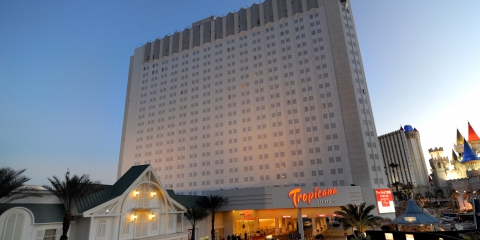
After all the gangster angst, Briggs sold the Tropicana to Ramada in 1979, which immediately redesigned the casino in art-nouveau style, adding the $1 million 4,000-square-foot leaded glass dome and 28-color carpeting. They also opened the five-acre water park and 22-story 800-room Island Tower.
In 1989, Ramada spun off its gaming operations by creating a new subsidiary called Aztar. A year later, Aztar sold the Tropicana Golf Course to Kirk Kerkorian, who wanted to build another world's largest hotel on the property.
Columbia Sussex acquired Aztar in 2007 and quickly announced a $2 billion renovation, which just as quickly drowned in the Great Recession. Indeed, Columbia Sussex's casino division went bankrupt in 2008. In July 2009, the property was bought out of bankruptcy by a Canadian private-equity firm, Onex Corporation. And here it came again, another grandiose announcement, though only worth $165 million, about renovating the 50-plus-year-old Tropicana around a South Beach theme.
Part of the plan did actually come to fruition: One of the original garden-room wings was torn down to make room for a second entrance to the casino and additional surface parking and a new sports book was opened.
In 2015, the Tropicana changed hands again, acquired by Penn National Gaming for $360 million and until a few days ago, Penn was looking to flip the faded beauty.
When we originally put together this answer, we wrote, "It's a good time to sell, with Vegas property at record highs, Allegiant Stadium opening, and all the new convention square footage coming to fruition. Penn needs to deleverage its debt and focus more on the Trop's much younger step-sister, M Resort."
That was before the virus hit and all bets were called off. But Penn did manage to offload the Trop, or more specifically the real estate underneath it, to Gaming and Leisure Properties for $337.5 million in a leaseback transaction in which Penn will continue to operate the hotel-casino. Penn will pay a "nominal rent," while GLPI "explores all options"; if the Tropicana is resold within 24 months, Penn will receive a percentage of the net. It's great timing for Penn, which gets a large infusion of cash at this fraught time.
So there you have it, the whole story of the "ancient-in-Vegas-years" Tiffany on the Strip. Its 40 acres right in the heart of the south Strip lend themselves to the first casino implosion since the Riviera's last tower came down in 2016, then a new one rising phoenix-like in the desert. Then the Sahara will be the soul survivor of the grifty Fifties.
(Who wants to hear the history of the Sahara?)
 |
[email protected]
Mar-31-2020
|
|
[email protected]
Mar-31-2020
|
 |
Roy Furukawa
Mar-31-2020
|
 |
Don Woodward
Mar-31-2020
|
 |
O2bnVegas
Mar-31-2020
|
 |
sassiebrat
Mar-31-2020
|
 |
Bumbug
Mar-31-2020
|
 |
Ray
Mar-31-2020
|
 |
Teresa Harrison
Apr-01-2020
|

