A:
We knew the answers to these questions (other than the Stardust Auditorium), but thought it would be fun to go to a primary source, Jeff at VintageLasVegas.com. We knew he'd be able to supply some great details and link us to photos on his site that you won't see anywhere else.
Here's what he has to say about the locations in the Elvis flick.
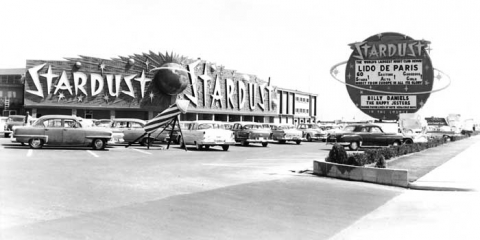
The Stardust Auditorium was the casino of the former Royal Nevada Hotel & Casino, designed by Paul R. Williams, and next door to the Stardust. When the Royal Nevada went bankrupt in 1959, the Stardust/Desert Inn moved in and incorporated the entire hotel into the Stardust. The name "Stardust Auditorium" was used only until the mid-'70s, but the entire annex remained until the Stardust's demolition in 2007. Here's the link.
The Polynesian restaurant was also at the Stardust, the Aku Aku. It was right next to the Auditorium. What we see in the film was their sign that read, "Polynesian Food / Aku Aku / Exotic Drinks," in use in the early to mid-'60s.
The
Tally-Ho, as some of your readers no doubt are aware, was a short-lived non-gaming motel that became the Aladdin. These Tudor-style hotel rooms were in use up until the Aladdin's demolition in 1998.
Silver Palace was relatively modern, built from the ground-up as a casino in 1955 on Fremont and 1st. It changed names multiple times over the decades: Carousel, Gambler's Hall of Fame, Sassy Sally's, and finally Mermaids, demolished in 2017. Here's
another great photo from tumblr.
Lucky Casino had just opened when
Viva Las Vegas filmed on Fremont Street in July 1963. This casino, part of Del Webb's Sahara-Nevada Corp. that also owned the Mint and the Sahara, was only around for a few years, but it briefly had
the tallest sign in Las Vegas and was immortalized in a 1964 essay by Tom Wolfe: "In Las Vegas, no farseeing entrepreneur buys a sign to fit a building he owns. He rebuilds the building to support the biggest sign he can get up the money for and, if necessary, changes the name. Yesterday's Lucky Strike Casino is today's Lucky Casino ... sixteen stories of flaming peach and incandescent yellow in the middle of the Mojave Desert. In the Young Electric Sign Co. era, signs have become the architecture of Las Vegas."
Thank you, Jeff. Great stuff!
On a side note, the architect, Paul Revere Williams, who designed the Stardust Auditorium was the first African American member of the American Institute of Architects, inducted in 1923. Based in Los Angeles, he designed houses for Frank Sinatra, Lucy and Dezi, Lon Chaney, Barbara Stanwyck, and many more celebrities. He also designed a number of public buildings, along with several in Las Vegas, including the unique La Concha Motel and its portico, which now serve as the visitor center for the Neon Museum. (And thank you, XY, for bringing our attention to Paul Williams.)
Here's the link to the new poll on your preference: Old Vegas or New Vegas.
No part of this answer may be reproduced or utilized in any form or by any means, electronic or mechanical, without the written permission of the publisher.


