

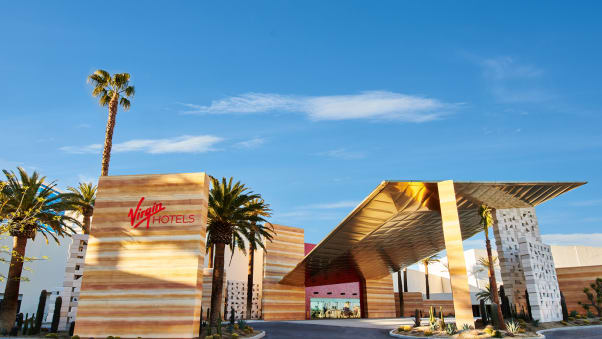
After 69 days, the Culinary Union’s strike against Virgin Las Vegas is over and both sides are taking victory laps. Who won? It depends on who’s doing the talking. The Culinary is saying it got a contract that’s “in line” with Las Vegas Strip casinos, although “in line” sounds suspiciously like a euphemism for “almost, but not quite.” Virgin, for its part, did eventually cave to the union’s demand for a 32% wage increase. However, it’s to be phased in over five years, with 10% coming immediately.
That’s still a great deal better than what Virgin was offering, which was essentially that workers suck it up for the next couple of years, then accept smaller wage hikes—or else. The onus of keeping financially rickety Virgin open was placed squarely on the workforce, a bit of emotional blackmail we don’t recall be laid on union workers in the previous quarter-century. Rank-and-file employees bear enough risks from Virgin and President Cliff Atkinson‘s incompetence, in the form of being terminated at any point—without being told the property’s survival hinges on them tightening their belts when all their colleagues elsewhere are cashing in on a wave of post-Covid prosperity. We don’t see Atkinson and his executive team making sacrifices, never mind their obscure (and unlicensed) Canadian sugar daddies.
Atkinson, who has the ear of Vital Vegas columnist Scott Roeben (or vice versa), used that forum—or some of his toadies did—to assert that the Culinary didn’t get beans and wasted 69 days instead of taking the hotel’s insulting first offer. If you read Vital Vegas, you’ll get the notion that the unplesantness of the past 10 weeks was all the Culinary’s doing, endured with saintly forbearance by Atkinson & Co. Never mind the sight of Virgin siccing its goon squad periodically on the picket line. Nope, the house doesn’t just always win, it’s always right, too. Anyway, it sounds like neither side got everything it wanted, which is the usual definition of a satisfactory compromise.
For once, we disagree with Richard Schuetz, peerless columnist on gambling operations and the regulation of same. Nevada Gov. Joe Lombardo (R) is NOT “a decent man.” All we’ve seen from him in two years is venality, opportunism and a healthy dash of ineptitude. Lombardo is so spineless that it’s a wonder he can sit upright. That goes double for his dealings with the Silver State’s signature industry, which he has recklessly tried to deregulate. As Schuetz puts it, “Lombardo took this very sick patient and choked the life out of it.” Partly this was through regulatory inaction while Rome burned, which was also a consequence of cronyistic appointments to the Nevada Gaming Control Board that were either debatable or, in the case of George Assad, downright inexcusable.

Now NGCB Chairman Kirk Hendrick has more or less had enough and—following a cryptic meeting with Lombardo—will depart at the end of the Lege, having barely gotten his gavel warmed up. Couple that with the under-fire departure of Brittnie Watkins (accused of practicing reverse racism), and all we’ll be left with is the clueless Assad, who doesn’t know his regulatory ass from a hole in the ground. We have no wish to preempt Schuetz’s latest column, of which every word is worth reading, with a zinger in each sentence. Suffice it to say, he fears that the NGCB’s sleepiness on the job (while Scott Sibella, MGM Resorts International, Resorts World Las Vegas and others ran amuck) has raised the very real prospect of federal intervention in Nevada regulation. Some of us would welcome that, although Schuetz does not. Lombardo’s sycophancy toward the new administration in Washington, D.C., suggests he’s trying to head that off through servility. Appointing competent casino regulators might be an even better start.

Speaking of Resorts World, it would have had us believe people were scared to gamble during an election campaign. We scoffed at the time and now oblique refutation comes by way of J.P. Morgan analyst Joseph Greff. Commenting on regional gambling trends, he observes that 4Q24 action was “good” in October and “solid” ever since. On the strength of that and of better-than-expected regional results overall, he raised his cash-flow estimates for Penn Entertainment, although he didn’t budge from an “Overweight” rating or a $27/share price target.
That’s good news that Penn surely needs, as its ESPN Bet will be taking a bath on bettor-friendly sports scores this fall and winter. Across the four quarters of 2024, Penn’s revenues went from down 4%, to flat, to down again (-2%) to up 3% in the 4Q. Allowing for construction in several Penn markets, its winnings were up 5% in October, 9% in November—but 3.5% down in December. Greff predicts $10 million increase in 4Q24 cash flow to $467 million, set against a $105 million negative return on investment online, widening from -$90 million. The analyst was sanguine about Penn’s land-based forecasts for the next two years but predicted a bigger online loss in 2025 (-$70 million), with $60 million in elusive profit arriving in 2026, although that implies a significant ESPN Bet turnaround along the line, which seems improbable at this juncture.

Greff was also upbeat about comparably diversified Boyd Gaming, so much so that he raised his price target from $74/share to $80. The reasons for Greff’s optimism were much the same as his for Penn, with regional strength offsetting softness in Las Vegas and at FanDuel. Except for a modest (-1%) dip in the first quarter of last year, Boyd has been quietly up throughout 2024, especially in 4Q. Most of the growth came from the new iteration of Treasure Chest (+81%), with the rest of the portfolio just up by a point. Greff sliced his Downtown cash-flow forecast to $22 million, from $27 million, while boosting the Midwest/South numbers from $187 million to $193 million. Las Vegas suburban cash flow went from $107 million to $109 million but FanDuel-derived cash took a big hit, tumbling from $41.5 million to $31 million.
While not budging on his forecasts for Vegas locals and online in 2025, Greff knocked Downtown cash flow from $85 million to $78 million, while boosting Midwest/South monies from $738 million to $750 million. As for the next earnings call, sometime next month, “we would expect management’s outlook to contemplate what has likely been depressed demand as a result of the recent adverse and brutally cold weather that has been experienced across many parts of the country.” In other words, déja vu from early 2024.

Forget about sports betting in California, online or otherwise, until 2029 at the earliest. Tribal representatives attending ICE Barcelona this week let it be known than A) it’s too soon to revisit the issue and B) it needs to be tied in with iGaming too. Voters in 2022 spanked both the private sector and tribes, who were pushing rival OSB agendas. At least some private-sector providers now acknowledge that the road to OSB in the Golden State runs through the rez, while speakers at ICE say that the tribes need to present a united front, which they’ve not been able to do up to this point.
Sadly Scott is such a shill for access, he will report whatever management wants the people to hear. I think a ton of people stopped taking him seriously, I hope that number only continues to increase.