

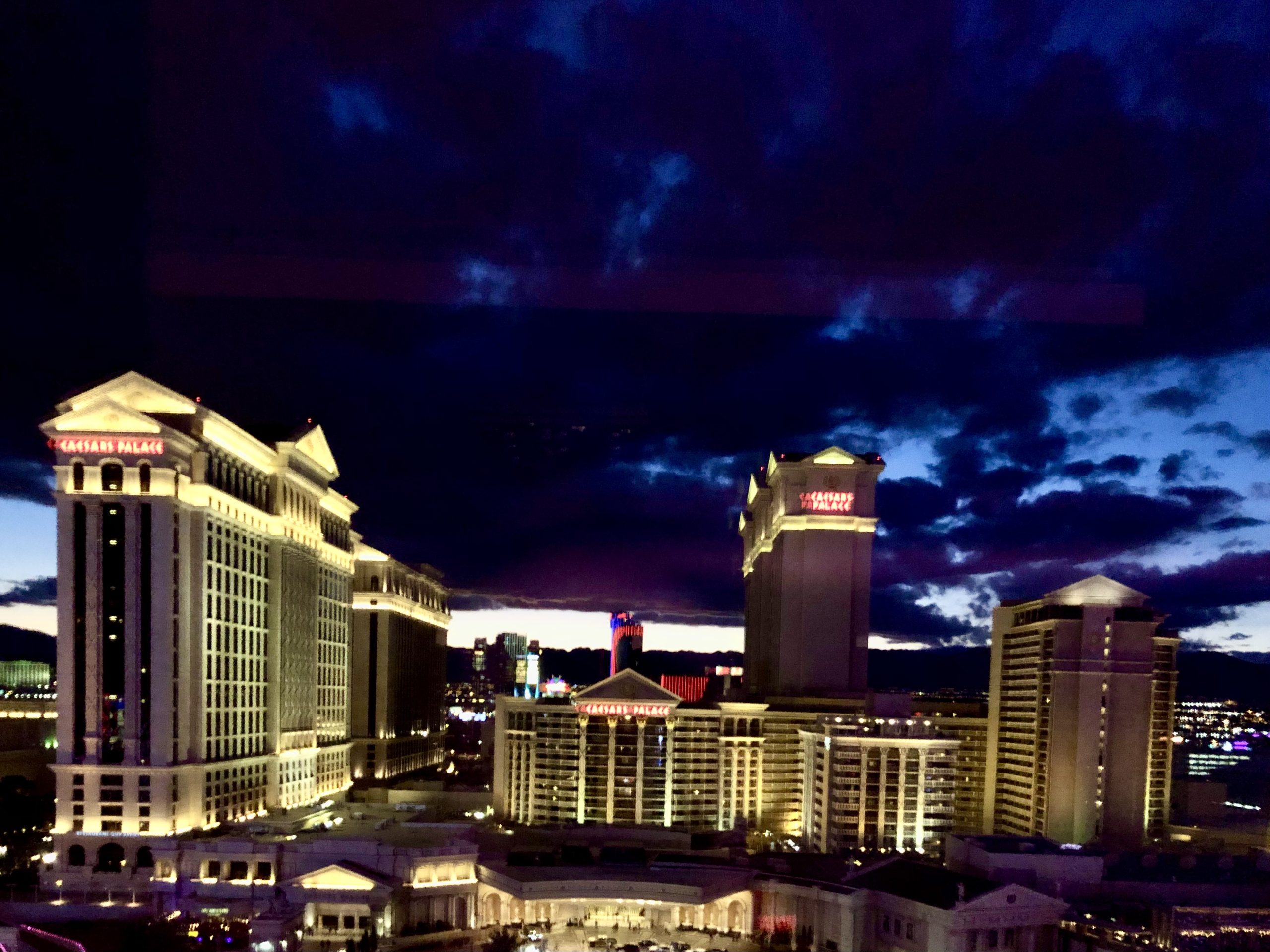
A sobering report on the economic future of Caesars Entertainment and, by extension, Big Gaming in general, appeared (aptly enough) on Halloween. Deutsche Bank analyst Carlo Santarelli penned gloomily that “What was once an outlook/bull case … has given way to concerns around the impact of a looming recession and a deteriorating U.S. consumer. We have believed and continue to believe that the cyclical peak for CZR, and others exposed to the LV Strip and domestic drive to markets, has passed …” Santarelli swiftly dismissed the Roman Empire’s 3Q23 results as not “overly meaningful,” as they merely confirmed that regional casinos are challenged but Las Vegas “remains resilient.” He chopped his price target on the stock from $70/share to $60 but kept a “Buy” rating on CZR.
In a longer note, he allowed that Caesars’ numbers were “broadly better than our forecasts.” Even with Culinary Union talks hanging fire, increased labor costs were already showing up on the bottom line. Added Santarelli, “Management noted that the Union deal would be a 5-year contract, with the upfront increase being the most significant increase in history.” Casino revenue growth in the provinces continues to be driven by new facilities, while the i-casino and sports betting segments saw significant growth in handle, “largely fueled by incremental states coming online and the new technology on the iCasino side.” The Caesars Palace i-gaming app is a hit but OSB revenue dropped 6% and promotional costs are going up, never a good metric.

“Management commented that Las Vegas remains quite strong and continues to be driven by a strong leisure customer, healthy casino demand, a robust event calendar, and continued strength from the group and convention segment,” Santarelli chronicled. Las Vegas Strip revenues of $1.1 billion were $39 million higher than anticipated by Wall Street, and would have been better still were it not for “more significant disruption from the Versailles tower than anticipated.” Look for that to persist until year’s end. The latest on the controversial Las Vegas Grand Prix is that it will boost cash flow and revenue 5%, and be better than New Year’s Eve. It’s helping to drive a comeback by international players—as is the Super Bowl.
“Management remains optimistic that they will reach an agreement with the unions,” continued the analyst. So does Vital Vegas author Scott Roeben, who called a Nov. 10 strike date “Bluster.” We think both are whistling past the graveyard, as the Culinary is obviously spoiling for a fight and shutting down the Strip one week prior to Formula One’s advent will send one hell of a message to the Big Three. Speaking of Roeben, today he reported on X/Twitter that 30% discounts off Grand Prix tickets are being hawked, yet another powerful indicator that the event has been grossly oversold, both literally and figuratively.
“Excluding markets with competitive supply and Atlantic City, CZR is seeing demand equal to last year, plus or minus ~2% across the portfolio,” Santarelli reported blandly. That’s a heckuva of an exclusion, as Caesars said it was facing challenges from new competitors in Chicagoland, Council Bluffs and Tunica, to say nothing of underperformance on the Boardwalk. Also, relief from reinvented Caesars New Orleans is more than a year distant. Compared to 2019, Caesars was seeing third quarter declines in Iowa (9.5%), Indiana (7%), Illinois (1%), Atlantic City (5%), Missouri (1.5%) and so on. Revenue from the digital sphere was $215 million (+1%) and a $2 million return on investment. I-casino play contributed $77 million, a 23% increase, which gives you and idea of what it could do were state legislatures not so afraid of it. Sports betting revenue was up 14% but that included so many new jurisdictions (four) as to be insignificant.

Choosing to take a more clement view of the Roman Empire was J.P. Morgan analyst Joseph Greff. “Fundamentals [are] a lot better than what’s priced in,” he wrote, calling the stock price ($40/share) “too cheap.” He still lopped $11 off his $71/share target and stayed “Overweight” on the stock. Greff heaved a sigh of relief that Caesars’ 3Q23 number manifested none of the negative indicators seen in the recent Boyd Gaming underperformance. The “outlook in Las Vegas remains upbeat,” with $25 million in extra cash flow coming via Formula One weekend. Demand for credit play during that and Super Bowl weekend is potent, “suggesting strong high-end volumes.” Contrary to Santarelli, Greff reported that the regional casino bloc “continues to benefit from returns on recent capex, which should continue through 2025,” though he conceded challenges in Mississippi and the Chicago area. Finally, “Digital continues to benefit from recent technology launches and a more competitive product, while simultaneously reducing promotional expenses.”
Caesars execs went on the record about labor talks (“we’re in active dialogue and optimistic on reaching a solution”) and noted yet again that they’ve been stockpiling money against wage increases since June. They weren’t able to dissuade Greff from reducing his casino cash-flow projections for 2024, “for no other reason than to incorporate a fairly downbeat scenario and one that we’d like to believe is very conservative and serves to de-risk estimate expectations going forward.” He added, “In spite of our estimate reduction, we have CZR generating appealing free cash flow that equates to an attractive 15% yield at current price levels. This is too cheap, in our opinion, to ignore at current levels.” He also dismissed cybersecurity worries as “silly.” Are they? When Caesars CEO Tom Reeg (below) just caved and paid $15 million in ransom? Should insurance have to cover that?

On the debt front, Caesars is aiming to reduce its leverage to 4.1X cash flow by year’s end. However, it’s kicking the can of debt reduction into future years, with $2.5 billion in repayments punted into 4Q24-4Q25. “Management noted that the [3Q23] quarter was a record for casino, hotel, and food & beverage revenues and that mix shift drove a higher proportion of non-gaming revenues relative to table games due to the timing of group related business,” with Strip occupancy at 96.5%. Jettisoning The Rio was also deemed a plus. Regionally, softness in some markets is being offset by new or revamped casinos like Horseshoe Lake Charles and Horseshoe Indianapolis. “Management noted that it is not seeing weakness among its customers (encouraging given BYD’s commentary),” Greff added.
Barry Jonas of Truist Securities also noted a “positive tone” to the conversation, although he too lowered his estimates, “for conservatism.” Keeping a “Buy” rating, he moved his price target down to $62 from $70/share. Provincial casinos did better than he expected and the online profit proved noteworthy. Management did a brilliant job of managing expectations there, tantalizing the The Street with forecasts that black ink wouldn’t show up until 4Q23. Jonas predicted a 4%-6% wage hike for casino workers, much less than the Culinary is apparently seeking. The company has had to staff up (by attenuated, post-Covid standards) in its regional casinos, driven by bigger guest headcounts. Jonas concluded, “Guest demand is stable across the portfolio as investors remain wary of cracks in the consumer amidst an unfavorable macro backdrop.”

In contrast to the trepidation of the Caesars earnings discussions, casinos and racinos in Ohio reported record revenues for September of $192 million. That’s 2% better than last year and a 24% vault from 2019. MGM Northfield Park slipped 3.5% to $23 million and nearly lost supremacy to Hollywood Columbus ($22.5 million, +1.5%). The biggest gainers were Hollywood Toledo ($18.5 million) and Hollywood Dayton ($13 million), both jumping 7%. Jack Cleveland was flat at a robust $22 million and Hard Rock Cincinnati was also flat for $20 million. Scioto Downs ($18 million) didn’t budge either. Belterra Park (above) gained 5% to $7 million. Other positive movers were Jack Thistledown ($15.5 million, 3%), Miami Valley Gaming ($19.5 million, 3%) and Hollywood Mahoning Valley ($13 million, 1.5%).
The palm for Buckeye State sports betting went to both FanDuel and DraftKings, each with $28.5 million. Overall, sports betting brought in $79.5 million on $668 million of handle. But $52.5 million of that revenue went right back out the door in the form of promo giveaways. Fanatics was particularly splurge-prone, spending 25% of its handle on promotions. BetMGM consoled itself with $6 million, as did Bet365. Behind them were Fanatics ($4 million) and Caesars Sportsbook ($2 million). Fanatics’ showing is impressive for a total newbie.

As we predicted, the Seminole Tribe is moving with all deliberate speed toward sports betting. It will go live (again) next month in six Hard Rock-branded locations. The inceptions will roll out from Dec. 8 through Dec. 11. “This is a historic milestone that immediately puts Florida in the same league with the world’s great gaming destinations,” said Hard Rock CEO Jim Allen. Neither he nor Seminole mouthpiece Gary Bitner elaborated beyond the start dates, however. Expect West Flagler Associates and No Casinos to try and throw a body block on this, by dint of a court injunction. Also (again).
Still to come: Earnings reports from Penn Entertainment, DraftKings, Bally’s Corp. and Golden Entertainment. Also, fallout from the Trump Links sale to Bally’s and sports betting returns (not again!) to the California ballot box. See you soon.
Quote of the Day: “I can’t imagine myself being a politician—it has cost me a couple of billion dollars to be a politic—everyone else makes—they make—I said no we can’t do that—I could’ve made a fortune—countries are coming — we’ve got to build a job, and we’d like to have you involved—billions, I say —I tell my kids, sorry kids, we can’t do it, I’m President—I respected the office—and then I get out, and I see the stuff Biden’s been doing, and I say, well I did it the right way—you know—the money—and my kids say, Dad could we build a job here or there—in the Middle East—certain countries—they got a lotta money—and they’d love to build a nice Trump job—no kids you can’t do that, it’s a conflict—I didn’t do that (sniff)—so I was willing—and the of course they made it much worse with legal fees—I have $100 million worth of legal fees—and they are doing good—at least I have a good lawyers—you could spend $100 million on lousy lawyers too—it happens—but no I said, I said, right from the beginning— I told Ben and Candy a long time ago—I said, you know it’s incredible—as soon as you win, they start coming to you—wanna do this—-and I told my kids you can’t do that, you can’t do that—too much respect for the office—and uh …” Verbatim, stream-of-consciousness monologue by failed casino owner Donald Trump, Oct. 29, Sioux City, Iowa.