

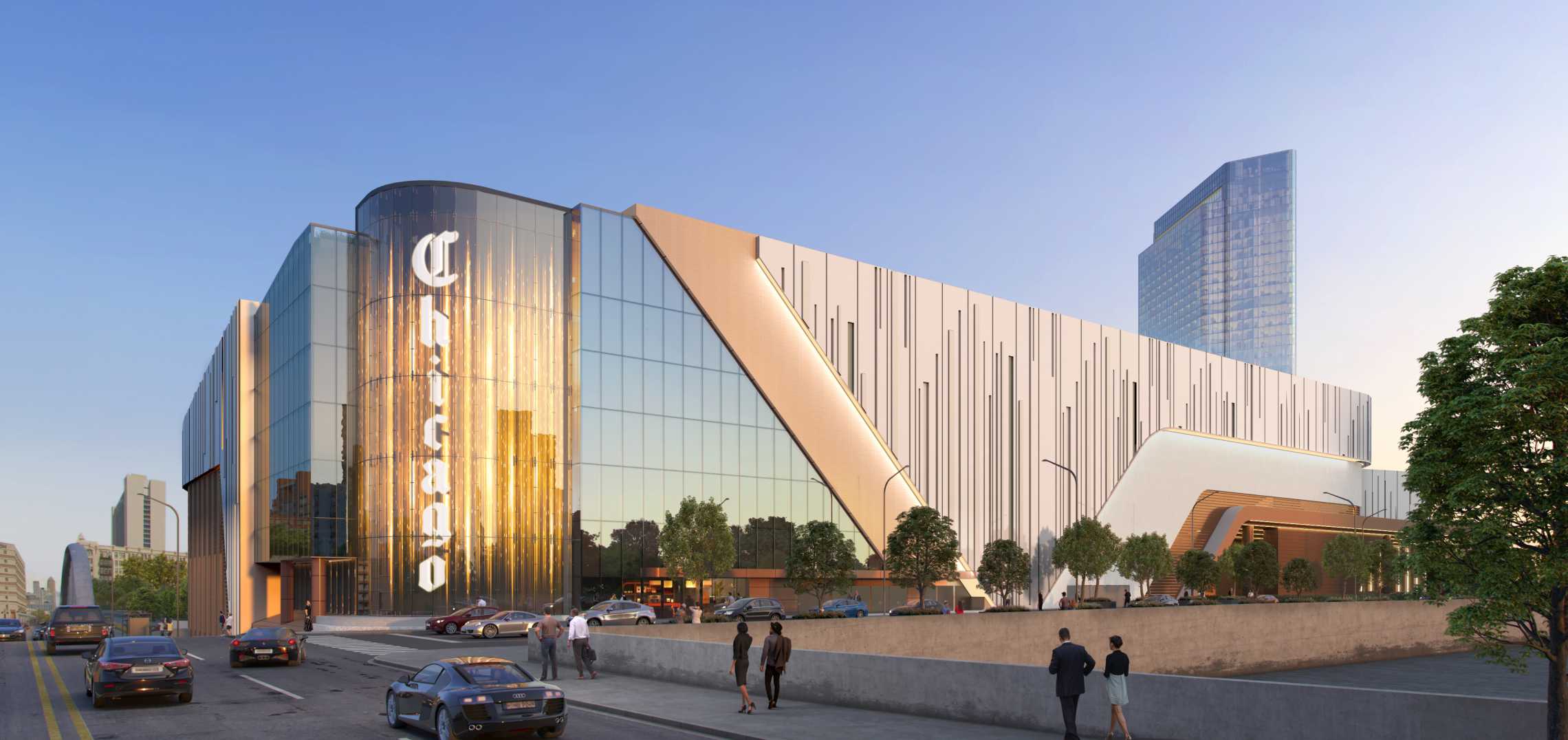
Big, beautiful Bally’s Chicago (above) looks more and more like the altar upon which Bally’s Corp. will be sacrificed. Company Chairman Soo Kim continues to chop up his company into kindling into order to fuel the money pyre that is the $1.7 billion Chicago megaresort. In part to raise the $450 million he needs in Windy City completion money, Kim cut a deal with Intralot to sell them Gamesys for $3.2 billion. Actually, only $1.7 billion (funny figure, that) is in cash. The remainder is equity in a joint Bally’s/Intralot Internet venture.
You remember Intralot? It’s the Greece-based company that landed a sweetheart deal to run sports betting in Washington, D.C. And promptly made a royal fuck-up of it, getting run out of the District before its contract had elapsed. Now Intralot has a 45% chunk of Bally’s international Internet-based operations. According to Fitch Ratings, online gambling and sports betting represent 55% of Bally’s cash flow. So Kim is sacrificing quite a lot in order to score some Second City closing costs.
It’s not clear whether CEO Robeson Reeves is moving on from Bally’s but he’s also slated to become Intralot CEO, so he’ll have quite a lot on his plate. Then again, Kim’s gluttonous appetite for publicity has sidelined Reeves into a figurehead role at Bally’s. Ditto CFO Marcus Glover and President George Papanier. Their pictures should be on the sides of milk cartons. As for Bally’s itself, its Internet ‘strategy’ has appeared to consist of random stabs in the dark and bolt-on acquisitions, so maybe rolling the whole international ball of wax over to Intralot will constitute an improvement.

This latest Soo Kim fan dance spooked Fitch sufficiently to put a Rating Watch Negative alert on Bally’s debt. As of March 31, Bally’s had $209 million cash on hand against $3.5 billion in debt, some of which will presumably retired from the Intralot windfall. However, the questions of how Bally’s is going to finance Star Entertainment, build $4 billion Bally’s Bronx AND redevelop the Tropicana Las Vegas site are largely being begged. One headache at a time, Wall Street seems to plead. At any rate, Kim’s commitment to have a Las Vegas casino open by mid-2028 appears to have vanished into the hazy yon.
Another moving part in the fan dance is Bally’s sale of its two Rhode Island casinos to sugar daddy Gaming & Leisure Properties Inc. That makes Kim the leader of a ‘casino empire’ that has no real estate. Give Kim credit: $735 million for the Twin River twosome is awfully generous. Perhaps GLPI CEO Peter Carlino was feeling expansive. Kim’s far-flung obligations mean the capital will be swiftly gobbled up. Like U.S. consumers at large, Kim has been making impulse purchases even as the economic indicators look grim.
To be fair, Fitch was optimistic about Bally’s Chicago: “The property’s scale, location in the city, and strong demographics should result in win-per-unit metrics that are in line with or stronger than comparable Chicago properties.” The salvation of the project lies in just how much stronger those metrics are. As Fitch notes, it’s a saturated and steeply taxed marketplace, and Bally’s Chicago will need a long ramp to get up to speed. Meanwhile, the growth of Bally’s terrestrial casino revenue will slow from 11% this year to 6% the next, despite adding the Queen Casino portfolio. At least U.S. OSB and iGaming will go from being a black hole to a wash in 2026.

It’s been All Soo, All the Time this week, what with Bally’s holding a virtual dog-and-pony show for Bally’s Bronx (above). The online announcement heralded “letters of confidence” from U.S. banks, supposedly good for $2.5 billion of the needed $4 billion. No word on whether an increasingly jaded GLPI is expected to pick up the other $1.5 billion. A pair of project renderings were appended to the fanfare, although they are somewhere between “oblique” and “sketchy,” suggestive of an unfinished or hasty design process.
Our favorite part of the declaration of intent was a ghoulish detail: Bally’s boasts that its Bronx site is flanked on one side by a graveyard. While this presumably ensures quiet neighbors, it is unlikely to attract superstitious gamblers. Of the promised nine million players per year, Bally’s predicts that only 800,000 of them will come from the Bronx. Given that Bally Links (the casino site-to-be) sits cheek-by-jowl with a public-housing development, Throggs Neck Houses, it’s a vow Bally’s should have no difficulty keeping.

GOP to Gamblers: Screw you! In a sadly premature ejaculation, American Gaming Association President Bill Miller came to the sudden conclusion last December that a change in the White House meant joy for the gambling industry and its constituents. Since then the GOP has been sodomizing Big Gaming with glee. Therer’s been no meaningful action (hell, no action at all) against Miller’s favorite bugaboo, offshore casinos. To make matters worse, the prediction markets jumped with both feet on the AGA and into unlicensed, unregulated, unrestrained sports betting while the Commodity Futures Trading Commission looked the other way. There goes seven years of diligent industry work following the striking down of the Bradley Act. And now the GOP is sticking it directly to gamblers themselves.
Tucked away in the federal budget that passed the U.S. Senate yesterday by one vote is an obscure provision whereby taxes on gambling win go up: way up. Did you used to deduct gambling losses on your taxes? Tough shit, friend. Now your deduction will be capped at 90% of net winnings. So if you lost more than you won, you’re really screwed. And if you won more than you lost, you’re still not out of the woods The math is a little tricky, but at a 24% tax rate you could easily finding yourself paying out more in taxes on the jackpot than you actually won from it.
So forget about the mythic ‘life-changing jackpot’ that Big Gaming likes to dangle before our eyes. Uncle Sam is coming for all of it and more. Or, as NBC Sports columnist Mike Florio puts it, “The more someone gambles, the harder it will be to turn a profit. Because the total losses that offset the winnings will always be reduced by 10 percent.” Solution? Don’t gamble. How’s that for a lose-lose proposition? Not for the house necessarily. To quote Florio, “that will leave the gambling industry with the casual gamblers who are more likely to lose.” They win. We lose.

Don’t take it from us bleeding-heart, tree-hugging liberals. We yield the mike to Captain Jack Andrews, gambler advocate extraordinaire. We won’t go as far as he did in saying, “This will implode the entire gaming industry.” But we defer to his experienced head in this matter otherwise …
“If you file the way the IRS intends, you declare gross winnings and deduct losses. This means even losing gamblers would owe money on their gambling. Combine this with the deep cuts in state funding and states will be looking to find revenue from increased gaming operator taxes (which squeeze the consumer).” Don’t believe Andrews? Just look at Illinois, where DraftKings and FanDuel will be dunning customers $0.50 per sports bet starting Sept. 1 … and where smaller-fry Fanatics is piling on with a $0.25 impost. (Citations available upon request.) Maybe—just maybe—this conservative fuck-you to the gambling public will be weeded out in conference committee. But never underestimate the unmitigated gall of ideologically hidebound politicians, of any stripe, when it comes to trying to legislate private conduct.

In the meantime, keep an eye on that shifty-looking character above. He’s freshman Rep. Mike Rulli (R) from Ohio and he’s got his mitts itching for the 0.25% excise tax that Big Gaming pays to the guvmint. Under Rulli’s subtly named “GAMBLER Act,” the entirety of the fund (which is currently a discretionary account for the Treasury Department) would be seized and handed over to Immigration & Customs Enforcement. It’s not clear why Rulli’s beady eyes fell upon the excise-tax monies, although their acceleration from $33 million in 2019 to $373 million last year might have something to do with it.
Rulli’s Web site doesn’t address why Big Gaming is his target of opportunity, drenching readers instead in a septic bath of xenophobic rhetoric. Presumably, disdain for gambling has something vaguely to do with it, hence the name of the bill. Let’s just hope Rulli doesn’t get the bright notion of increasing the excise tax. Congress would probably pass it. Hey, Bill Miller: The next time you think about bragging on all the taxes the industry pays, think again. You’re just giving The Man ideas … and not good ones.
LOL- I know some many big time MAGA gamblers. He conned ’em.
Is there any group or lobby that is actively trying to get this removed from the bill? We all thought that they would increase the W2G threshold to $5K. Guess we were duped. Noah is right, Trump conned them, if he does not demand that gets removed. Trump will say that it was part of the compromise to get the bill passed, and it’s not his fault. Bull!
Hammers Republicans in DC for anti gambling legislation.
Notes Illinois does something similar, but doesn’t name the party.
Partisan hack.
Clinton, I didn’t mention the Illinois tax hike. You did. Yes, Democrats were responsible for it. And in New Jersey. And Maryland. But the GOP gets credit [sic] for the OSB tax increase in Louisiana. We’ve long since made it clear that both parties are equal-opportunity bandits when it comes to grabbing gambling revenue.
UPDATE: In the haste to pass the spending bill (and contrary to the premature boasting of Rep. Dina Titus [D]), the gambling tax was not stripped out. So we appear to be stuck with it.