

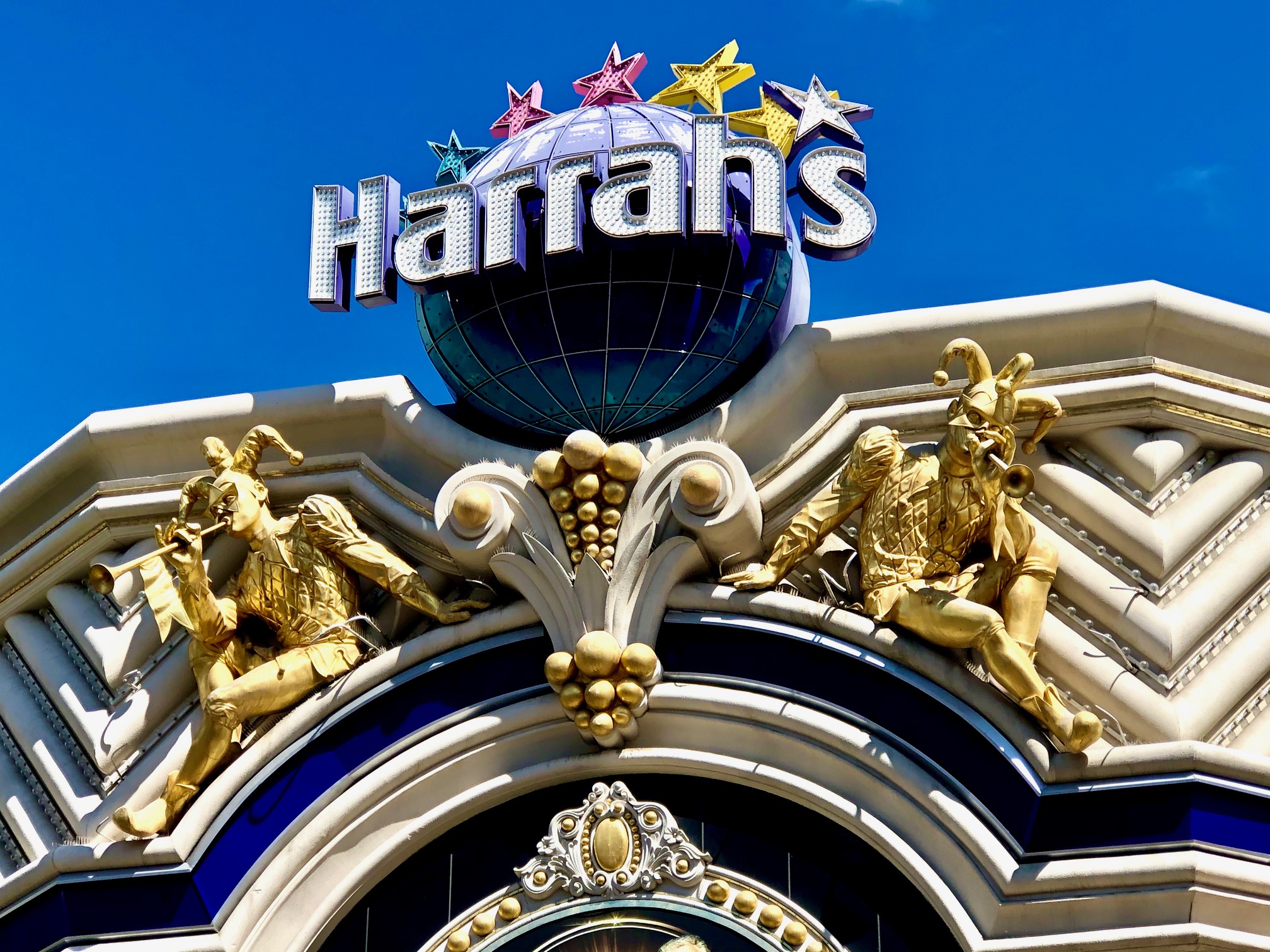
Gone are the capering jesters of the 2023 Global Gaming Expo, dispersed for another year until they reconvene to shake their cap and bells. One of the benefits (aside from the obvious economic ones) of having 25,000 gaming professionals descend upon Las Vegas was that it gave Wall Street analysts a chance to chat up the big boys in person. One such was Deutsche Bank boffin Carlo Santarelli, who managed to meet with at least six major companies. We break down his reports as follows …
Caesars Entertainment. Santarelli seemed unmoved by the Culinary Union‘s saber-rattling. “While we expect more noise from the union negotiations prior to an agreement, we remain of the view that the chances for an actual strike are negligible ,” he wrote, anticipating a deal by the time Formula One hits town next month. The impact to Caesars in terms of higher wages is pegged at $40 million to $60 million a year, against which the Roman Empire has been stockpiling money since June 1. Also, margins should actually improve once the drag anchor that is The Rio is severed. The company expects Las Vegas Strip boosts from the $100 million Versailles Tower redo at Paris-Las Vegas and from inccremental business stimulated by the Fontainebleau opening, which the rebranding of The Mirage is seen as a relative non-factor.
Regionally, Caesars anticipates growth next year from its outlying casinos. Drivers will include the expansion of Harrah’s Hoosier Park, the continued performance of new casinos in Virginia and Nebraska, and the Nobu hotel tower at Caesars Atlantic City. Besides, there’s always “focusing further on the customer up sell model, which has worked well in Las Vegas to drive incremental high flow through revenue.” Caesars Sportsbook is looking to grow its market share by taking more action from sharps and larger bets. Mergers and acquisitions appear to be off the table, given a focus on debt reduction. Also unlikely are share buybacks, “given the cyclical nature of the industry and the largely unsuccessful history of buybacks in the space.”

Wynn Resorts. “Despite the broader, largely negative, tone around the Macau market, WYNN management provided what we believed to be a relatively upbeat and constructive narrative, driven primarily by the outperformance of the premium mass segment and their leverage to the segment,” Santarelli chronicled. Also, more young players and families are flocking to the enclave. Maybe Red China‘s diversification agenda isn’t entirely crackers. Wynn is reported to now be reaping the rewards of higher Macanese promotional spending. Despite “limited” contributions from three junket operators, management pronounced itself pleased with high-roller play. Wynn Palace is expected to return to pre-pandemic cash flow soonest, in part because the other Macao casinos run by Wynn are more favored by mass-market and tour-group players, who are lagging the rest of the customer base.
The Las Vegas Strip was almost an afterthought for Wynn, although “trends remain strong, and management was optimistic with respect to the 2024 outlook, noting that group for 2024 is pacing up year over year.” Of interest to Strip aficionados, Wynn West is “on” again … albeit after New York City is resolved, so expect a long wait, at least until July of next year, if not longer. Once that is settled, Santarelli expects Wynn to “pivot” back to Strip development.
Penn Entertainment. Were it not for M Resort, it would seem odd to meet with Penn in Sin City. There hasn’t been a lot of joy there for Penn. Not surprisingly, the conclave focused mainly on the launch of ESPN Bet. Penn “plans to take a more aggressive promotional strategy than it did with Barstool, but does not expect to be atop the promotional aggression pyramid.” Even so, promos will “likely be amongst the best available, at the time, and certainly outpace redeposit bonus offers.” Santarelli thinks Wall Street is putting too little stock (pun intended) in the interface between ESPN’s app and ESPN Bet, including an embedded ‘bet builder.’ “Simply, this will allow users to do some actual basic research on a game and place a wager, without flipping between multiple apps.”
Penn can flow 12 million DFS players into ESPN Bet, much as DraftKings and FanDuel did upon venturing into real-world sports betting. Even so, Santarelli doesn’t expect similar impact, since the latter two companies have so much of a head start. Although the sports network is opting out of i-casino action, the ESPN Bet app will have a tab that enables users to go to Penn’s i-gaming platform. Anticipate low hold percentages at first: “We expect North Carolina, which will launch no earlier than January 8th, to be an interesting litmus test, as it will be the first market in which ESPN Bet will launch in conjunction with peers.”

Station Casinos. This behemoth can wait in the wings no longer. Management is already thinking about adding 400 more hotel rooms to Durango Resort, perhaps because it expects the modest, upscale room footprint Durango has to skew business toward locals. Santarelli thinks Durango will pull customers from the Silverton, South Point, The Orleans and Station’s own Red Rock Resort. Phase 2 of Durango has already jumped ahead of Inspirada (a dagger aimed at South Point and M Resort) and Sky Canyon. No other development projects were mentioned. Job demand at Durango has been strong, with 30,000 people—a third of them from other Station properties—vying for 1,800 positions. Although Station isn’t unionized, it expects the Culinary contract on the Strip to lift all employee boats, in terms of higher expected wages. “That said, a healthier income for Strip employees should serve as a partial offset, on the revenue side.”
The Sunset Station revamp, which we headlined earlier this week, was also discussed, as was marketing. Station execs described the current environment as “stable,” despite “sporadic” upsurges from single-property and privately held casinos. Lastly, the sites of Fiesta Rancho and Texas Station are supposedly close to liquidation, “and we believe the sales proceeds are likely to be better than expected.” The sales will shave 74 acres off the 523-acre Station land bank.

Golden Entertainment. Also “very stable” was GDEN’s bread and butter, its tavern business. Santarelli was informed that “week to week volatility has been more pronounced of late, with business levels more a function of the event calendar in Las Vegas, while also noting that periods without events have been a touch weaker from a Y/Y perspective.” Management at Golden continues to view The Strat as their “upside driver,” with a four-point agenda: Reduce reliance on online travel agencies (which currently represent 60% of bookings), Revamp rooms; Ditto the F&B offerings and the casino floor; Promote the heck out of Atomic Golf. Golden gets as much as 9% of the latter’s revenue and Santarelli thinks its presence could add anywhere from $5 million to $10 million in Strat cash flow, starting next year.
Gas prices have negatively impacted Laughlin‘s Golden properties, so reliant upon special events and drive-in traffic. “We felt the tone around potential M&A was a bit more pronounced, with management noting that it believes growth via acquisition was a realistic strategy at present, given the strength of the balance sheet.” Golden execs are looking west of Colorado, mainly for stand-alone assets or small portfolios in the annual cash flow range of $30 million to $80 million. Back home, Golden execs believe Super Bowl bookings will make up for the absence of CONAG next year, while the Culinary Union situation could go right down to the Las Vegas Grand Prix wire, with a mid-November resolution expected. Golden itself doesn’t plan to engage with the union until the Big Three have struck deals. “Roughly 800-900 employees at Strat fall into the union negotiations. As such, we expect the impact on costs to be less than $5 mm, on an annual basis.”
Light & Wonder. Only one manufacturer was on Santarelli’s docket and that was LNW. Management voiced a 2025 cash-flow goal of $1.4 billion. This is driven by the Asian casino recovery, market-share gains in all spheres of Light & Wonder, a steady replacement cycle, continued growth of social gaming and the launch of live-dealer games. Whew! Not resting on their laurels, LNW bosses are eyeing Georgia, Oregon, Canada and Class II tribal casinos—as well as historical-horsey jurisdictions—as potential markets for further growth. Overseas, business has been swelled by the sale of 3,000 machines in the Philippines. A market of “significant growth” is Australia. That’s good because the domestic replacement cycle is expected to flatten next year, as “we don’t get the sense commercial operator budgets are increasing in 2024.” Also, operators are shifting away from fixed-fee revenue-sharing games toward wide-area progressives.

Jottings: Smoke was in the air, metaphorically, at a first-ever American Gaming Association roundtable on casino tobacco policies. Participants ranging from Parx Casino in Pennsylvania to Sky City Casino in New Mexico literally shrugged off the importance of smoking to the bottom line, with several noting the increased costs involved in catering to smokers … Caesars Entertainment is on pace to finish its permanent Danville, Virginia casino in roughly a year. Work on the hotel tower has reached the third floor and staffing for the $650 million project will begin in 3Q24 … The boutique Fairfield by Marriott Luquillo Beach & El Tropical Casino has opened in Puerto Rico. The casino is clearly the economic engine of the 104-room hotel, with 300 slots, six table games and electronic roulette … The permanent, $450 million iteration of Desert Diamond Casino (above), near Glendale, Arizona, has been topped off. When finished, Desert Diamond will offer 900 slots, as well as an unspecified number of table games, plus poker and sports betting.