

Global Gaming Expo is a time when Wall Street analysts descend upon Las Vegas to romance Big Gaming’s high and mighty. Among those being wined and dined was Station Casinos CFO Stephen Cootey. (What, Frank Fertitta III couldn’t make it?) Cootey was wooed by J.P. Morgan analyst Joseph Greff, who hosted the investor dinner. The essence of the meeting was that the song remains the same. High-end properties, strong; low-end casinos, weaker. Promotions? “Rational.”
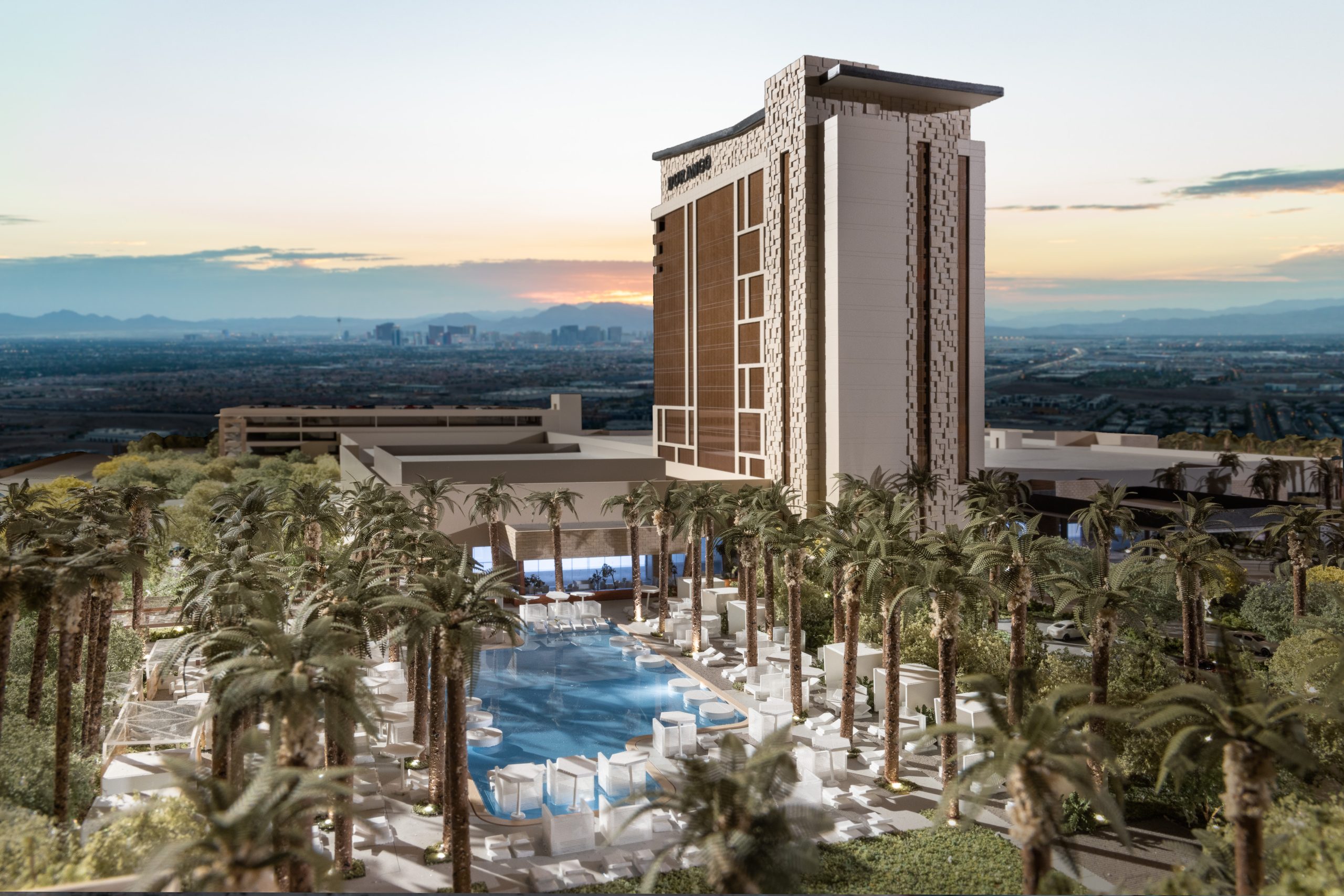
Greff’s big takeaway was that Las Vegas Strip business might be normalizing but locals’ custom wasn’t. Despite lower interest rates from the Federal Reserve, Station isn’t in a hurry with its capital-intensive projects. Durango Resort expansion is slated to begin in a few weeks (after Formula One insanity subsides). As for capex projects, like the Green Valley Ranch hotel makeover, those won’t add to debt as Station plans to just roll free cash flow back into improvements. Sound thinking, that. Greff didn’t get the juicy revelations that Deutsche Bank‘s Carlo Santarelli had—like the indefinite postponement of Skye Canyon—but he obtained solid intel.

After hemming and hawing about its digital strategy, Greff says, Penn Entertainment is suddenly a Chatty Cathy. Much of this is ascribed to the arrival of new Chief Technology Officer Aaron LaBerge. “We were impressed with Aaron and think he can bring better connectivity with the ESPN ecosystem and are more encouraged than not with its early and improving app features, ensuing better parlay mix, and higher-than-expected structural hold,” Greff reacted. He also seemed to find ESPN Bet‘s earnings projections through 2026 achievable, at least to the lower end of guidance.
Terrestrial casinos will not be so lucky, with Penn warning of a third-quarter shortfall, attributable to bad weather, poor table hold and construction disruptions. Brick-and-mortar cash flow for 3Q24 is projected to fall in the $465 million-$475 million range, well below Greff’s anticipated $505 million. Interactive did better, shaving $125 million off projected negative ROI of $115 million, best case scenario. Sucker bets, er, parlays are “driving better-than-expected sportsbook hold rates and lower promotional intensity.” Also, ESPN Bet’s hold has catapulted from 5% to 9%. Lookie Lous from the launch period were reported to be coming back for more and promotions represented a fairly small (3%) part of handle during the early NFL going.

By the way, it’s still a wait until 2026 for the new Hollywood Aurora, the Hollywood Columbus hotel (above) and M Resort expansion. However, the new Hollywood Joliet is said to be flying along and on pace for a mid-to-late-2025 debut. Even better, all four projects remain on budget, too.
Santarelli brought the discussion back to ESPN Bet, in which Penn execs expressed unbounded confidence, it seems. They expect at least $100 million of ROI in 2026, maybe as much as $372 million. Stiff hold plays a role in these projections, with Penn shooting for 9% or even 12%. If you care about Ontario (and you probably don’t), Penn says it holds a double-digit market share there, thanks to brand loyalty to theScore. iGaming is also ramping up nicely in Ontario. In New York State, deployment of ESPN Bet goes slowly, with Penn opting for caution. Overall consumer behavior was described as stable.

It’s “tough not to get excited” about Wynn Resorts being cleared to operate a casino in the United Arab Emirates, where gambling nonetheless remains illegal. That’s Greff’s viewpoint, anyway. Try us, we’re pretty unexcited. Although Wynn brass rolled out some eye-popping numbers for Wynn Al-Marjan (like $1.7 billion in annual gambling revenue), Greff found the execs “very credible and thoughtful” on the subject. This may have been what led him to wax so favorably on the $5.1 billion casino’s ROI prospects. But Greff could be taking sentiments—though not the exact words—out of our mouth when he writes, “this market, which will likely be license constrained and focused on the high propensity to spend luxury consumer in the region, has the potential to have similar characteristics as the attractive and high ROI Singapore IR market.” Absolutely. A second Singapore, definitely. A sun-baked Macao, not bloody likely.
What’s more, Greff sees success in the UAE springboarding Wynn into Thailand eventually. He added, “Those investors who enjoy staying at Wynn/Encore in Las Vegas (and Macau) should be impressed by the property’s design.” The UAE may be an eight-hour flight (blech!) from three-fourths of the world, but how many people of means are there who are filling to fly eight hours to gamble in one of the most backward parts of the globe? That remains to be seen, we think. The emirates are already baking in 8% increases in tourism and international tourist spending. The decadent tastes of the region in consumer goods were also said to be potentially benefiting Wynn Al Marjan’s retail profile.

While it may not have the growth potential of Macao (only one casino per emirate is the plan), the UAE has a lot of things that city doesn’t. Like direct ownership of real estate. And casino credit. And a low gambling tax rate (no higher than 12%). It’s easy to see why Big Gaming is in love with the land of petroleum. If Wynn’s ROI projections for the property hold firm, it will pay for itself in as few as seven years. Greff also spoke glowingly of “labor cost efficiencies” in the UAE, which is a nice spin to put on the terrible income inequities in that region.
Said Santarelli of the Wynn Al Marjan dog and pony show, “if WYNN’s goal was to put this development firmly in the purview of investors, as a step change future value driver, we believe the event was a success.” He saw Wynn as progressing from a Macao-dependent strategy in 2019 (with 76% of the revenue eggs in the Macanese basket) to a more internationally diversified one, with Boston and Las Vegas gradually playing even more important roles. Santarelli found Wynn, if anything, conservative in its revenue projection and its high end forecast of $800 million in Arabian ROI. Why? “For starters, WYNN has a history of meaningfully outperforming peers on an EBITDA per hotel room basis, as evidenced in Las Vegas.”
In Macao, Wynn has been outpacing the competition in room revenue and it is clearing $1 million per hotel room per year. The expectation in annual revenue per room in the UAE is at least $324,000 per room, perhaps as much as $519,000. Additionally, “Given its history of budget overruns, management spent considerable time explaining the budget process and the construction timeline expectations.” Sounds like some hand-holding was needed on The Street. For the curious, the Al Marjan tower is to be topped off in a year from now, followed by the interiors, which will take until early 2027. A dreaded “soft opening” is to follow shortly thereafter. The relevant numbers are 1,542 (hotel rooms), 297 (suites), six (townhouses), 22 (villas), 16 (restaurants) and six (bars).

Caesars Entertainment‘s top brass was invited to dinner with Santarelli and conveyed that “despite the sentiment around LV Strip fundamentals, the sky is not falling.” Secondly, iGaming was said to be looking up, particularly with regard to the launch of the rebranded Horseshoe Casino imprimature. They’re pleased as punch with the Versailles Tower re-do at Paris-Las Vegas, saying the room rates are a 40% premium to what Paris historically yields. As for the Las Vegas Grand Prix being better for business the second time around, forget that. Caesars described the expected bump as “negligible … Further, management acknowledged that November is likely to be challenging on the Strip, but this is primarily due to groups shifting from November into December.”
When Caesars New Orleans debuts next month, its parent company expects a hearty 15% ROI on the $435 million. Players are flocking in for upcoming Taylor Swift concerts, which is generating Super Bowl-like levels of requests for casino credit. Respect.
Although Caesars expects no new iGaming legalizations next year, it waxed very optimistically about its product, which it said would achieve 10% market share sooner than expected. On the Caesars Sportsbook side, “We expect the near to medium term to be characterized by cost reductions and increasing parlay mix driving better hold percentages.” So be updating your resumé if you work there and don’t blame us. We’re just the messenger.

Greff gets the last word, having taken Caesars’ top dogs out for dinner and coming away bullish on the future of the Roman Empire. He noted that Caesars was poking around in the Middle East for a good casino opportunity, even though international operations haven’t been the company’s strong suit for at least 20 years. Caesars Virginia and Caesars New Orleans were additional causes for Roman giddiness. Even though its expectations from F1 are muted, the company is adding 30% more high-limit casino space at Caesars Palace, hoping to have it ready by race week.
The feeling about Caesars’ regional empire was more muted, with 2025 projected to be flat with this year … which is hardly chopped liver. Heightened competition (largely from Penn, it appears) will further pressure Caesars’ outlying casinos, but New Orleans and Danville, Virginia are expected to compensate nicely. Incidentally, CEO Tom Reeg & Co. claim that reducing debt is Priority #1, but their actions give the lie to that. They just bought back $141 million and have their eyes on $500 million more. Kinda makes you miss the pre-Reagan days when that chicanery was illegal, as it ought to be now.