

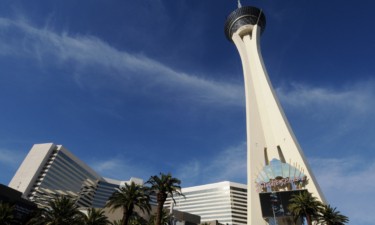
What might have been a disappointing quarter for Golden Entertainment was redeemed in Wall Street‘s eyes by the initiation of stock dividends. Golden will be paying $0.25/share on a quarterly basis. This has been made possible by the wholly laudable reduction of the company’s debt to 2X cash flow. “We believe the decision to institute a dividend, more so than the dividend itself, speaks to the optionality and flexibility of the Company at this stage,” applauded Deutsche Bank boffin Carlo Santarelli.
Cost increases from the new Culinary Union pact took a bite out of 4Q23, although Golden execs assured investors they could maintain “flattish” profit and cash flow margins, thanks in large part to the addition of Atomic Golf, which is opening behind schedule. Net revenue came in $4 million more than Wall Street expected while cash flow was $49 million, a hair below what stock analysts were expecting. Santarelli was told that January had been “somewhat bumpy” for Golden (and for other Las Vegas Strip operators, we might add) but that February brought a boffo Super Bowl boost, including an extra million dollars in hotel revenue.
The Las Vegas Grand Prix was a pain in the butt for The Strat, which took an $800K cash flow hit from it. Quoth Santarelli, “Management believes there is a general acknowledgement that changes need to happen moving forward, for a more widespread benefit, and noted a group is working with F-1 to make the event more beneficial for the broader Strip.” That’ll take some mighty heavy lifting. Interestingly, Global Gaming Business reports today that Formula One never had an agreement with Clark County (which nevertheless shelled out $80 million for the race) but was imposed on it by the Las Vegas Convention & Visitors Authority, Sin City’s most reliable villain these days.
The Strat ran at 79% occupancy during 4Q23, with weekends full and weekdays improving to 66%. Due to an ongoing renovation project, The Strat is down 125,000 room nights vis-a-vis 2019. Santarelli expects the belated opening of Atomic Golf later this month to add as much as $10 million a year in annual cash flow to the property. Elsewhere, Golden continues to both add and subtract, shedding its Nevada slot routes and the $100 million-plus in revenue they provide. Instead, Golden hopes to up its tavern portfolio to 72 or so this year. Why not? They generate 25% ROI. Try getting that from a casino nowadays.

Did a veteran regulator commit truth during a recent online appearance? Or will Dave Rebuck turn up on Monday with a cushy new job at DraftKings? We’re inclined to think he got a (job) offer he couldn’t refuse, prompting his sudden resignation, effective yesterday. There are definitely echoes of the recent departure from the National Indian Gaming Commission of supremo E. Sequoyah Simermeyer, who left abruptly and quietly to take a post with FanDuel. It would definitely be a coup for someone to snare Rebuck and his gaming bonafides, which include 13 years running the New Jersey Division of Gaming Enforcement, the gold standard for U.S. regulation.
Then again, Rebuck was awfully candid about his agency’s Big Brother powers lately, saying (among other things), “We know more about you and your family and your affairs than you yourself do. You can’t be anonymous. We know where your money is coming from. We know you have money … and we save it forever.” But let’s give him the benefit of the doubt. Garden State Attorney General Matthew Platkin was expansive in his praise, saying of Rebuck, “His extensive knowledge of the gaming and casino industry has made New Jersey a recognized regulatory leader and pacesetter in the U.S.”
The unenviable task of replacing Rebuck has fallen to longtime second banana Mary Jo Flaherty, who has been in gambling regulation for 45 years. She won’t need any time to get up to speed, although a probable industry source moaned that “this was the last direction I had hoped the AG would go,” which likely means it was a good decision.

Casinos and racinos in the state of Ohio grossed $176 million in January, down 11% from last year but 25% better than 2019. Despite slipping 9%, MGM Northfield Park retained its supremacy with $22 million. Close behind was Jack Cleveland with $21 million (-8%). That doesn’t mean that all big-city dwellers chose to play close to home. Hollywood Toledo ($16.5 million, -12%), Hollywood Columbus ($20 million, -13%) and Hard Rock Cincinnati ($18 million, -18%) all took their lumps. Low-grossing Belterra Park ($6.5 million) outperformed everyone by ceding only 3.5%. Scioto Downs had it the worst among the racinos, falling 14% to $16 million. Greater and lesser bites were felt by Jack Thistledown ($14 million, -7%), Miami Valley Gaming ($18 million, -6%), Hollywood Dayton ($11.5 million, -9.5%) and Hollywood Mahoning Valley ($12 million, -10%).
While players stayed home, sports betting benefited, realizing $110.5 million on handle of $792 million, quite an impressive number for such a young market. FanDuel led with $53 million, trailed by DraftKings ($34 million), Bet365 ($6 million), BetMGM ($6 million), ESPN Bet ($4.5 million), Caesars Sportsbook ($2.5 million) and Fanatics ($2 million). Then again, promo offers ate up $40 million of that gross, especially from the smaller fry, although Caesars largely abstained.

No one is in the news more often these days than failed casino owner (three bankruptcies), convicted fraudster and convicted sexual abuser Donald Trump, whose antics never end. Considering that his legacy as a businessman rides largely on the myth that he was a successful gambling mogul, a look at the record may be instructive and one was taken today. The pseudonym-employing writer notes that “Trump’s history with casinos is perhaps most emblematic of his political style and says a lot about where America is as a society.” Citing economist Brett Christophers, they go on to argue that Trump’s greatest accomplishment was to create the illusion of value. He’s a ‘rentier’ capitalist, maybe the first great one, “offloading risks to others, while ensuring he walks away a winner, regardless of the impact to those who trusted him, or relied on him.” Many of those who are aware of this evidently regard it as an admirable trait. S&G cult figure Scott “Woody” Butera is among them.
Former Resorts International exec H. Steven Norton puts Trump’s Boardwalk legacy into perspective: “He helped expand Atlantic City, but he just did not put the equity into the projects he should have to keep them solvent.” Or, as investment guru Marvin Roffman, one of the few to call Trump out on his business bullshit, puts it, “There’s something not right when every single one of your projects doesn’t work out.” Even so, Trump was able to bamboozle his investors and executives at will, getting Trump Entertainment Resorts (ticker symbol: DJT) to pay him $380 million for the then-Trump Marina. Eventually Tilman Fertitta would relieve TER of it for a mere $38 million. It’s no coincidence that the national debt ballooned while Trump was in the White House. It’s what he did to his casinos and, not having learned from history, we were doomed to repeat it.
On an altogether more admirable Atlantic City note, Hard Rock Atlantic City (the former Trump Taj Mahal—oh, the irony!) split a $10 million bonus among its thousands of employees. It also gave them a chance to compete for $100,000 in prizes and cash. As Hard Rock International CEO Jim Allen said, “Hard Rock Atlantic City team members are the key to our success in the market, and we are honored to recognize them and their hard work. We witness our team members’ unwavering dedication to providing superior service every day, and it is truly inspiring.” Now, about that smoking issue …