

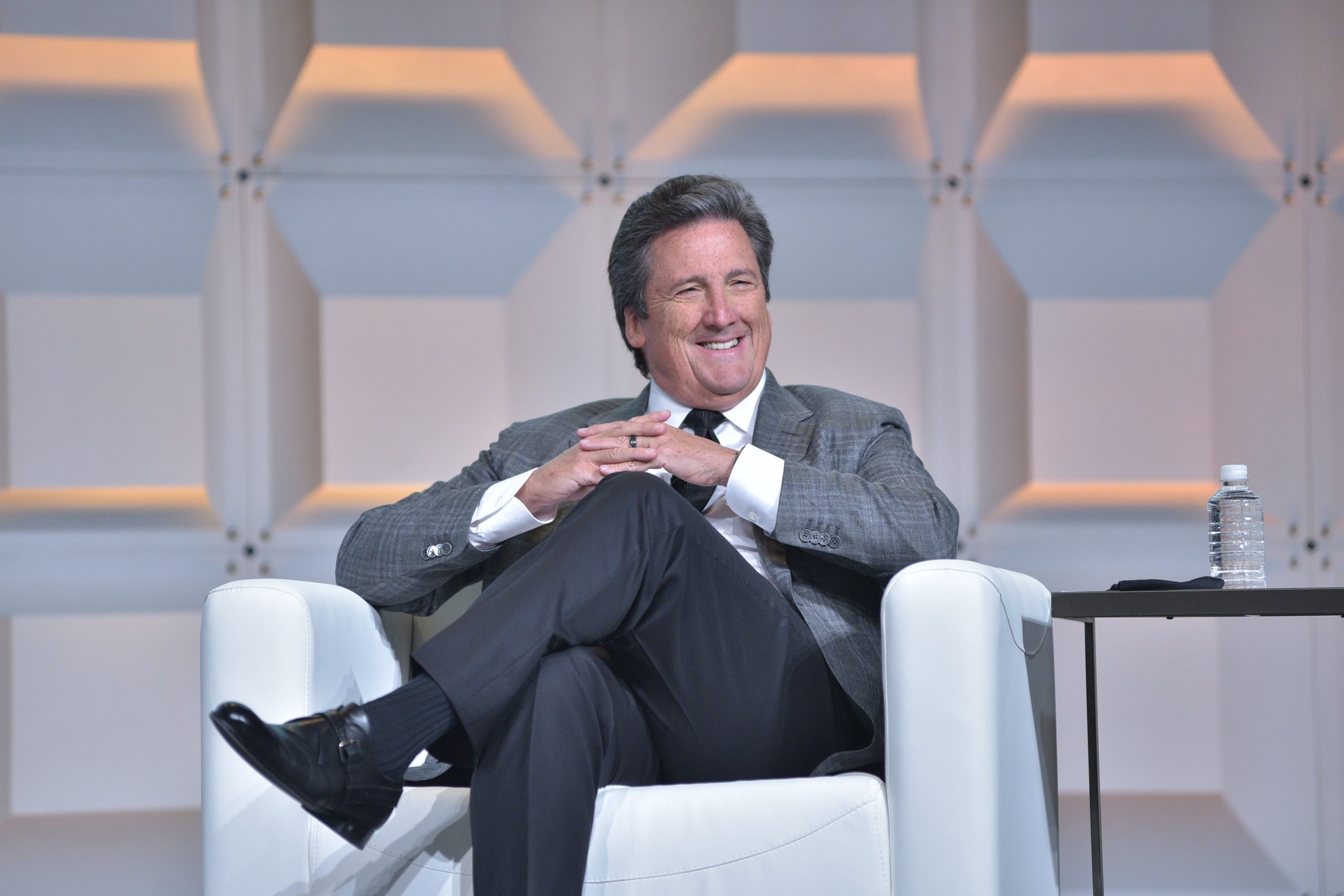
Don’t you just hate it when reality refuses to conform to Big Gaming’s preferred narrative? MGM Resorts International CEO Bill Hornbuckle sure does. That would explain the hissy fit he threw last weekend. Faced with a Las Vegas that was 9% down in visitation in December and off 6% in gambling grosses, Hornbuckle stuck with the ‘Happy days are here again’ mantra.
Addressing a friendly crowd at the Vegas Chamber, Hornbuckle tried to paint a smiley face on 2025’s dismal numbers (-7.5% visitation, 83% Las Vegas Strip occupancy). “Over the next 14 to 15 months, we will have more conventions on the books and in our city than in history. We are as solid as a rock,” railed Hornbuckle. He beat a straw man, saying, “I read headlines that Las Vegas is dead. Stop.” That’s right, you damn media, cease your reporting what’s really happening. That’ll sure change things.
Actually, few of us are saying “Vegas is dead.” That’s a Hornbuckle construct. A phantom. A pig in a poke. What has been said and apparently needs to keep being said is that Vegas has a serious pricing problem and Big Gaming is in denial. Also, it clearly has a serious tourism problem and people like Hornbuckle should acknowledge it instead of spouting happy talk to like-minded audiences.

Parroting a White House talking point, Hornbuckle argued that Vegas afforability is a hoax—or at least a state of mind. “Value doesn’t mean to be cheap. We have evolved to the point where value isn’t about cheap, but about experience in what you get.” In other words, pay up and quit your griping. To bolster his argument, Hornbuckle chose a terrible example, disclosing that Shadow Creek was still booked solid even though greens fees had been jacked up 150%. Now, nobody—and we mean nobody—is contending that rich people can’t afford a $1,250 round of golf anymore. The luxury contingent is the one stratum on which Sin City has been able to rely, which is why Wynn Resorts is laughing off the doldrums. Maybe if the upper crust did go away, so would the Las Vegas Grand Prix, but we’re not liable to get that lucky.

Although Boyd Gaming CEO Keith Smith no longer talks to the media, he did show himself for the Vegas Chamber. Unlike Hornbuckle, he made a few nods to the grim situation out there. “There’s no question that visitation to Las Vegas is down and it’s not anything we haven’t seen before … Is it concerning? Sure. But this has happened to us before and it’s not the end of the world.” Unfortunately, Smith is buying into the narrative that what’s being seen is merely cyclical, “just a dip” and not cause for worry. At least he criticized Formula One and its disruptiveness (somewhat), so give him points for not singing straight off the hymnal.
Smith can afford to be sanguine. Unlike MGM, Boyd has a vast network of regional casinos to backstop it when Vegas is under stress, as it is doing. That was Big Gaming’s astute calculation of yore: Get ’em close to home AND in Las Vegas. It’s worked wonderfully well, too. MGM isn’t as strong in the outskirts, having put most of its marbles on the Strip (and Osaka). So no wonder Hornbuckle is so touchy.

Hornbuckle had even more cause to be nettled this week when MGM Resorts International scored an own-goal by prematurely releasing its fourth-quarter financials, forcing the earnings call to be moved up from Feb. 11 to Feb. 5. Not fun. Especially when your regional casinos miss their targets, as they did. However, the Strip and Macao outperformed expectations, especially the latter. “We view these results positively in the context of current investor sentiment,” wrote J.P. Morgan analyst Daniel Politzer. Even so, he acknowledged soft tourism in Vegas. Cash flow was a healthy $1.2 billion on $4.6 billion, even if the outlying casinos came in a bit under projections. (Why is Hornbuckle bellyaching?)
One analyst who saw good things in the MGM numbers was Truist Securities‘ Barry Jonas, who noted that the company was benefiting from tight hold and the completion of an MGM Grand makeover, which affected as many as 1,000 rooms. “That said, Luxor and Excalibur (which primarily cater to the low end) continue to have a disproportionate impact to the segment as mgmt is not seeing any changes in behavior for its value customer,” he wrote. But, as Hornbuckle himself would (and does) point out, they’re just 6% of MGM cash flow, so Joe Average players can just pound sand.
Management, Jonas (below) said, is hoping for a return to 2023 levels of business, drafting off the Consumer Electronics Show and upcoming ConAgg Expo. The last quarter of 2025 didn’t solidify the Strip market, the way the industry said it would, but MGM is still projecting a good 2026. It’s pinning its hopes on an uptick in conventions (which shores up midweek traffic) and high-end slot rooms at Aria and Bellagio. “Still, mgmt remains aware that solutions are still needed for Canadian and leisure travel,” Jonas observed. “Overall, we think management makes a good case for a return to growth, but they did so last year at this time too.“

Regionally, cash flow was meh but slot revenue hit Q4 and annual highs. Counterintuitively, management is hastening to be rid of MGM Northfield Park in Ohio (which is 100% slots). 1Q26 was described as stable to date, benefiting from room redos at Borgata. “Additionally, weather hasn’t been as bad as last year, with mgmt expecting a few million dollar impact to Q1 results,” quote Jonas. They’re pining for a MiniMe edition of the Sphere, near MGM National Harbor, banking on a boost from another of those big-ticket attractions. You guys don’t care about Macao or Brazil, so we’ll skip those and note that MGM Osaka is 20% done and still on track for a 2030 opening, while MGM keeps beavering away on a resort in Dubai, hoping for an Arabic casino there. Given the amount of petrodollars that Wynn Al Marjan is expected to rake in (we’re talking billions), you can’t blame MGM for having Arabian aspirations.
Cheers & Jeers …

Cheers to Oklahoma, where the Lege may finally get it together on sports betting this year. State Sen. Bill Coleman (R) may use tired sports metaphors but he’s fighting the good fight on behalf of wannabe bettors. He credits Kalshi with giving him a rude awakening: “You can do anything on this thing and it’s perfectly legal. The state of Oklahoma gets zero revenue from Kalshi. The state of Oklahoma has no say in how it’s regulated.” Preach it, brother. On the other hand, there are 39 Native American tribes with skin in the game, as well as Gov. Kevin Stitt (R), a perpetual wild card. If Coleman & Co. can come up with a deal that’s amenable to both the tribes and fellow solons—and Stitt—it would be a model that California would be wise to study.
Jeers to Dixie, where state legislatures continue to dither while OSB dollars get away. Online wagering faces an uncertain future in Mississippi. It’s passed the lower house but the state senate is far from a given. The state’s pension fund needs an infusion of capital, which OSB taxes could provide. But the senate has whiffed on this twice before. Kudos to Rep. Casey Eure (R) for pointing out that “These are Mississippi residents crossing into other states, and the outcome of that is that Mississippi receives zero tax revenue, there’s zero oversight, zero consumer protection against these people placing bets, and problem gambling goes undetected and unmanaged.” He thinks the state could be looking at a $80 million payday, off a reasonable 8% tax rate. Tell that to state Sen. David Blount (R), the primary obstacle to passage.
Cheers to Hawaii, for at least considering a crackdown on prediction markets. Not in terms of outlawing that form of fungus but reclassifying it as what it is—gambling. Given that Commodity Futures Trading Commission figurehead Michael Selig (a puppet of prediction-market interests) has abdicated authority on the issue, states are going to have to move to fill the vacuum, as well as capture the tax dollars that the Polymarkets of this world should be paying. For once, we and casino detractor Les Bernal find ourselves on the same page. It’s a miracle.

Jeers to the House of Representatives, where leadership [sic] once again thwarted consideration of Rep. Dina Titus‘ Fair Bet Act. It would restore deductibility on gambling losses to 100%, not the current 90%—thanks to Sen. Mike Crapo (R) and a sneaky provision in the last federal budget. Speaking of Crapo and his club of 100, the action now moves to the U.S. Senate, where Sen. James Lankford (R) airily proclaimed the new levy “pretty minor.” It is, if you don’t have to pay it. Gamblers would disagree. Sen. Catherine Cortez Masto (D) has her Full House Act teed up and we hope it comes to a vote, if only to find out who our friends and enemies are.

Cheers to sharp bettors, who are keeping action alive on the Super Bowl. Big Gaming better hope (as we do) that the underdog New England Patriots win. This would be a betting nonevent otherwise. A lopsided 67% of wagers are on the Seattle Seahawks, meaning a colossal payout from the sports books if conventional wisdom prevails on Sunday. Also putting heavy money on the Pats is Houston-based whale John “Mattress Mack” McIngvale. He’s wagered $2 million on them. Since McIngvale is a real character and a George donor to charity, we hope he rakes it in Sunday night. Bonus good news is that Patriots field general Mike Vrabel won Coach of the Year last night—just as we said should be the case, months ago.
We’ll see you at the game.
Before work I stopped by Rivers Casino and bet the Patriots on the money line and got odds at +185. Almost everyone on ESPN and CBS Sports took the Seahawks to win so I just bet the opposite. I think the game will be close and 20 -17 either way.