

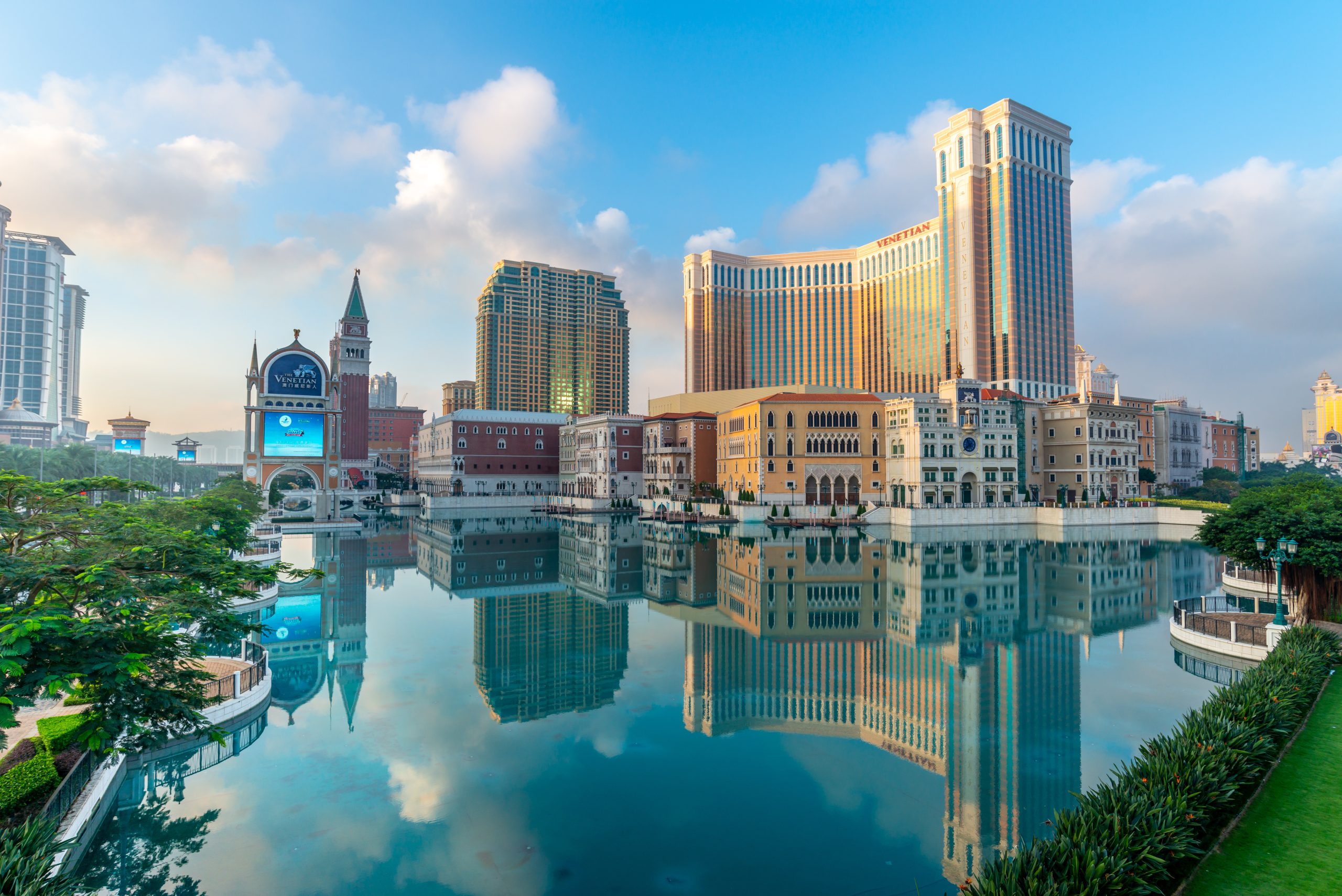
Reviewing some disappointing first-quarter financials for Las Vegas Sands, the colorful analyst for Deutsche Bank, Carlo Santarelli described it as “a Tale of Two Markets, But Investor Focal Points Fall Short.” His opposite number at J.P. Morgan, Joseph Greff was blunter: “Stellar in Singapore. Less So in Macau.” Inciting incidents included construction at Sands’ behemoth Londoner megaresort and loss of market share to the competition. Greff dropped his price target to $55/share from $59, while Santarelli was sunnier, despite dropping his price target to $62/share from $66, and he recommending buying the stock. The company splurged on $450 million in share buybacks, which should mollify investors.
Getting the Macao disappointment out of the way, Santarelli noted that Sands’ cash flow in the market was $72 million below the $708 million he had modeled, whereas Marina Bay Sands came out $33 million ahead, notching $520 million (amazing for one casino). He noted that Sands seemingly preferred to give up market share in Macao rather than engage in promotional warfare. Santarelli wrote that the “results were aided by a strong event calendar, though management downplayed the significance, and we believe the hold-adjusted result outpaced the more bullish buyside forecasts.”
In Macao, the Londoner was a double liability, not only from rooms being offline but in that the casino was seeing more wagering but less revenue. The property’s overhaul includes renovating and re-marketing its Conrad and Sheraton hotels, redoing the Pacifica Casino, as well as “new attractions, including dining, retail, entertainment, and health offerings.” In addition, Cotai Arena is out of service until October at the earliest, as Sands looks to improve its amenities.

Greff may have been guilty of understatement when he called the Singapore outcome “stellar and better than expected.” Although it was certainly both of those. He credited both ongoing renovations to the room product and improved tourism from China. Table game revenues were 17% higher than Greff had forecast, well (as in 61%) above pre-Covid levels. “This is the good part of LVS’s 1Q24 results,” Greff said darkly. As for Macao, he noted that Sands’ overall table game performance (very few people bother with slots there) was trending up—but much less than its competition. He also mentioned the promo battles, observing that Sands’ market share was 93% of its 2019 altitude, and alluded to higher corporate expenses (flinging money at Texas?) as a contributor to his markdown.
“We think it could be a couple of quarters for its Macau business to see sequential improvements (of any note) but do think Singapore remains healthy,” Greff said of Sands. Its CEO, Rob Goldstein, preferred to talk about Thailand, which understandably excites him, and New York City, which frustrates him. Heck, anybody without the patience of Job would be tested by New York State’s snail-powered casino-selection process. Goldstein sounded like he was laying the groundwork for a Sands exit when he fumed, “Now, they’re saying 2025 or 2026. We don’t have any clarity and to be honest, it’s confusing and disappointing. We’ve put a lot of time and work into New York, but I have no guidance. We wish they’d figure it out and let us know. We’ll remain hopeful that things turn around there.”
As for Thailand, “It could happen quicker than in Japan, that’s conceivable.” OK, that’s not saying much. Anyplace (even New York) is quicker than glacial Nippon. Still, “It’s a very exciting market at a lot of levels with its sheer size of population and accessibility and willingness of people to travel to Thailand. It’s one of the resort destinations in Asia. There will be a lot of pent-up desire among both business and government to work toward this.” Any less degree of enthusiasm from Goldstein would be a downright downer.

Saturation continues to manifest itself in Pennsylvania, where $313 million was lost by gamblers last month. That’s 1% more than last year but 16% less than in pre-expansion 2019. It’s no reason to panic but it does say something about the assumed elasticity of the gambling market. Parx Casino was flat with an otherwise awesome $53 million, rivaled only by Wind Creek Bethlehem‘s $48 million (+6%). The Philadelphia area, minus Parx, was led by Philadelphia Live with $24 million (+7.5%), followed by Rivers Philadelphia, slipping a point to $21 million. Valley Forge was flat at $13 million, which was still better than Harrah’s Philadelphia and its $12.5 million (-10%). Better sell that place while you still can, Caesars Entertainment. Or at least make it look like something other than a warehouse for slots.
Rivers Casino ($32.5 million, -2.5%) easily dominated the Pittsburgh area, despite challenges from Pittsburgh Live ($11 million, +4%) and Hollywood Meadows ($17 million, -11%). Mohegan Pocono climbed 2% to $19.5 million while Mount Airy hopped 4% to $16.5 million. Presque Isle Downs gained 5% to $9.5 million, Hollywood Penn National plunged 13.5% to $14 million and Lady Luck Nemacolin leapt 23.5% to $2 million. (If we don’t include tiny Lady Luck, we hear about it.) All the remaining satellites were up: Hollywood York ($9 million, +5.5%), Hollywood Morgantown ($7 million, +7%) and relative newcomer Parx Shippensburg ($4 million, +29%).
iGaming was boffo, with $191 million. BetRivers continues to recede into third place, despite its $33 million taking. FanDuel brought in $51 million, while the catchall Hollywood Casino brand was good for a plentiful $72 million. Sports betting operators made $45.5 million on $801 million but sent $18 million back out in promotions. FanDuel led with $32 million, followed by DraftKings‘ $15 million. Everybody else was way back in the pack, whether it was ESPN Bet ($4 million), BetRivers ($3 million) or BetMGM ($3.5 million). Caesars Sportsbook ($2 million) and Parx ($1 million) were just in the picture.

We still have no clarity as to whether or not MGM Resorts International intends to evacuate Massachusetts, although once you’ve trotted out the idea of selling a casino it’s impossible to walk that back. Anyway, red-headed stepchild MGM Springfield did $25 million last month, a 5% improvement, albeit half of what MGM initially expected to get out of the place. Plainridge Park racino leapt 8% to $15.5 million without the benefit of table games. And Encore Boston Harbor improved 6.5% to $70.5 million. Sports betting ginned up $48 million from $655 million of handle. DraftKings captured fully half of the money, with FanDuel settling for 33% (the Bay State doesn’t release dollar amounts), BetMGM 6.5%, ESPN Bet 5.5% and Caesars Sportsbook 4%.
Another state that’s big into online gambling is Michigan, where sports betting generated $42 million on handle of $480 million—$27 million after promotional deductions. The latter wiped out Fanatics‘ entire, $1.5 million haul. FanDuel bested DraftKings, $18.5 million to $10.5 million. BetMGM did $6 million, ESPN Bet $2.5 million and Caesars Sportsbook $1.5 million. BetRivers faded below the Mendoza Line and WynnBet rang up a big, fat zero. It fared somewhat better at iGaming, engendering $3 million. BetMGM got knocked off its top-rung perch by FanDuel, $57.5 million to MGM’s $55 million. DraftKings also made $48 million worth of noise. (It’s more than a little surreal to see DFS providers outperforming the casino industry in casino games.) Also-rans were BetRivers ($13 million), Caesars Palace ($11 million), BetGLC and FoxBet ($3 million each), and Hollywood Casino ($5 million).

Finally (whew!), there’s been a dead-cat bounce in Louisiana casino revenues, up 1% from last year but still -9% from before Horseshoe Lake Charles, even if the latter now appears to be a spent force. Sports betting added $35.5 million, on handle of $319 million—not a bad return, as the market finally appears to be heating up. The aforementioned Horseshoe Lake Charles slipped further into irrelevance, -4.5% to $8.5 million. It was handily bested by L’Auberge du Lac ($31 million, +2.5%), Golden Nugget ($29.5 million, flat) and Delta Downs ($16.5 million, +8.5%). Over in New Orleans, the eponymous Harrah’s New Orleans was becalmed at $22 million but still doubled the performance of its nearest competitor, Boomtown New Orleans ($11.5 million, +5.5%). Also in the hunt were Treasure Chest ($8 million, +8%), Fair Grounds racino ($4 million, -4%), Amelia Belle ($3 million, +14.5%) and Evangeline Downs ($7 million, +7.5%).
New product continues to trump history in Baton Rouge, where Queen Casino surged 71% to $8.5 million and second place. Ancient Belle of Baton Rouge sank 34.5% to a pitiful $800K, while L’Auberge Baton Rouge ceded 9.5% to $16 million. Despite an 11% subsidence, Margaritaville ($18 million) continued to rule the Shreveport/Bossier City area. Horseshoe Bossier City faded 15% to $11.5 million, while Bally’s Shreveport slipped 2% to $10 million. Gainers were Boomtown Bossier ($5 million, 4.5%), Sam’s Town ($4 million, 9%) and Louisiana Downs, charging out of last place with a 23% gain and almost $5 million gross. A good month for them and an excellent one, all around, for Boyd Gaming‘s Pelican State properties.
Quote of the Day: “Asking a sports gambling operation to get out of props is like asking a trattoria to stop serving pasta.”—Jason Gay of the Wall Street Journal, on the fallout from the Jontay Porter scandal.
What all of these sports gambling companies should do is prohibit sportsbooks from offering wagers on players who have two-way contracts.