

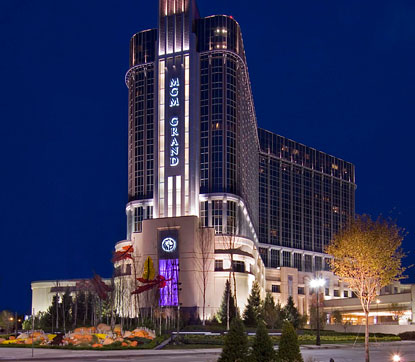
Since the Great Pandemic, gambling has never been quite the same for Detroit. Last month’s casino tally of $105 million was flat with 2023 and 9% down from the pre-pandemic pace of 2019, a recurrent theme in Motown. MotorCity beat the odds and posted a 1% increase, hitting $31.5 million for the month. Hollywood Greektown, which had been on a tear, was flat at $24 million, leaving $49 million (-1.5%) for MGM Grand Detroit. As J.P. Morgan analyst Joseph Greff reminds us, this includes a Leap Day, which probably kept Detroit’s casinos revenue-neutral for February.

Revenue comparisons fought to something of a draw in Indiana, where receipts were 2% down from last year but still 16% above 2019 (+1% on a same-store basis). Grosses totaled a healthy $194 million, not counting the tally from sports betting. Basically, February was a rough month for northern casinos, a good one in the south and so-so around Indianapolis. Surging was Hard Rock Northern Indiana, up 9% to $38 million. Former Chicago mayor Lori Lightfoot (D) had tried to paint a target on Hard Rock whilst juicing Bally’s Corp. into a Second City casino. Mission failed, undoubtedly. Less fortunate was Horseshoe Hammond, tailspinning 23.5% to $22 million. Ameristar East Chicago took a 9% wallop, down to $15 million. Blue Chip escaped damage, flat at $11 million. All of these casinos, however, outgrossed Bally’s Casino in Chicago.
Not even a relaunch could keep Harrah’s Hoosier Park from dipping 2.5% to $17 million, although maybe it lured a few players away from Horseshoe Indianapolis ($25 million, -2.5%). The biggest revenue leap—oddly unmentioned on the latest Full House Resorts earnings call—was the 23% vault of tiny Rising Star ($3.5 million), while Belterra Resort jumped 9.5% to $7 million. Bally’s Evansville recovered sufficiently from competitive pressures in Kentucky to hop 5% to $15 million and French Lick Resort climbed 7% to $7 million. The two biggest properties were strangely becalmed. Hollywood Lawrenceburg was flat at $13 million and popular Caesars Southern Indiana dipped 3% to $21 million.
Sports betting yielded $38 million (a 37% leap) on handle of $409 million (+15%), on 9% hold. It was a close contest between FanDuel ($14 million) and DraftKings ($13.5 million). In distant third place was BetMGM ($3 million), followed by Bet365 ($3 million), Caesars Sportsbook ($2 million) and Bet ESPN ($1 million). Between them, BetRivers and Fanatics barely grossed a million. Since Indiana legislators are allergic to i-gaming they will continue to miss out on the big enchilada.

Sports wagering also grew last month in Maryland, where revenues were up 8% ($43 million), as was handle ($428 million, 32%). Despite high hold, it looks as though books failed to clean up on the Super Bowl, with its unexpected outcome. Freebies were pretty George, too, with $13.5 million going out to recruit players. FanDuel far outpaced DraftKings, $23.5 million to $13.5 million. The latter still crushed BetMGM ($3 million), ESPN Bet ($2 million) and Caesars Sportsbook ($1 million). Looking like dead meat were BetRivers and Fanatics, who could only scare up a half-million combined.
Down in the dusty state of Arizona, sports betting was good for $69 million in January, a 50% catapult. Handle was $704 million, up 19% as the books cleaned punters out. The operators then turned around and blew over $23 million on promos, so players didn’t make out altogether badly. Again, FanDuel was predominant, with $31 million to DraftKings‘ $23 million. BetMGM fared well, with $10 million, followed by Caesars Sportbook‘s $3.5 million. One needed a microscope to find ESPN Bet … or BetRivers for that matter.

Goodbye and good riddance to GamebetDC, the much-reviled, city government-owned sports betting app that dominated the District of Columbia for the past four years. Don’t let the doorknob hit you in the butt, Intralot, on your out back to Greece where you belong. In a decision embodying the worst of D.C. politics, Intralot was awarded the $215 million D.C. sports betting contract in sweetheart, no-bid fashion and delivered a product so dysfunctional (infamous for going down on Super Bowl Sunday two years back) that the prospect of its renewal became untenable even in City Hall.
So out goes Intralot and in comes FanDuel, which promises to be a far more competent operator of OSB, even if that’s not the compliment that it ought to be, given the local history. For instance, the D.C. guvmint boasted it would garner $84 million from its sweetheart deal with Intralot. It made $4 million, with GamebetDC posting a $4 million loss in Year One. Nor was the city the only one on the outs, as bettors found the Intralot’s high hold percentage also made it a less attractive proposition, tech screwups aside. FanDuel inherits a near monolopy, as you can only log onto BetMGM or Caesars Sportsbook within the environs of Nationals Park and Capital One Arena. So FanDuel isn’t a solution for all of D.C.’s OSB ills … but it’s an awfully good restart.

Stiff of the Month goes belatedly to Resorts World New York City, which gypped a gambler on a massive scale. In 2017, New Yorker Katrina Bookman hit a $42,949,672 jackpot at the casino—only to have it voided by Resorts World and later by state regulators. Bookman was given a $2.25 voucher and the dusty excuse that the big win was a “malfunction.” Where have we heard that one before? Oh, and instead of a big payout, Bookman was offered … a steak dinner. She sued the casino and the case was ultimately settled out of court, undoubtedly for a lot more than the cost of a good steak. As Bookman’s attorney said, “You can’t claim a machine is broken because you want it to be broken. Does that mean it wasn’t inspected? Does it mean it wasn’t maintained?” Good questions. Resorts World—which just pitched a $5 billion redevelopment to New York City officials—was good for the $45 million and should have put its money where its mouth was.