

Did somebody screw the pooch at Penn Entertainment? It appears to have flubbed its ESPN Bet launch, judging by its 4Q23 numbers, which were an interactive bath in red ink. J.P. Morgan analyst Joseph Greff called them “much (much) larger … than what we were expecting … We think investors were bracing for a wide range of Interactive losses, but the magnitude of the absolute dollar value is, we think, surprising.” He had anticipated a loss of $180 million (the Wall Stree consensus was $151 million) and Penn came in -$334 million. Wow. We knew ESPN Bet-related promos had been—well, the word “generous” is inadequate. But we never anticipated this. And when you’ve lost Greff you’ve lost Wall Street.
Greff attempted to salve the wound by pointing out the Penn’s tangible assets came in better than expected, with cash flow being 4% better than The Street’s consensus, led by Penn’s Dixie casinos. Getting back to ESPN Bet, he noted hopefully that promos were down to 3% of handle and “cash handle was flat sequentially in January, which we find more encouraging than not.” That is to say, ESPN Bet is showing stickiness. After hearing Penn bosses spin the numbers on the earnings call, Greff still knocked four bucks off his price target, reducing it to $22/share, below its current value. After, the projected loss from ESPN Bet had widened to $400 million from The Street’s $230 million.
The analyst thought Penn might be exaggerating the long-term loss (Penn would look all the shinier if it now outperformed) “but, to be fair, the ability for us to forecast the near term is tough.” If ESPN Bet carves out a 10% market share, that’ll mean a $200 million return on investment. Even 7% means negative ROI of $75 million, though. Penn’s -$400 million augurs pessimism. Greff wrote, “we are (still) adopting a wait and see approach on ESPN BET, which is likely the biggest driver of the stock in the foreseeable future.” A New York State launch in time for NFL season would perversely make things worse, bloating the potential loss to $420 million. For those willing to hang in there until 2025, Penn predicts positive ROI then, with more to follow in 2026. Even Penn leadership didn’t see the present calamity coming, guiding Wall Street to a $105 million loss prediction. Yes, they blew it.
More clement than Greff was Deutsche Bank analyst Carlo Santarelli, who kept a $28/share target on PENN. Other news from the call was fairly routine, although casinos yielded $476 million in cash flow, $28 million more than Santarelli had modeled. There was some digital upside that he found, including 280% user growth on the Hollywood iCasino platform and “greater than expected” initial depositors on ESPN Bet. Even so, he warned that “the $700-750 mm of cumulative losses PENN anticipates before breaking even, with aspirations to garner greater than 10% market share in the OSB segment, are not supported by historical experience.” He predicted “a long and bumpy road” for the newcomer. One glimmer of hope is the upcoming integration of ESPN Fantasy: “We believe the integration of the Fantasy platform is the next source of potentially significant customer acquisition, albeit at a much more friendly cost.“
Weighing in after the call, Truist Securities analyst Barry Jonas reported that PENN shares were “spiraling,” even if the presence of ESPN Bet “accelerates profitability,” so elusive during the Barstool Sports era: “We think risk/reward is more interesting at current trading levels, though we’d want to see further ESPN Bet proof points.” He also noted an interesting ESPN/Penn synergy, in that 33% if signups came from within 50 miles of a Penn casino. (We can’t say “Penn-owned” anymore.) He drilled down into the presentation, noting strong results in terms of parlay bets (360% growth), 40% growth in NBA punters and 35% higher female representation in the database. We like those metrics.
Unlike Santarelli, Jonas was sanguine about the departure of the founding Levy family from theScore, a key Penn asset that should be boosted by the launch of Internet casinos in Alberta. Penn execs also “noted encouraging trends from prior Barstool customers, and were not concerned with the recent DKNG (Buy)/Barstool agreement.” Take that, Dave Portnoy!
In other Penn news, stock buybacks are unlikely this year, despite $750 million in reserves, thanks to ESPN Bet costs. Also, Hollywood Greektown will open an ESPN-branded sports book in time for the NBA draft. Execs said the company “would potentially consider involvement with new state greenfield opportunities, though nothing was imminent, while LV Strip M&A opportunities were limited.” We’ll say! We can’t blame Penn for being Las Vegas Strip shy after the Tropicana Las Vegas muddle. Better luck next quarter, Mr. Snowden.
After rallying in December, casino revenues in Louisiana plunged 15.5% last month. Players not only visited less (-6%), they also kept their wallets closed (-10%). Sports betting operators did better, raking in $53 million on handle of $346 million, an astronomical hold of 15%.
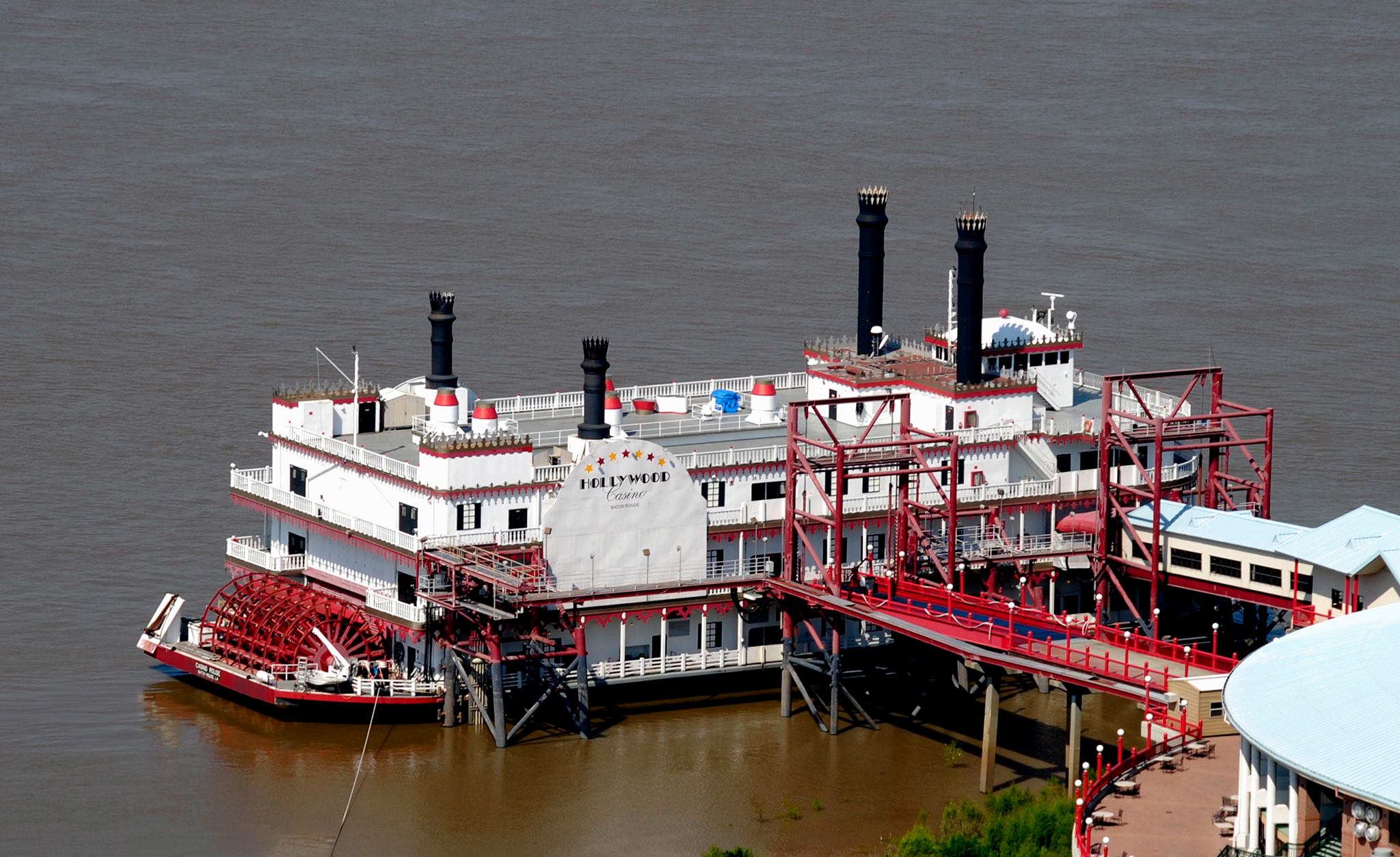
Boy, has the novelty worn off Horseshoe Lake Charles. It collapsed 44% to $5.5 million. And a sinking tide lowered all boats as Golden Nugget fell 11% to $23 million, L’Auberge du Lac plummeted 27% to $20.5 million and Delta Downs was down 13.5% to $11 million. The Baton Rouge market saw new Queen Baton Rouge (below) soar 63% to $6 million, contrasted with decrepit Belle of Baton Rouge sinking 39% to 600 dimes, and L’Auberge Baton Rouge slipping 10% to $13.5 million and suddenly looking mortal. New Orleans was comparatively stable, as Harrah’s New Orleans made $19 million (-7%), Boomtown New Orleans did $9.5 million (-3%), Treasure Chest banked $6.5 million (-7%) and Fair Grounds cantered to $3 million (-4%).

Boyd Gaming‘s outlying properties held their ground well: Amelia Belle made $2.5 million (-1%) and Evangeline Downs scored $5.5 million (-2.5%). Both of the market leaders suffered badly in Shreveport/Bossier City. While Margaritaville toppled 24% ($13 million), Horseshoe Bossier fell 25% ($9 million). Bally’s Shreveport ($6.5 million, -31%) also took it in the neck, as did Boomtown Bossier ($3 million, -19%). Sam’s Town was down 8% to $2.5 million. Guess the low rollers wanted to smoke.
The other Kelce brother, the beloved Jason Kelce, made Las Vegas-related news this week. Appearing on New Heights Podcast, Kelce was dogged by a persistent cough. The cause? Secondhand smoke. “Vegas man. I’ve been surrounded by cigarette smoke and yelling,” he explained. “I’m not smoking nothing but all these casinos, turns out you gotta let smoking by.” Put that in your pipe, casino apologists.