

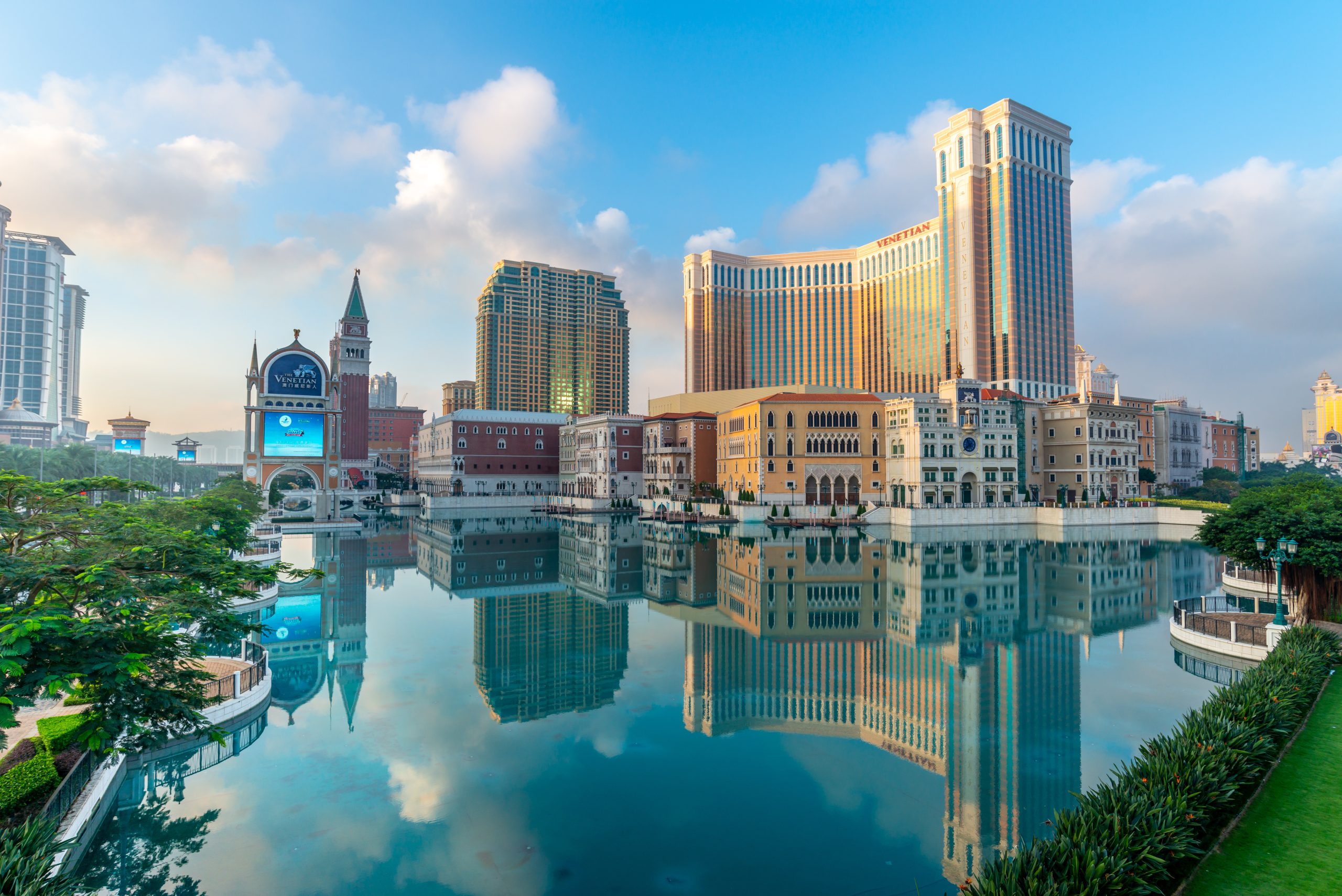
Fourth-quarter results from the far-flung empire of Las Vegas Sands were lauded by J.P. Morgan analyst Joseph Greff as “solid.” He wrote that they “should be viewed favorably in relation to recently subdued investors’ expectations and China-macro-concern-driven awful investor sentiment.” Looking ahead to this year and the next, he projected continued mass-market-propelled growth for Sands in both Macao and especially Singapore (which is really driving the bus right now), where Sands enjoys a duopoly.
Greff saw no correlation between China’s macroeconomic woes and Sands’ Macanese performance, which “is acting like other gaming/travel markets coming out of the COVID-19 recovery.” Hinting at another stock buyback, he noted Sands’ “relatively cheap valuation.” (The stock trades just below $50/share.) If Marina Bay Sands was in line with Wall Street cash-flow expectations ($473 million last quarter), the company’s bevy of Macanese casinos overperformed, coming out comfortably ahead of Wall Street’s $690 million high end. Although visitation to Macao still badly lags 2019, table game play and win are almost at those dizzying levels again. Singaporean win is way ahead (as in 133%) of where it was in late 2019, which helped moved Greff’s price target from $56/share to $59.

Even more enthusiastic, Deutsche Bank analyst Carlo Santarelli put a “Buy” on LVS, with a price target of $66/share. He noted that mass-market win was less driven by promotions now and that there has already been an “expected,” $505 million share repurchase. Like Greff, he observed that investors take such a dim view of China right now that the downside to buying LVS is limited. Sands came out slightly ahead of his projection for Singaporean net revenue ($970 million) and way ahead in Macao ($1.9 billion), although the sheer volume of productivity from Marina Bay Sands has to be a source of admiration.
If you think Las Vegas hotel rates are dizzying, a night at Marina Bay Sands will set you back at least $647. That didn’t hurt the $117 million in hotel-derived revenue (with more rooms on the way) coming off the Johore Strait. The company has earmarked $600 million or more to expand its Singapore hotel inventory, add an arena and more convention space. As for Macao, while $225 million has been allocated for refreshing the product, that’s chicken feed to the $4.5 billion Sands will spend placating Peking with new, tourist-friendly, non-gambling attractions. Nobody said the price of another 10 years in China was going to be cheap.

Casino customers continue to ignore the recessionary moans and groans of Wall Street. Look at Ohio, where December’s $212 million gross marked a 10% increase from last year—and leapt 25% over 2019. All these gambling dollars are coming from somewhere, and the old excuses of stimulus money and “pent-up demand” just don’t cut it anymore. MGM Northfield Park led the pack with $27 million, up 12%, followed mostly closely by Jack Cleveland ($24.5 million, +4%). An 11.5% surge wasn’t enough to get Hollywood Columbus closer than $24 million and a tight third place. Hard Rock Cincinnati jumped 11% to $22.5 million and Hollywood Toledo accelerated 13% to $20.5 million. The non-MGM racinos were led by Miami Valley Gaming, leaping 14.5% to an impressive $22 million. Scioto Downs was flat at $19.5 million, which is as close as anybody came to being revenue-negative. Jack Thistledown grossed $16.5 million (+13%) and Belterra Park vaulted 18% to $7.5 million. Penn Entertainment‘s two outlying racinos performed well: Hollywood Dayton up 17% ($14 million) and Hollywood Mahoning Valley up 3.5% ($13.5 million). Everyone had reason to be happy, for a change.
High hold helped online sports betting operators net $84 million off $810 million in handle. However, 33% went right back out in promotions and discounts, more than that in the case of ESPN Bet. The latter had $8 million in revenue to show for it. Top honors went to FanDuel ($37.5 million), pursued by DraftKings ($25.5 million), Bet365 ($4.5 million), BetMGM ($3.5 million) and Caesars Sportsbook ($2 million). Whatever one thinks of the Penn/ESPN alliance, it’s well outperforming the former’s ill-fated marriage to toxic Barstool Sports.

Meanwhile on the Boardwalk … Things are evidently bad for valet-parking attendants. Their issues with management, whatever they may be, have driven them into the arms of the United Auto Workers. Since the UAW gets results for casino workers, whether in Atlantic City or Detroit, it was a sound decision. In other random news, our East Coast correspondent reports …
“Stockton University‘s Maple Syrup Project is funded by two federal Department of Agriculture grants totaling more than $900,000. So far this year they gathered 730 gallons of sap, which yieldedseven to 10 gallons of maple syrup. Wow, what a bargain! Last year their harvest was a total of 22 gallons of syrup. Time will tell if they can match last year.” That’s some pricey syrup.
“Last spring, before the local state primary elections, the people running for state office promised a ‘property tax relief program, which would not be done until this year. On Tuesday January 23, after all the politicians were sworn in, an announcement was made that there will be a New Jersey state income ‘shortfall’ this year that would ‘pause’ the plan before it sends out a single payment.” Small wonder that New Jersey ranks 49th out of 50 in terms of the best states to retire, although our man thinks it should be at least one notch lower.
Yesterday, Hard Rock Atlantic City was slated to host Mayor Marty Small (D) for his ‘state of the city’ speech. Hizzoner probably wouldn’t be discussing any of the following: “As 2023 came to a close, the mayor was facing criticism over the city’s delay in using a $3.7 million federal grant to increase police numbers, its lack of action to help Atlantic City Housing Authority residents get basic services like heat and hot water, a county prosecutor’s investigation into hiring practices in the city’s anti-violence and reentry services programs, and a lawsuit by casinos and the local hospital system over the ‘road diet’ that is slimming Atlantic Avenue down to two vehicle lanes from four. On top of that, a proposed $3.2 billion development for the city’s Bader Field has not moved forward, in spite of a memorandum of agreement being signed last March.”
Finally, November was a cold month for sports betting in Arizona, where revenues fell 25%. Books netted $41 million on $712 million in handle (+16%), as bettors made out like bandits, more power to them. Hold was a dismal 6%. To add insult to injury, fully half to revenue realized was returned to players as well, in the form of promo outlays. Much of that came from ESPN Bet, which forked over 45% of its revenue. DraftKings bested FanDuel, $17 million to $14 million, BetMGM edged ESPN Bet ($5 million vs. $4 million) and Caesars Sportsbook stayed relevant with $1 million. Barely registering a pulse was BetRivers, along with everyone else operating in the state.