

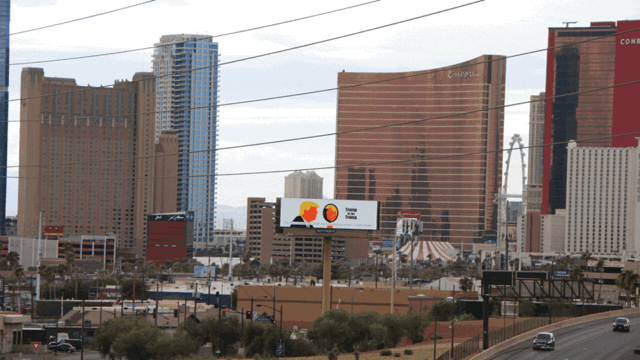
Yes, the Las Vegas Strip is mildly swooning. It was down 2% last month, the third straight month of declivity. But before one ascribes to headline-writer hysteria, remember that this is a decline from the most dizzying heights Big Gaming has ever scaled. People may complain about price gouging, high table “minimums” and lousy odds in Las Vegas casinos, but that sure hasn’t stopped them from staying and playing, in droves. We’re not going to take a victory lap, like American Gaming Association CEO Bill Miller did at Global Gaming Expo, but neither are we pushing the panic button.
McKee’s First Law of economics is that what goes up must inevitably come down, and Sin City has been up for a very, very long time. Ever since Covid-19 restrictions were lifted, in fact. So a cooling-off of consumer spending is not exactly shocking or unexpected news. For the record, Strip casinos raked in $727.5 million, so we shan’t be needing any crying towels. It should be noted that the September calendar featured two fewer weekend days, dimming the outcome. But it also benefited from having end-of-August slot revenue rolled over (thanks to a bizarre Nevada Gaming Control Board accounting quirk) into it, so that’s pretty much a wash. Slots held at 9%, with coin-in up 2.5%, for an 11.5% increase in win ($427 million).
What really hurt was a dearth of whales, as baccarat wagering plummeted 22%. The house still got its clock cleaned, with win careening down 40% to $88.5 million. Other table games were flat at $212 million, as placid wagering counteracted steep hold (15.5%). Locals slot revenue was up 12.5% to $207 million on flat coin-in and loose, 6.5% hold, while tables did 26% better ($52.5%) on healthy wagering (+14%) and considerable hold (14.5%). Deutsche Bank analyst Carlo Santarelli did warn, however, “While the +7.0% result appears solid, recall, on their recent earnings call, [Boyd Gaming] management noted that it believes the LV locals same-store market [gross gaming revenue] is trending down low to mid single digits, which comports with our analysis.“

Downtown surged mightily, vaulting 33% to $91 million. The Boulder Strip also got healthy, jumping 19% to $80.5 million. Thanks in large part to Durango Resort, miscellaneous Clark County was up a hefty 16% to $156 million. North Las Vegas was flat at $23 million, clearly not hurting from the subtraction of gambling inventory, and the only unfortunate jurisdiction was Laughlin, falling 8% to $38 million.
The border towns of Mesquite ($14 million, +2%) and Wendover ($22.5 million, -1.5%) were performing contrarily, with Wendover confirming its reputation as an economic harbinger for Nevada at large. Reno had a reassuringly good month, up 8% to $98 million, whilst Sparks saw its novelty factor continue to fade 6% to $16 million. Lake Tahoe closed out the summer with an aberrant, 19% plunge, grossing $21.5 million.
Next week, if you’ve somehow managed to avoid noticing, is Election Day (Nov. 5). Several ballot measures on gambling will be up for grabs. Colorado is considering Proposition JJ, which would reallocate OSB revenues. We have no dog in that arcane fight. In Arkansas, the woes of Pope County continue, as Amendment 2 would strip it of a hotly disputed casino license. In case you’re wondering, we urge a “No” vote on that, the better to chap the ass of the holier-than-thou Powers That Be.

Virginia sees a plebiscite in Petersburg, where voters will weigh whether or not to approve a casino license that was twice rebuffed by Richmond (above). While we have a hard time envisioning a Cordish Gaming casino in low-profile, low-key, history-forward Petersburg, neither do we oppose one. So we guess that’s a tepid endorsement.
Missouri is the big enchilada, with obscene amounts of campaign spending to match, as it is weighing not only a casino in the Ozarks but also retail sports betting and OSB. This has been a long time coming. Thankfully, the sports-wager issue has finally been decoupled from the legalization of black market slots, the latter the darling of some ethically dubious legislators. Although the ballot language is rather sloppy and hazy, as we’ve covered previously, we see no good reason not to pull the lever in favor of Amendment 2. It’s opposed by an unholy coalition of prudes and slippery Caesars Entertainment, so there’s that bonus.
The Lake of the Ozarks casino is a more difficult proposition, aka Amendment 5. There’s not a great deal of money to made from casinos in outstate Missouri. Also the project is juiced into Bally’s Corp., which can’t afford to built casinos in Chicago and Pennsylvania (having ignominiously pulled out of the latter for financial reasons). But it can afford—to the tune of $10 million—to prop up a ballot proposition for a sweetheart deal in the Show-Me State. We’re really torn on this. On the one hand, our free-market sensibilities say let the chips fall where they may: Bally’s will probably fail and someone else will step into the breach. Then again, why approve such a suicide mission? We urge, not without qualms, a “No” vote.