

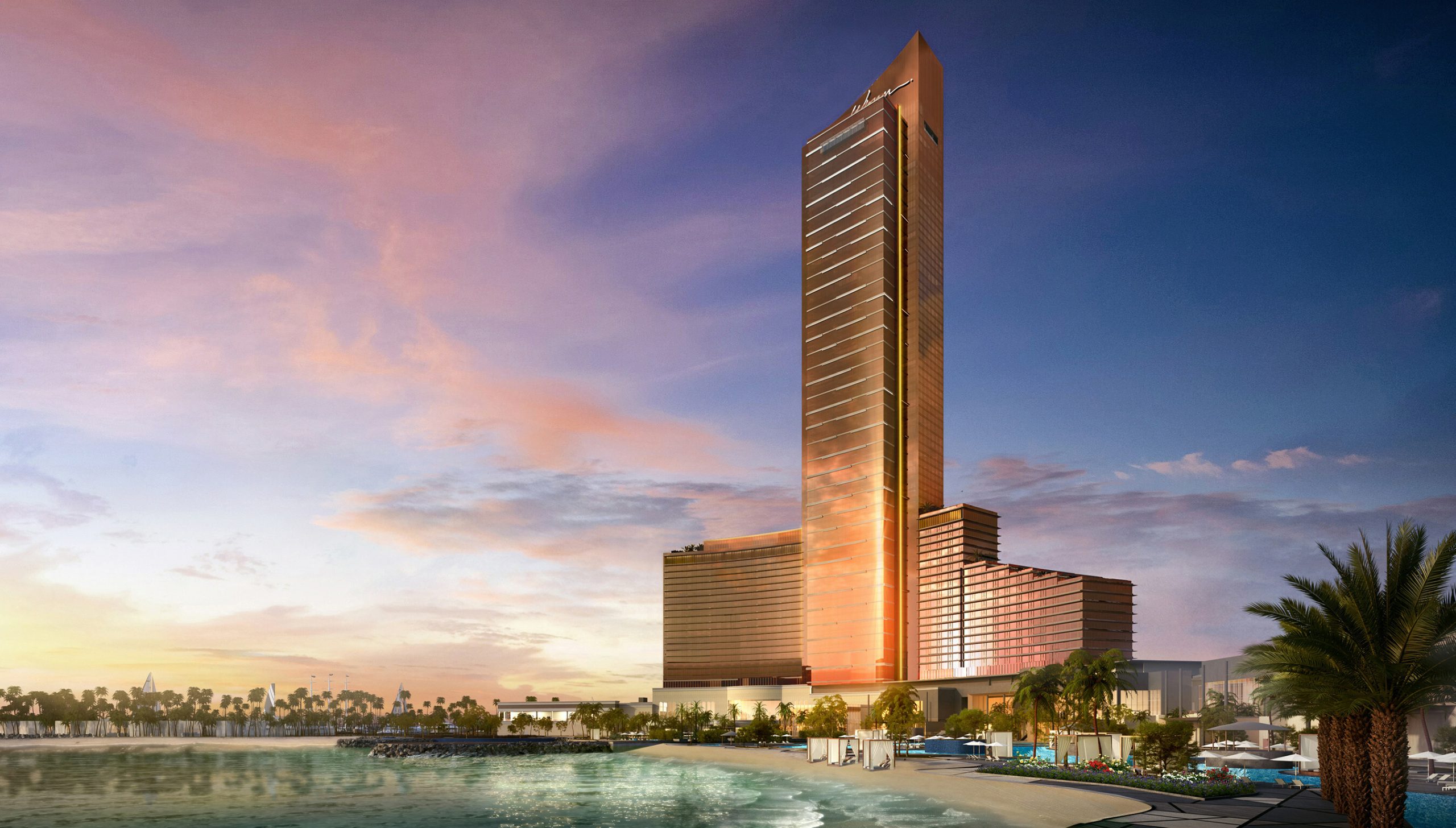
Thanks in part to a boost from the Las Vegas Grand Prix, high-end Wynn Resorts was able to “squash forecasts,” according to an impressed Carlo Santarelli of Deutsche Bank. His price target on WYNN stock leapt from $124/share to $132 on the strength of a 4Q23 that surpassed Wall Street‘s expectations. (J.P. Morgan analyst Joseph Greff added $5 to his $113/share price target.) Wynn Resorts brought in fourth-quarter cash flow of $632 million, $69 million more than Street analysts anticipated. Wynn’s Macao assets outperformed, with the older ones achieving 74% of pre-Covid cash-flow volume: “We believe this is likely to put to rest some of the structural concerns around the Peninsula in general.” The company’s Chinese flotilla also maintained its share (14.5%) of the mass market.
Wynncore cleaned up in 4Q23, with its beat driven by high hold, implying that it hosed the high-rollers who flocked in for Formula One Weekend. Wynncore beat estimates for 4Q23 cash flow by $44 million, compared to Wynn Macau (+$22 million), Encore Boston Harbor (+$4 million) and fugly Wynn Palace (-$9 million). Both Greff and Santarelli observed a pronounced disconnect between a mixed macroeconomic outlook for China and the Macanese revival. As Greff noted, Wynn stock is ailing from “apathetic investor sentiment driven by China macro concerns.” On the Las Vegas front, Greff said the Formula One impact was “obvious … but activity was pretty even throughout the quarter.” Interesting.
Looking ahead to 1Q24, management allowed that January was “effectively flat” but that the Super Bowl was supercharging business. Ditto Chinese New Year, “for which management noted they have 2x the front money relative to last year.” There won’t be a CONAG expo in Sin City until 2026, so that’s a negative going forward. Even so, “For the balance of the year, management noted that group pace is strong and current pace would represent a record year for the property on the group side.” Meanwhile, work continues apace on Wynn Al-Marjan Island. Foundations have been fully laid and management believes it will, at worst, have to share the market with one competitor. Even with a 2027 opening, Wynn should have the region to itself for two years, minimum.
Formula One is so very in the rearview mirror, as Wynn execs look forward to record-setting hotel-room price for the Super Bowl (we almost fell victim to Vegas obsequiousness and wrote “the Big Game”). Gambling volume is expected to suffer but the hotel take should make up for it, perhaps more. The company has retrenched to New York State, Michigan and Nevada for downsized Wynnbet, helping to hold the negative ROI on that to $2 million. And Fontainebleau‘s impact on Wynncore? None, said execs. Good news for Wynn, very bad news for F-blue.

Also posting a giant quarter was locals mammoth Station Casinos. It beat Wall Street projections both in terms of revenue ($463 million) and cash flow ($220 million), thanks in no small part to Durango Resort, which powered the quarter despite being open for only 27 days of it. So far Durango is generating an implied ROI of $200 million in Year One (which Greff acknowledges may be overoptimistic) for a potential return of an almost-unheard-of 25%. Even if that’s hyper-aggressive, Greff says, “nonetheless it’s pretty impressive and illustrative of a strong start.” Cash flow should stay steady through 2024, with $226 million expected in 1Q24 and $880 million by year’s end. Beyond that, we are told we’ll see “steady LV Locals market wide growth.”
Greff’s price target on RRR shot all the way up to $63/share from $53, and that’s without attaching any value to Station’s vast land bank. Acknowledging that Station is exposed to just one market, Greff added that it “is an attractive one, with continued population growth, an improving mix of higher income earners, and a development land bank with beltway access in high population growth and high-income communities with limited or no gaming competition.” And the Las Vegas Valley is growing at the rate of 4.5 people per hour. The development queue still looks like Inspirada next, then Skye Canyon and finally (?) Cactus Lane, with only the last of these matching Durango in cost (think $800 million). That’s assuming that there isn’t a building crunch and the Feritta Brothers don’t find themselves chasing costs, as happened with Red Rock Resort and Aliante Station.

Santarelli expanded on Greff’s observations, reporting that rated play at Station properties “remains strong” and that in “what we believe is a sign of strength and a resonating confidence in the opening and future performance of Durango,” Station announced the issuance of a special dividend, payable more or less immediately. Salaries were described as “appropriate” and promotional activity as “stable.” The sales of the Texas Station and Fiesta Rancho sites has closed, at about $800,000 an acre ($58 million for 73 acres), not too shabby for parcels that no longer have gaming entitlements. Another 48 acres are actively being shopped, worth as much as $1 million per acre.
“Notable tidbits” included the disclosure that Palace Station is expected to encounter rough sledding from one of its prime nemeses: road work. Wrote Santarelli, “it appears some of this impact has already been felt, given the project was underway in 2023, though the situation has gotten a bit more cumbersome in recent months.” Energy costs were up, adding $1 million to expenses (not bad when one considers the number of lights Station keeps burning). On the labor front, the Culinary Union is anticipated to have an indirect impact, as its new pact with non-Station casinos will exert upward pressure on Station’s wages, which are roughly equivalent to Downtown ones (i.e., 70% of Las Vegas Strip paychecks). The Sunset Station upgrade (below), meanwhile, will account for as much as $100 million of a capex budget that could stretch to $180 million.

At first blush, those casino revenues of $119 million in Illinois must have looked impressive, up 5% year/ year. Except that on a same-store basis they were a debacle: -14%. And down 3% from 2019. Four new casinos in 11 months will do that to a state. Some of us (ourself included) warned that this would happen but Illinois lawmakers, greedy for tax dollars, paid no heed. Thanks in part to going to ’round the clock service, Bally’s Casino in Chicago had its best month yet, making $9 million. The Temporary at American Place did a decent $7 million. Between cold weather and cannibalization, everyone else took it in the neck—even Rivers Des Plaines, which fell below $40 million a month for the first time in recent memory, plunging 15% to $39 million. Other Chicagoland victims included Grand Victoria ($10 million, -13%), Harrah’s Joliet ($9 million, -15%), Hollywood Aurora ($7 million, -13.5%) and Hollywood Joliet ($6.5 million, -14.5%). The state’s only gainer was Hard Rock Rockford, ($5.5 million, +12%).
If that was cold comfort, the results grew even more dire for downstate casinos. Harrah’s Metropolis plummeted 27% to $4 million, Bally’s Quad Cities fell 19% to $3.5 million and Par-A-Dice tumbled 20% to $4 million. Argosy Belle slipped 9% to $2.5 million while DraftKings Casino Queen ceded 5% to $6 million. Newbies Golden Nugget Danville and Walker’s Bluff Casino made $3 million and $2 million respectively.