

A well-financed player, “Hal,” hired me some time ago to teach him 9/6 Triple Double Bonus Poker. This is not a particularly good game (98.15%), but it was the best he could find for the large stakes he wished to play.
I warned him, of course, that the game would likely be very expensive. He didn’t care that much. The excitement of hitting large royals and aces with a kicker (AWAK) would counterbalance any losing sessions he had. Okay. It’s not the way I want to play, but I was happy to teach him.
Fairly recently, he texted me the following picture:
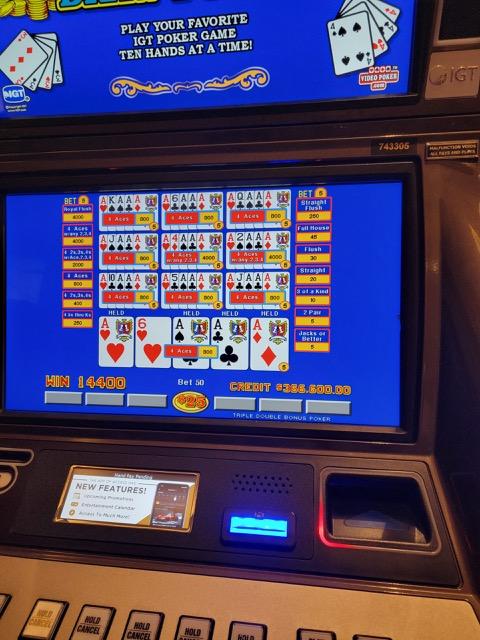
Hal had been dealt four aces without a kicker on $25 Ten Play. This was a hand he paid $1,250 to play. This was the kind of hand he’d been waiting for. (In his dreams, of course, he was dealt the kicker with the aces for a cool million bucks.) He held the aces, hit the button, and ended up with two AWAK ($100,000 each) and eight of the hands didn’t improve ($20,000 apiece.) It added up to $360,000. Sweet!
Hal wanted to know if getting two AWAK was what he was supposed to get on this draw. I was not near my computer at the time, so I told him that it was a fairly common result and I’d get him more details once I got home.
To analyze this, I used the binomial distribution formula built into Excel. This is a good exercise to demonstrate how to use this formula.
The letters in blue across the top and the numbers in blue down the left side of the chart below have been added by me. On my computer, the row and column numbers show up outside the chart itself — so they don’t transfer when I cut and paste. I labeled them so you know what I’m talking about.
Rows B and G are identical. They indicate the number of successes (i.e., AWAK) out of ten tries, starting from AAAA.
Row C is the probability for each of the tries. There are 47 unseen cards, and 12 of them are kickers (namely four 2s, four 3s, and four 4s). Twelve chances out of 47 comes out to 0.255319, which is the number you see on every line in column C.
There will be formulas listed below. These formulas do not end with a period or a comma, even though when you put them into a sentence it appears necessary to add these punctuation marks.
Column D represents the chance for that total number of hits for each of the 11 possibilities — namely 0, 1, 2, 3, 4, 5, 6, 7, 8, 9, or 10. You can’t get less than zero. And with ten chances, the most hits you can get is ten. The formula for space D7 is =BINOMDIST(B7,10,C7,FALSE)
This formula must be entered exactly, or at least equivalently. (For example, you could have used 0.255319 instead of C7.) The B7 refers to the probability of number of hits. The 10 refers to ten chances. The C7 refers to the probability of each hit, and FALSE is the code word indicating exactly that number of hits.
Once you’ve entered in the formula in space D7, you can copy that all the way down the page. Excel will fill in the correct formula on each line.
Column E represents the probability of getting that number of AWAK, or fewer. (That is, for E10, it’s the probability of getting 3 AWAK plus the probability of getting 2 AWAK plus the probability of getting 2 AWAK plus the probability of getting 0 AWAK. For E7, fill in the formula =BINOMDIST(B7,10,C7,TRUE) and then you can copy downward. Notice that E8 is always the sum of D7 and D8. E9 is always the sum of D7, D8, and D9. Etc.
Column F is merely the inverse of column D. To create this, on space F7, enter the formula =1/D7
Even though the probability of hitting a lot of AWAK is listed as 0.000 in D15, D16, and D17 on the chart, the computer internally keeps this number to quite a few decimal places.
| A | B | C | D | E | F | G |
| 2 | ||||||
| 3 | ||||||
| 4 | Number of | Chance for | Chance for | Cumulative | Inverse | Number of |
| 5 | Successes | 1 Hit | Total Hits | Chances | of Total Hits | Successes |
| 6 | ||||||
| 7 | 0 | 0.255319 | 0.052 | 0.052 | 19.07 | 0 |
| 8 | 1 | 0.255319 | 0.180 | 0.232 | 5.56 | 1 |
| 9 | 2 | 0.255319 | 0.277 | 0.510 | 3.60 | 2 |
| 10 | 3 | 0.255319 | 0.254 | 0.763 | 3.94 | 3 |
| 11 | 4 | 0.255319 | 0.152 | 0.916 | 6.57 | 4 |
| 12 | 5 | 0.255319 | 0.063 | 0.978 | 15.97 | 5 |
| 13 | 6 | 0.255319 | 0.018 | 0.996 | 55.90 | 6 |
| 14 | 7 | 0.255319 | 0.004 | 1.000 | 285.31 | 7 |
| 15 | 8 | 0.255319 | 0.000 | 1.000 | 2219.12 | 8 |
| 16 | 9 | 0.255319 | 0.000 | 1.000 | 29125.90 | 9 |
| 17 | 10 | 0.255319 | 0.000 | 1.000 | 849505.35 | 10 |
This chart is good for AWAK as well as 2s, 3s, or 4s with a kicker. It works just as well for Double Double Bonus as it does for Triple Double Bonus.
The chance of being dealt four aces without a kicker (rounded) is one in 72,200. There are three times as many chances of getting 2s, 3s, or 4s without a kicker, namely about one in 24,065.
When Hal looked at a version of this chart, he responded: “It looks like I’m supposed to get two or three hits when I try ten times.”
My response was that there is no “supposed to.” Ending up with two or three kickers are the most likely outcomes, but each of the 11 possibilities between 0 and 10 inclusive are possible.
If you want to label zero hits as “unlucky” and five hits as “very lucky,” go ahead. There is no precise definition of what luck is, but most people would agree with those labels in these cases
I have never drawn a royal from 4 to a royal. It’s always been 3 or fewer. So I was playing 100 play and draw 4 to a royal. I figure this is my time to break the streak. I didn’t draw any royals I immediately didn’t think it was possible but when I did the math, I found there is around an 11% of not drawing any royals from 4 to a royal on 100 play.
I have gotten many royals in my time–single line, multi-line, dealt, drawing to one, two, three, or four to the royal, all games, quarters and dollars. What I have never gotten is a royal on the re-draw, or what I refer to as “the throw away” of all five cards. Never one time. I suppose I’ve been dealt many fewer ‘trash hands’ than hands with at least one ace or face card to draw to, which would reduced the frequency of that possibility. I’ve just always wished to see that happen (a royal on the re-draw) at least once. Would be a fun shocker.
Is he up or down after taking $360k?
A number of years ago, I was playing a 10-line Ultimate X machine and was dealt a full house resulting in ten 12 times hands on the next draw. The familiar 12X bell rings as I hit deal and I’m dealt 4 to the royal with only the ten missing (I forgot what the off card was, but it was neither a ten, nor suited to the other four). Though only playing nickels, even a single royal at 12x is pretty sweet. Well what happened next absolutely stunned me. I closed my eyes, hit deal and listened for the sweet sound of hand pay music. Instead, all I heard was silence. I somehow did not manage to fill a single winning hand, let alone a royal. I took a picture because to this day, I never experienced anything even close to this level of unluckiness (if you measure luck somehow). I did some back of the envelope math and determined this to be the unluckiest pull one could probably ever have. Sure, there are hundred play machines. But I doubt you could ever pull a gutterball on it from a dealt 4 to a royal, regardless of what the missing card was. The fact I had 10 12x multipliers made the timing just insanely furiating. Not a pair, not a straight, not a flush, not a royal, while holding the 4 suited cards from Jack to Ace. I don’t remember what the final odds of this occurring were. But when you factor in the fact it was dealt after a full house. Well, I probably should find another hobby.
Anyone care to calculate what my odds were. I recall it being in the billions. Maybe one in 4 billion or so. Anyone want to check my math?
I’ve had at least one “Razgu” (I use this term when describing throw away hands which I believe was coined by Lenny Frome) royal on 5 play. Certainly startling when you have low expectations. I may have had others on 50 or 100 play but only one I can specifically recollect. Conversely I have had 6 dealt Royals.
Triple Double Bonus Poker is hard core gaming and designed for people with deep pockets. That’s my opinion. I remember the afternoon I went tilt while staying at the Suncoast. At that time they were offering this game with a nice pay structure, I think it was something like…7/9 version with 7 for a flush and 9 for full house. Please somebody correct me if that’s not the correct info that is in my mind . However, I tried to get back to even and blew 1000 or so in no time on a lousy quarter machine that just wouldn’t give me any high paying quads with kicker. I remember having held 3 aces with the kicker which is the same like holding 4 to the royal. Never got dealt the case card and left the machines in frustration. I think the correct play is even to discard Aces-full with low pair in order to try and hit the BIG 1. And of course I tried that a few times just to find out that I ended with a miserable three of a kind with only paid a fraction.
Today I am a little wiser to understand that high volatility games require big money and a lot of patience. And even if you do hit a 4-of-a-kind with kicker that pays you extra , then there’s no reason to become extatic because you will need that extra money on your road to fame and fortune :)))) That 4-of-a-kind , aces, with kicker, is something I never got on my screen. But I saw many pictures of evidence of other players that accomplished that.
From Switzerland
Boris
A couple of years ago I was playing Triple Double 100 play and I was dealt a full house with 3 aces and a pair of 2’s. I held the 3 aces and 1 deuce and hit draw. I ended up with 3AWAK’s. I was thinking at 100 play that was about average. 2 on a Ten Play is great!
Wandering through a casino’s high limit room I saw lights that were a blinking. One the screen were 3 royals on a $25 triple play, 9/6 TDB. How nice. Under closer observation, it was not a dealt royal, the player drew 1 to the royal and connected on all three. An 103823/1 shot. I’ve seen 2 out of 3. I’ve done that myself. But this is the only time I saw 3 for 3.
Zero hits is 5% and five hits is 98% according to the cdf. To me, it’d be disingenuous to call 1/50 “very lucky,” but plenty of people indeed associate 50/50 as a “sure thing” or 90% as it’s a guarantee, two ways to Sunday, definitely gonna happen, etc. The kind of thing you’d hear on a used car lot.