

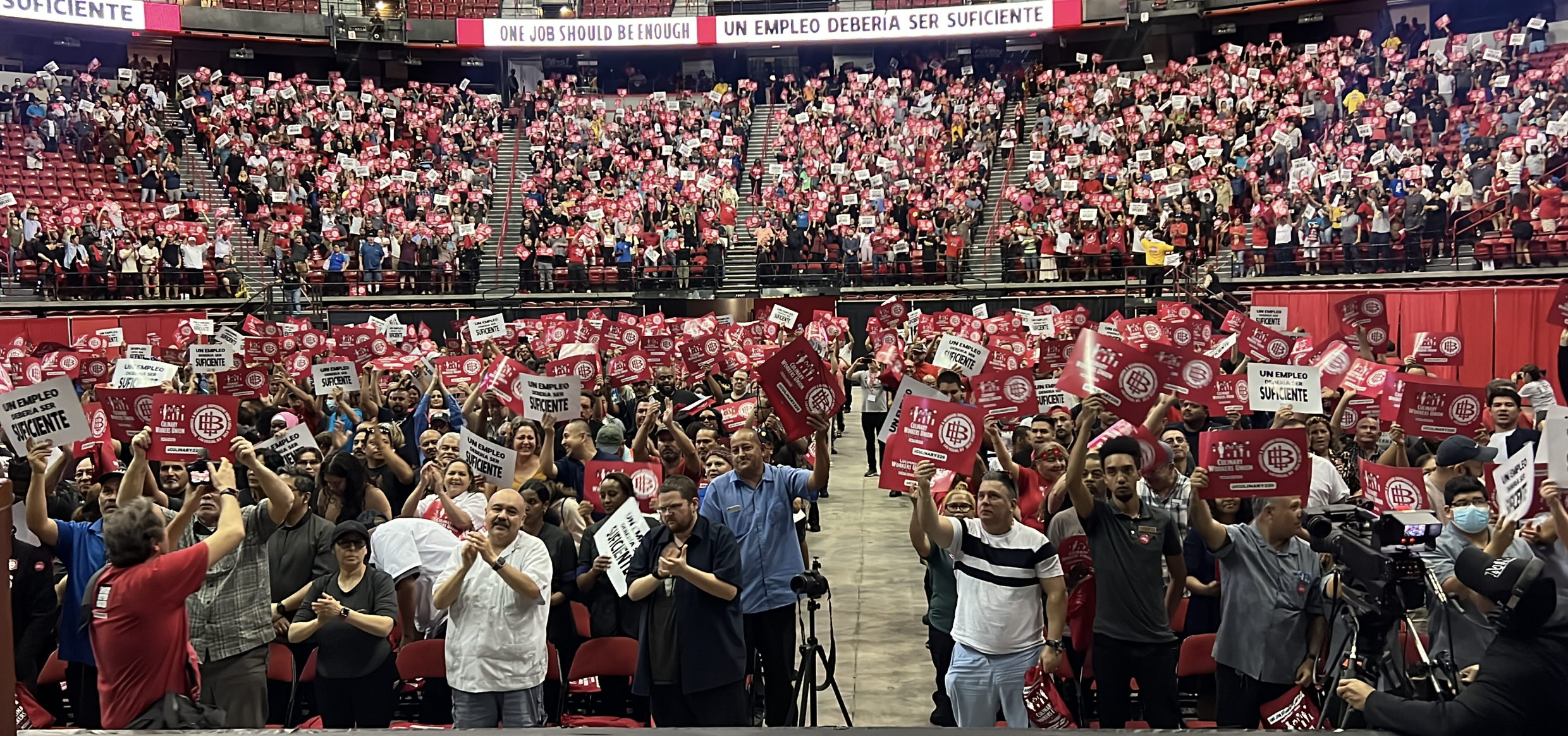
In the end, it wasn’t even close. 95% of Culinary Union members voted to authorize a strike (no date set) against 22 Las Vegas Strip casinos. Was a different outcome expected? Frankly, no. Mind you, casinos have no one but themselves to blame for the overwhelming plebiscite. Big Gaming used the Covid-19 pandemic as a catchall excuse to downsize service and employees, while simultaneously upsizing profits—which they weren’t shy about publicizing. To say that didn’t sit well with Culinary members would be an understatement. Add the casino industry’s complicity in the Las Vegas Grand Prix fiasco, which is making life miserable for the average Las Vegan, and you have all the makings of a “yes” vote on a potential labor action. That being said …
Nobody—probably not even the Culinary—seriously expects a picket line and shame on us if we’ve ever suggested otherwise. Indeed, the pro-strike vote is arguably being overplayed in the media. Talks between the Culinary and Caesars Entertainment, #1 employer MGM Resorts International and Wynn Resorts continue, albeit without much evident progress. During a field trip to Las Vegas, stock analyst Barry Jonas of Truist Securities did the unlikely (for Wall Street) and met with Culinary officialdom. His finding was that both sides were “highly motivated” to reach an accord before Formula One hit town, since “a strike would have sizably negative ramifications for both companies and tipped employees.” Casino bosses were sanguine about the prospects for an accord, which they think will be reached next month.
Culinary officials told Jonas that their sticking points extended well beyond wages, with replacement of workers by technologies (“which many consumers are more and more demanding”) and reduced workloads, which may prompt the removal of bathtubs from hotel rooms, as the key issues. Jonas thinks the casinos will have to staff up further if workloads go down—but don’t expect the Culinary to object to that.
We appear to have reached a tipping point in American labor history where ownership’s take-take-take attitude, especially as manifested in obscene executive salaries and stock packages (mostly at non-gaming companies) is no longer being abided by the workforce, hence the recent spate of strikes. “We are the glue that keeps these hotels together, and we should be paid what we deserve,” Deanna Virgil of Wynncore told the Los Angeles Times. “There’s no telling where I would be if I didn’t have the support of my daughter. There are a lot of us who have two jobs, but one job should be enough.” Yes, whatever happened to the ‘Las Vegas dream’? It seems to have become a Culinary member’s nightmare.

It’s no fun being Florida Gov. Ron DeSantis (R) these days. Not only is his presidential bid tanking, now his signature compact with the Seminole Tribe is under siege. West Flagler Associates, owners of Magic City Casino, are suing DeSantis and the State of Florida, arguing that by giving the Seminoles a statewide monopoly on sports betting they overrode the state constitution. West Flagler will find sympathetic ears among many in the Florida public, which has imposed a severe crimp on the Lege by requiring all expansions of gambling to be decided by popular vote. Needless to say, no one consulted the electorate about how sports betting would be implemented, if at all, in the Sunshine State.
“The Governor and Legislature have attempted to avoid the Florida Constitution’s mandate by having the 2021 Compact and the Implementing Law ‘deem’ online bets placed anywhere in the state to have occurred ‘exclusively’ on tribal lands where the bets are received—a transparent artifice,” write West Flagler’s legal beagles. Whatever the merits of the case, it’s a handy way of gumming up the works should a stay on Seminole sports betting not be placed at the federal level while SCOTUS decides whether or not to hear the case. Given its seismic ramifications for tribal gaming, the Supremes really ought to weigh in, regardless of their final ruling.

Remember those diversity programs of which MGM and others are so proud (and rightly)? Well, uptighty whitey Edward Blum has a problem with them. He’s the racist pest behind the recent Supreme Court case that saw race-conscious admissions policies at colleges and universities struck down. Gotta keep them darkies in their place on the plantation, you know. Now Blum is going after Section 1981 of the 1866 Civil Rights Act, which was intended to give Blacks and whites a level playing field when drawing up contracts. Blum is targeting Atlanta venture capital firm Fearless Fund for using race-based criteria in grantmaking, arguing that the Civil Rights Act cuts both ways.
“All of our nation’s civil rights laws—including the 1866 Civil Rights Act—enshrine the command that someone’s race and ethnicity must never be used to help or harm them in public and private employment and contracting,” railed Blum, whose pinched face matches his Victorian attitudes. Sarah Hinger of the ACLU was quick to fire back: “This is an effort to scare similar employers and investors away from what is in some ways a nascent effort to address inequities.” Blum’s beef with Fearless, ostensibly, is that by targeting investments to Black-owned businesses, it is discriminating against poor, downtrodden, white people.
Fearless’ attorneys respond by pointing out that it was hunky-dory with right-wingers like Blum when the Supreme Court ruled that it was OK for a Christian-oriented bakery to discriminate against gay people, taking us back several decades. Discrimination, they imply, is fine with Blum as long as it’s against the right kind of (minority) people. In case you think DEI programs aren’t in dangers, one of the objects of Blum’s wrath, craven law firm Morrison & Foerster has already scrapped its diversity initiative. If a building fell on Blum, it would do America a great service.
If gambling regulators want to send a message to scofflaws, they could take a page from their colleagues up in Michigan. Confronted with the problem of illegal slot machines, Wolverine State enforcers seized the offending devices and publicly smashed them to pieces. Or rather, crushed them like old cars (how appropriate for Michigan.) Problem solved, publicity gained. Black market slot operators and the companies who supply them might think twice if they saw their shiny objects ground up like so much scrap. It’s not a small problem but one totaling 580,651 devices nationwide, per the American Gaming Association. Or, as Michigan Gaming Control Board Executive Director Henry Williams put it, “Operators running illegal gaming establishments are not reporting earnings or paying taxes—they are essentially robbing Michigan citizens of taxes and revenue used to support our schools through the School Aid Fund and our communities and local governments with essential state funding dollars.”
Michigan’s renegade slot operators can’t say they weren’t warned. Over 1,100 slots have been seized in the last eight years and 48 cease-and-desist letters were dispatched this year alone. One ignores that MGCB at one’s own risk, it seems. Detractors will say that regulators are doing the bidding of the state’s many casinos … but the latter pay their taxes and submit their machines for licensing. Black market operators have no such defense.

Our man on the Boardwalk has a few new culinary experiences to share. One of them took place at Philadelphia Live, which was more like Philadelphia Dead when he visited. “They … advertised a promotion to win prizes but the 20 winners won mostly only $50 to $250 in free slot play, not the thousands advertised. We tried to go to their food court, so we would have more choices, but found out only the pizza place was open. The only moderate price choices were Luk Fu, which we had gone to twice in the last month or Sports & Social, so we tried Sports & Social. It was just ‘bar food’ barely edible.”

As for his usual haunt, Atlantic City, he found the food at Gordon Ramsay’s Hell’s Kitchen—price aside—to be as nice as the man himself. (No, really. The TV chef is by all accounts one of the sweetest people you’ll ever meet, when not onscreen.) “Without any liquor, the cost was ‘only’ $200.00 plus tip. It was a great food experience: a shared scallop appetizer. I had his signature Beef Wellington. My wife had ‘amb chops. The ‘mac and cheese’ side dish was too much for both of us to eat. We finished with his signature pudding and ice cream, which all of his restaurants seem to have.” Worth $200? That’s your call, not ours.