

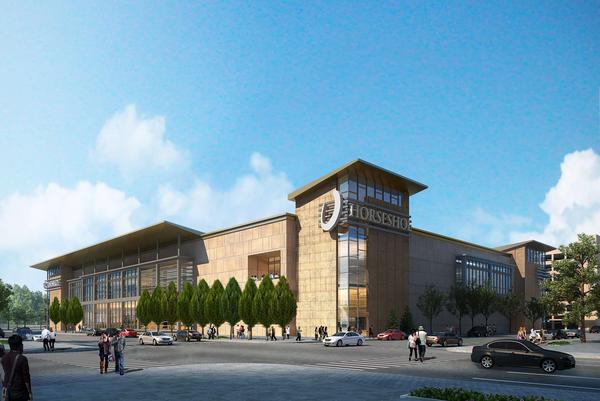
Casino receipts in the state of Maryland slipped somewhat last month, tallying $158 million. That’s 3.5% down from 2022, but 12% better than 2019. Poor table win (-9%) drove the bulk of the decline. The weakest performance was that of Horseshoe Baltimore, which plunged 10.5% to $14.5 million, its second-feeblest turnout in two years. No surprise, MGM National Harbor led all comers with $66.5 million, despite a 7% dropoff. The other revenue-losing casino was Rocky Gap Resort, down 6.5% to $4.5 million. Hollywood Perryville was flat at just under $7 million, while Ocean Downs gained 7% to reach $7 million and Maryland Live was up 1.5% to $57 million, a titanic number in almost any state that doesn’t have National Harbor in it.

You have to give Gov. Ron DeSantis (R) points for trying. Not unknown for advancing novel legal arguments, the DeSantis administration has made its long-awaited contribution to the Florida Supreme Court case involving the legality of sports betting in the Sunshine State. And what the state proposes to the courts has the advantage of being untried. DeSantis’ peeps are arguing that sports betting doesn’t need voter sanction because it is not “casino gambling.” That’s a good one. Every casino worth its salt has a sports book nowadays, as do the Web sites of almost all the major casino companies. But if DeSantis’ lawyers draw their argument narrowly enough, they might be able to thread the legal needle on this one.
More specifically—and the DeSantis is in the details—Attorney General Ashley Moody contends that because sports betting wasn’t listed as a casino game when Florida amended its constitution to give voters control over gambling expansions, it’s not gambling of the sort that has to go through the ballot box. Per Moody, “the types of games typically found in casinos was fixed at the time” and sports betting wasn’t included. But what about craps and roulette, which were impermissible until the most recent contract, the one which also legalized sports wagering? Moody risks being caught in a contradiction here and the Supremes could skewer it. It comes down to filleting the distinction between what is meant by “Sports betting is not a ‘type[] of game typically found in casinos,’” (Moody’s language) and what voters believed to be “game[s] typically found in casinos” five Novembers ago.
“The amendment is an enduring grant to the people themselves—and only them—to authorize new gambling in Florida,” responds a lawsuit filed by West Flagler Associates. “The constitutional provision should be interpreted for sports betting as it exists today.” So it comes down to how broadly or narrowly the Supremes construe the language of the amendment. Or, as Geena Davis says in Thelma & Louise, “The law is some tricky shit.” Covering their butts, DeSantis and Moody also threw in some eleventh-hour technicalities, including the assertion that the lawsuit in question should be tossed on account of having been filed late in the game—not unlike their response. They’re also trying to split the difference between the 2018’s amendments permission of gambling expansions on tribal lands … and the launch of statewide, online sports betting via the 2021 compact. That may be a contradiction out of which they’re hard-put to wriggle. We shall see.

The boss of MGM China, casino heiress Pansy Ho, is singing from the Red China hymnal of late, calling for a “complete” reinvention of Macao. Unlike Ms. Ho herself, Macao is not a leopard that can willy-nilly change its spots. Speaking Wednesday at the Brainstorm Design conference in the enclave, Ms. Ho stated, “Macao needs to take a completely new perspective.” That’s what the Peking government would like to see. However, Macao hasn’t worked so well as a command economy, so trying to turn it into a second Orlando just might be an expensive disappointment waiting to happen. It looks like the central government bent Stanley Ho‘s favorite daughter to its will during protracted and demanding renewal talks during the recent concession renegotiations: “I had to come and live here for six months in order to prepare … What the government has made us do is to practically write into the calendar on a monthly and even weekly basis, we’re going to have something to offer.”
As a gesture of obeisance, MGM China has commissioned a musical work from Commie-compliant composer Tan Dun. It also promised to redevelop 35,000 square meters near the waterfront, no small gesture. Still, Ms. Ho insists that gambling can “go up” in Macao, even as the city tries to remake its identity. Will family friendly Macao be more successful than family friend Las Vegas was? Place your bets.
“As a gesture of obeisance, MGM China has commissioned a musical work from Commie-compliant composer Tan Dun”
I don’t understand the need for this line at all. Tan Dun moved to America in 1986 and is currently the Dean of the Bard Conservatory of Music in New York. He is an incredibly accomplished composer writing operas, symphonic music, and some very famous film music in Hollywood, including the film score to “Crouching Tiger, Hidden Dragon,” for which he won a Grammy. Yet for some reason the writer felt the need to reduce him to “commie compliant.”
I’m going to assume it’s just an ignorant bad joke.
Horseshoe Baltimore has to be the worst casino in Maryland. 6-5 Blackjack is the norm. Video poker tables are horrible, even by Caesars standards. The only 000 roulette I’ve ever seen on the East Coast.
National Harbor isn’t much better. $75 minimums for pai gow and $100 minimums for baccarat. The parking garage is a nightmare. The only thing going for it is that it is the closest casino to the DC money.