

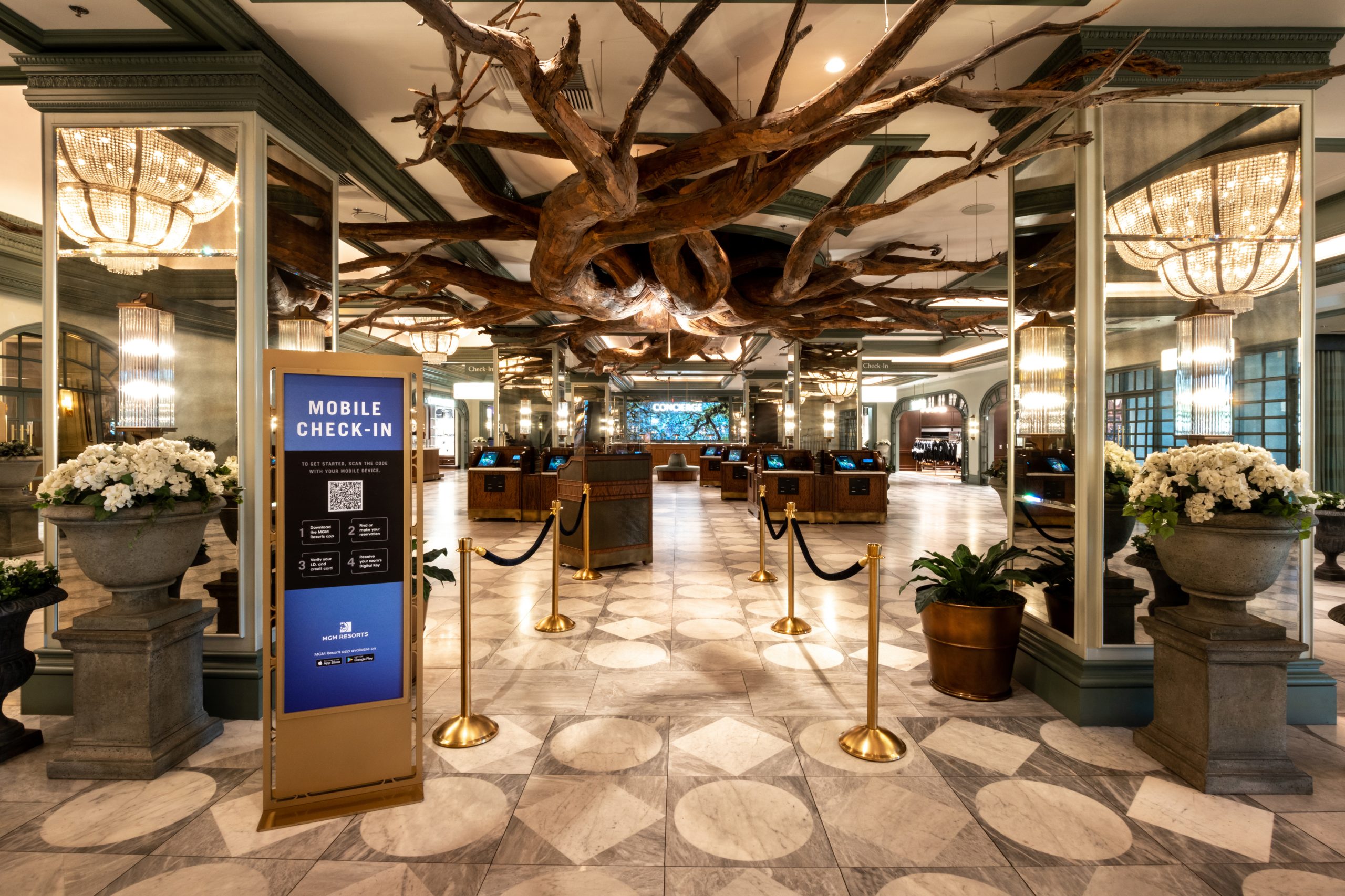
Perplexity was the mood of J.P. Morgan analyst Joseph Greff when confronted with MGM Resorts International‘s 4Q23 numbers, as “there were lots of moving parts.” Cash flow came in 1% higher than expected and Las Vegas Strip-derived cash flow of $864 million was way above Greff’s $794 million forecast. However, he discounted $50 million of that due to high hold percentages in table games (read: players were exceptionally unlucky). Macao generated cash flow of $262 million where Greff had expected $236 million. And regional cash flow—$233 million—well undershot Greff’s anticipated $264 million, J.P. Morgan having admittedly underestimated the hit MGM Grand Detroit would take from last autumn’s strike. Greff’s price target edged up two dollars to $54/share, a conservative move.
Mind you, Greff liked the “operating momentum and growth trajectory” of MGM in its two primary markets. “Moreover, we believe MGM has an underappreciated development pipeline (NY, Japan, UAE, Brazil) that is not priced in at current share price levels.” Given what CEO Bill Hornbuckle said during the earnings call, Greff didn’t expect any online M&A activity, least of all a takeover of BetMGM from Entain.
Strip casinos brought in $2.4 billion and if margins were a bit tighter, well, that could be ascribed to higher labor costs. Remember, a new collective bargaining agreement kicked in mid-quarter. Allowing for the sale of The Mirage, revenue on the boulevard was up 10%, as player losses were quadruple the increase (12%) in wagering. Formula One Weekend gamblers may have played large but evidently they didn’t play smart. Hotel revenues rose 14% in Las Vegas, on 12% greater ADRs and 91% occupancy. MGM execs apparently didn’t say much about Formula One but they sure talked up the Super Bowl, saying it brought in “ADRs near $1,000 and three of the top five room revenue days ever recorded.” Draw your own conclusions.

Regional casino revenues were down 9%, thanks in large part to dramatically less table wagering (-20%). “Recall that MGM Detroit was impacted by a union strike during the quarter, while MGM’s National Harbor property faced a difficult comparison year-over-year from higher end play,” Greff wrote. There was also some overhang from the 3Q23 cyber attack, leading to an unavailability of promotional data for Oct. 1-15. Macanese casinos outperformed, bringing in $983 million, as casino revenue hit 142% of levels right before the Great Pandemic. 200 extra tables helped drive MGM to over 16% of market share, an outsize portion, although management itself doesn’t think that will last.
Groundbreaking for MGM Osaka is still distant: 2025. In the meanwhile, MGM is dancing attendance on Abu Dhabi and New York State. Regarding the latter, Scott Sibella‘s recent guilty plea and MGM’s corresponding $7.5 million fine have to have put a serious damper on Empire State aspirations, although that’s not the sort of topic that is addressed in earnings calls (“Great quarter, guys,” is what passes for Wall Street scrutiny).

Deutsche Bank‘s Carlo Santarelli was less foxed than Greff, writing that despite “elevated expectations … MGM managed to deliver results that were better than our forecasts in both LV and Macau, though potentially below the more bullish buyside estimates.” Regionally, the resulta were, it had to be admitted, “a challenge,” although the Detroit strike took the blame. Even so, Santarelli’s price target leapt from $45.66/share to $53. Like Greff, he pooh-poohed the 4Q23 high-end action, saying it wouldn’t necessarily recur … and neither will F1. His estimates for the distortion caused by high hold were much more sky-scraping even than Greff’s (think $140 million in revenue). “Thus, for the 4Q23, we believe the impact of F-1 broadly offset the impact from the union wage increases, from a Y/Y comparison perspective.” So much for the biggest weekend in gambling history, the tide that was going to lift all boats.
Most exuberant of our analyst trio was Barry Jonas of Truist Securities, whose price target went from $45.66/share all the way up to $58. “Backing out the strikes in Detroit and a VIP staying home in Maryland, EBITDA was actually +3% ahead,” he wrote, cutting to the chase. His expectations for 1Q24 are broadly similar. Corporate leadership expects Vegas business to grow this year, buttressed by “resilience” in the provinces. Any adverse reaction to the announcements, Jonas opined, was tempered by positive vibes on the market for both the Super Bowl and a recent MGM stock buyback.
The Truist analyst factored in a $50 million cash flow bump from the Las Vegas Grand Prix, “MGM’s highest hotel revenue generating event in history,” with the success concentrated at the top of the Strip food chain. Despite some whining by unnamed casino execs that the Super Bowl was bad for business and shouldn’t return, Jonas predicted “near-record event gaming volumes. The Super Bowl should drive both hotel and gaming strength across the Strip, as opposed to F1’s more higher-end-only benefit.” Hornbuckle & Co. hedged on how the sports books fared, saying they’d do very well on prop bets, but not on the outcome of the game itself, bettors having wisely picked the Kansas City Chiefs to cover the spread. (The “Big Game” [blech!] also brought the 10% visitation lift that Jim Murren once vainly predicted would come with CityCenter‘s opening.) No word yet on the successfulness of the new Marriott International joint venture, which only kicked off last month.

As indicated above, the chink in MGM’s armor was MGM Grand Detroit. Its workers held out the longest and it registered the biggest declivity in January revenues, too. Winter weather in Detroit is harsh indeed and it contributed to an 11% dropoff in MGM grosses, to $44.5 million. The sturdiest performer was Hollywood Greektown, only 3% off for $22 million. MotorCity absorbed an MGM-sized hit (-10.5%) for a gross of $27 million.
Casinos also took a bad turn last month in Missouri, where the chill of winter was felt in a 12% depression of gambling revenues … which were still 7% better than in 2019. The $135.5 million gross was propped up by 4% more spend per visitor, even as actual visitation plunged 15%. As usual, Ameristar St. Charles led the state, even though its $21.5 million was emaciated by 11.5%. Hollywood St. Louis slipped 5% to $18 million, River City fell $13 to $18 million and Horseshoe St. Louis slipped 9% to $11 million. Bally’s Kansas City‘s recent string of gains came to a screeching halt with a $9.5 million gross and 13% plunge. Top honors in that market again went to Ameristar ($14 million, -10%), trailed by Argosy Riverside ($12.5 million, -14.5%) and Harrah’s North Kansas City ($11 million, -20%). Outstate, Century Casinos ran into adversity, down 10% in Cape Girardeau ($5 million) and 7% in Caruthersville ($3.5 million).
High hold helped propel sports betting revenues in December in Illinois. They came in at $128.5 million, up 56% from 2022. Parlay bets continue to burgeon, representing 40% of handle but 68% of total operator win, up from 57% in November. FanDuel was tops with $52 million although DraftKings closed the gap to $44 million. Some of the novelty sheen went off ESPN Bet, down to a 7% market share ($8.5 million) after debuting with $11 million. Other operators of consequence were BetRivers ($9 million), Fanatics ($5 million), Caesars Sportsbook ($5 million) and BetMGM ($4 million).
Then there were two. Markets in which failing WynnBet maintains a tenuous foothold, that is. The company is exiting New York State, having sold its licenses there to Penn Entertainment, which can now deploy ESPN Bet in the Empire State. The deal still needs regulatory blessing, which shouldn’t be a problem now the Penn is shot of scummy Barstool Sports. Penn spent a relative pittance ($25 million) for belated market entrance and shouldn’t have too much difficulty, even as a late starter, in recouping that thanks to the ESPN affiliation. Penn has been ambivalent about going for a Nevada sports betting alliance but, with WynnBet on the block, that probably won’t be the case for much longer.
A stopped watch is right twice at day and Nevada Gaming Control Board Chairman Kirk Hendrick at least once. Such was the case when he told the Nevada state Senate Finance Committee, “You have to get off of a 40-year-old computer system or bad things could happen. The system is used for running all the board functions. Every single division uses pieces of this system. It’s way past its retirement age.” (The latter could be said for certain NGCB members, too.) The sounds like casino regulation in the Silver State: superannuated, obsolete and begging for funds. Given Gov. Joe Lombardo‘s zeal to deregulate gambling, it’s surprising that he let Hendrick so far off his leash. What better way to suffocate Nevada casino regulation than to keep the Control Board on its 1980-vintage infrastructure?