

While most companies who were presenting at the J.P. Morgan Gaming, Lodging, Restaurant & Leisure Management Access Forum sent their CEOs and CFOs, Las Vegas Sands couldn’t be bothered. It kicked the matter downstairs to Senior Vice President of Investor Relations Daniel Briggs. We can only presume that Rob Goldstein had a pressing tee time. After all, Sands had almost nothing but good news to present to Wall Street analysts. Leaving aside Goldstein’s discourtesy, you may be wondering if and when Sands is returning to the U.S. The answer would appear to be …
… not anytime soon. Briggs played it cool on New York City, one of the places where Sands “weigh the cost of entry, tax rate, and presence of online channels in assessing their next projects to deploy capital, particularly in NY where it remains well-positioned for a license,” according to J.P. Morgan stock boffin Joseph Greff. Should Sands get the nod in Nassau County, construction would begin yesterday, happy to report. Sands will also be able to keep its leverage down to 2X or 3X cash flow, thanks to $5 billion in annual EBITDA flowing through from overseas. So far, so good.
As for Texas, Sands seems to be waking up and smelling the coffee. Attendees were told there is “a long road ahead” to casino legalization, which may be as far away as 2030. (Their opinion, not ours.) Public support appears to be solid—especially in Dallas—but ancient Lt. Gov. Dan Patrick (R), who sets the legislative calendar, remains intent on smothering gambling expansion in the cradle. As long as the intellectually fossilized Patrick (below) is in office, it would be wise to bet against casinos in the Lone Star State. The only qualm we had about Sands’ strategy is that its Austin outpost is mostly staffed with people who were “involved in passing of legalized gaming in Pennsylvania.” Texas and Pennsylvania are as different as night and day, and we hope Sands gets wise to that.

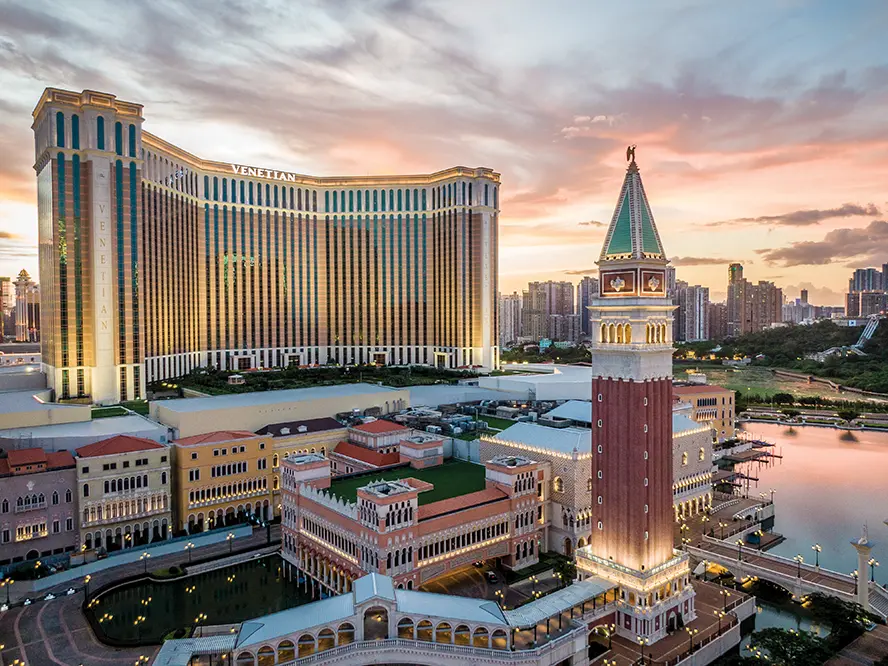
In Macao, Sands believes the market (with 1.5 billion customers on tap) is actually “undersupplied” in both table games (6,000 of them) and hotel rooms (40,000 tops) compared to Las Vegas, where the industry has 150,000 rooms to deploy. Sands may well be right although that argument is liable to get a frosty response from Peking. By converting The Londoner into a themed resort, management expects to double its cash flow from $750 million/year to $1.7 billion. More high-end suites and convention space are planned for Venetian Macao, and Chinese New Year traffic was described as “strong.” Greff saw Macao’s mass-market recovery as being in “the final stages,” which doesn’t bode well for the immediate future, as that’s where the post-pandemic softness is already to be found. (Tour-group visitation still hasn’t recovered, for one.) OK, we’re beginning to see why Goldstein may have chosen to absent himself.
As for Sands’ wheelhouse, better known as Singapore, management is in the process of doubling Marina Bay Sands‘ suite capacity to 700. Greff wrote that this “should continue to drive mass win per day higher as LVS yields on greater scale.” The company is happy with its after-Covid trajectory in Singapore, where cash flow is now higher than it was in 2019, despite emaciated Chinese tourism. The local population and non-Chinese visitors have more than made up for any shortfall. “Encouragingly, China recently dropped the visa requirement to travel to Singapore, and subsequently China visitation recovered to ~90% of 2019 levels in February,” wrote Greff. Indeed, that should augur little other than optimism for Sands. Texas can wait … and clearly will.

As though anybody cared, former renegade casino boss and all-around wastrel James Packer has let it be known that he’s taking his ball and going home. Which is to say he won’t get involved with casinos or China again, he says. That will be sad news to every half-assed casino project in the U.S. that could count on Packer to be a reliable pigeon, a fool and whose money were often quickly parted. Remember Alon? How about Crown Las Vegas? No? We barely could either. But they were among the many failsinos underwritten by the inept Packer, who took his father’s gaming empire and ran it into the ground (along with his engagement to Mariah Carey). Instead Packer, who tried to help erect several U.S. casinos, says he is relieved to no longer have to bear a gambling mogul’s “obligations to build things.” Instead, he wants to go into unregulated industries. In light of Crown Resorts‘ unlawful conduct on Packer’s errant watch (two words: money laundering), it’s no surprise Packer would want to go someplace where he could evade scrutiny.

Casino revenues were down a bit in Atlantic City, off 2% but 8% higher than they were in February 2019: $211.5 million. Cue predictable wire-service stories in which executives whinge that gamblers aren’t showing up as much as they’re supposed to. Hey, it’s called a business. The consumer owes you nothing. No matter how much casino bosses try to minimize Internet-derived largesse ($250 million even, last month) they’re getting as much as half of it. But it’s an unfortunate trope of Big Gaming’s to regard the dollar not made as being as real—if not more so—than the $5 actually captured from John Q. Customer.
The three Caesars Entertainment properties continue to slide toward grind-joint territory. Caesars Atlantic City plunged 14% to $16.5 million, Harrah’s Resort slumped 15% to $18 million and Tropicana Atlantic City ceded 3% to $17 million. Is it even arguable that Caesars is spread too thin on the Boardwalk? As for the actual grind joints, Bally’s Atlantic City took a vise-like grip on last place: $11 million and -13%. Golden Nugget actually improved 4% to $11.5 million and Resorts Atlantic City slipped 3.5% to $12.5 million. Despite a 7% dip, Borgata remained atop the leader board with $53.5 million, followed by Hard Rock Atlantic City ($41 million, +9.5%) and Ocean Casino Resort, which vaulted 18% to $31 million.
Internet casinos brought in nearly as much moolah as tangible ones: $182 million, a 28% increase. Sports betting engendered $67.5 million off of handle of $1.1 billion. The biggest beneficiary was FanDuel ($33.5 million), while BallyBet and ESPN Bet both finished in the red. Bally’s Corp. execs are continually telling Wall Street what a killing they’re making in New Jersey … perhaps in hopes of convincing themselves.

Before leaving Atlantic City, we should note that our Boardwalk correspondent had a very bad customer (dis)service at Ocean Casino Resort. Things started well enough with a bedroom-sheet giveaway on Friday: “To get a gift, you must swipe your player card at a kiosk and print out a gift slip. Then you go to the gift center and get your gift. This time, the employees would have to ‘update’ your player card. The line only took a half hour or so and they put a sticker on your card to show it had been ‘updated.’
“Saturday was the Ocean fiasco. The gift was from 2 p.m. to 8 p.m. It was a robotic vacuum cleaner. The photo shows only one of the six very long lines to the kiosk machines. After 20 minutes, people were walking around and telling others [vacuum cleaners] were ‘out of stock’ and were giving everyone $75 free slot play. The problem was, you had to swipe your card [at the kiosk] to get the free play. Then, all of the kiosks crashed and went out of service together. Just stay in line and wait some more.
“There seemed to be a few hundred unhappy people. (Does Ocean management care?) Ocean Casino was ‘Borgata busy’ because of the pricey ‘gift’ promised. Next month, Ocean is going to change its player-card system, so your earned credits will expire sooner than before (use them or lose them). They have most of one week blanked out on their schedule for the changes to be made. Other than those problems, Ocean is almost a good time.”
Congratulations for not mentioning Trump this time.