

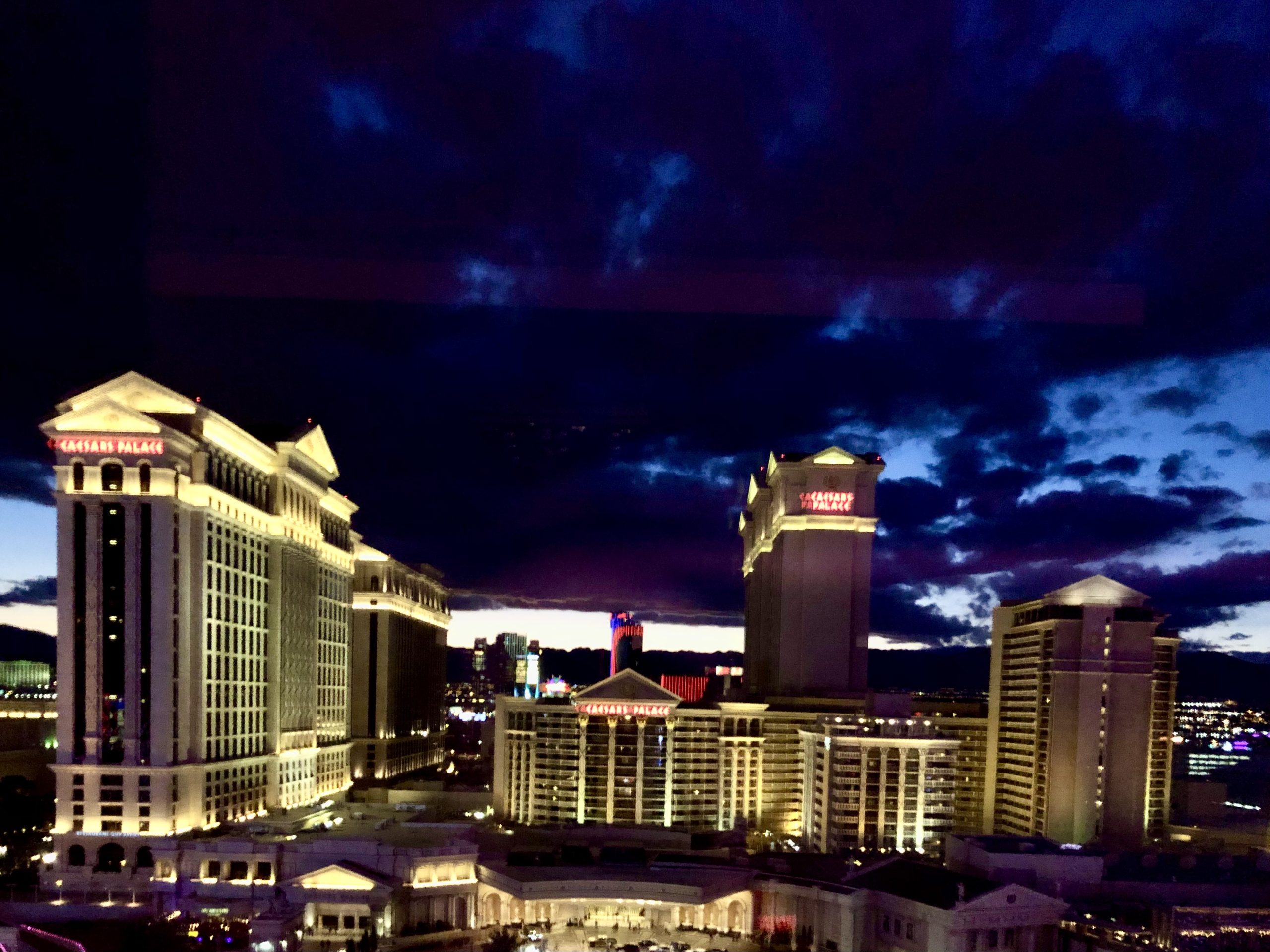
As CEO Tom Reeg said, just about everything that could go wrong for Caesars Entertainment in the first quarter did manage to go wrong. Deutsche Bank analyst Carlo Santarelli headlined his report “Low expectations missed.” While he remained “Buy” rated, Santarelli did so on the basis of Caesars’ long-term potential rather than on what was in the 1Q24 print.
Caesars’ numbers, Santarelli wrote, “were expected to be challenged, and they were just that, challenged … The print, while surely saddled by lower hold in Vegas and tougher weather compares in January in the regional markets, likely provided little in the way of confidence,” although took heart in managerial assurances of better regional results to come and stronger Las Vegas Strip numbers the rest of the way. He even raised his price target to $59 per share from $58. That’s confidence.
David Katz of Jefferies took a similar tack, writing that the 1Q24 was “not a good look … but the pieces are in place.” He primarily blamed exceptionally low table game hold in Las Vegas (15% rather than the usual 20% or even 23%. Secondary blame fell upon foul January weather and the cost of the OSB launch in North Carolina. There was even loose talk of asset sales. Katz had expected revenue of $2.9 billion and got $2.7 billion in change from CZR. Cash flow was $853 million, $90 million below Katz’s projection.

The wretched table hold negated record occupancies for Chinese New Year and the Super Bowl. The Super Bowl’s outcome, as well as that of March Madness, spelled misfortune for Caesars Sportsbook, which delivered only $282 million in revenue and a $5 million ROI. Regional gambling was just marginally off-target, albeit because new-property results offset the bad weather. But it’s never a good sign when you’re growing cash flow by dint of new casinos rather than same-store results. Caesars kicked the debt can down into 2031 by dint of refinancing $4.4 billion in red ink, while taking on $425 million more for the permanent Caesars Virginia in Danville.
Virtually the only analyst not to be disappointed by the Caesars numbers was Joseph Greff of J.P. Morgan. He called the results “about as we expected.” That presupposes some damned low expectations. Anyway, the 98% occupancy drove increases in room rates that were well into double digits, covering 75% of all room nights. Greff noted “genuine momentum” in digital gambling, which was up 56% from last year, from a higher mix of parlay sports bets, which favor the house.
Reeg was back to talking about lowering leverage by selling off the goodies, if only in the form of coyly non-disclosed, non-core assets. (Horseshoe Baltimore, maybe? Who’d want it?) Otherwise, the only debt-reduction strategy is to cannibalize excess cash flow, such as it is. On the minus side of the ledger, Adele was partly to blame for the 1Q24 miss, having postponed a block of concert dates, while Danville was a significant plus: “generating the highest win/unit performance in the entire system and is operating at 60%+ margins.”
Adding additional color to the picture was Barry Jonas of Truist Securities. He was as sanguine as Greff, despite referring to the Vegas shortfall as a “$70M hole [that]could be difficult to overcome for growth on a full-year basis.” According to Jonas, Caesars expects to able to raise Strip room rates for the balance of the year, thanks to group and convention traffic. As for regional numbers, they’ll be spurred by Caesars New Orleans, Danville and a permanent racino in Nebraska. Digitally, management is pushing a dubious “multi-brand strategy” to confuse, er, stimulate players.

Turning the page to the results from MGM Resorts International, Katz hailed them as “solid execution amidst a complex operating environment.” As Santarelli summarized, strength in Macao led MGM to surpass expectations. Like Caesars, MGM brass felt that Strip-derived cash flow would but improve over the remainder of 2024 while Macanese market share might even get up into the high teens, rarified air for MGM. Although Marriott International was tight-mouthed about its early innings as an MGM partner, the latter was more expansive, saying the first three months were “above initial expectations,” delivering $150/room revenue rather than the anticipated $100/night. Added Santarelli, “we think the print itself served as a bit of a relief for investors, as domestic results were largely favorable, relative to our forecasts, while Macau came in materially better, which was somewhat expected.”
Strip-derived cash flow was actually down a 1% smidgen, but still better than Wall Street consensus had it. Casino revenue was soft but room rates were up 10%. “Management noted the lower end remains softer, something that has been present for some time, in our view,” while marketing was significantly lower than 4Q23. “Additive” revisions to the Las Vegas Grand Prix were expected to help this year, even though MGM was already virtually the only beneficiary of the much-hated race. Overseas, MGM was seeing 17% market share in Macao, a substantial improvement over pre-pandemic days. “While it has been no secret that MGM has been promotional, and were again in the 1Q24, as commissions and incentives as a percentage of GGR rose to 23.9%,” Santarelli reported, way up from last quarter. The saving grace is that the gains in Macanese cash flow are worth it.

Regionally, MGM took somewhat of a drubbing, down 9% in cash flow, albeit $10 million better than Deutsche Bank had mapped. Given that the New York City license is unlikely to resolved much before 2026, Katz called 2024 an “investment year.” Like Santarelli, he put a “Buy” on the stock. He noted that BetMGM managed to lose $32.5 million, worse than his expected $28 million. Jonas emphasized the Macao numbers, headlining his report, “Enter the Dragon.” China-driven cash flow, after all, came out 13% ahead of The Street’s consensus. He wrote, “We continue to like MGM for steady land-based operations (with Vegas upside from Marriott) and a clearly defined growth algorithm,” and especially its hefty stock repurchases. “MGM saw lower slot volumes/revenues in the quarter, which mgmt strategically looked to reduce, with belief they recaptured any lost revenue on the hotel/convention side of the business fueled by Marriott,” so don’t be surprised if the slots are tightened.
The Marriott partnership, Jonas revealed, had been a real bonanza, yielding 130,000 room bookings, driving rates $100 higher, as well as generating $50/night in on-property spending. Sounds like a win-win, no? “MGM has been surprised by Marriott’s higher-than-expected contribution to group business thus far, fueling +29% higher Y/Y bookings for the remainder of the year.” Strip cash flow ($828 million) came in way above Greff’s $810 million anticipation, helped by $35 million in tighter table game hold. He seems to have been made a convert to MGM’s prediction that it would achieve greater Las Vegas cash flow this year on the strength of high-end products, “comments that we and the buy-side weren’t embracing pre-print.”
Greff was also bullish on the Marriott alliance: “We look at this program as (at least) having the potential to offset higher wages and other opex increases and is likely underappreciated by investors. It is also benefitting MGM with new group leads generated from Marriott.” He also deemed the Five Boroughs, Japan and United Arab Emirates possibilities “underappreciated.” Greff allowed that there was “fatigue” in MGM’s low-end player segment and, indeed, slot winnings were 6% down. A canary in the coal mine? We hope not.

One market that MGM has contemplated exiting is Ohio and we’re baffled as to why. March numbers showed the Buckeye State to advantage, up 2% to $223 million (21% higher than in 2019). MGM Northfield Park again led the way, with $28 million (+7.5%), trailed by Hollywood Columbus ($25.5 million, +5%) and Jack Cleveland ($24.5 million, flat). Behind them were upstart Miami Valley Gaming ($23.5 million, +5%), Hollywood Toledo ($22.5 million, +8%) and an adversely performing Hard Rock Cincinnati ($22 million, -8%). Only Scioto Downs was left to break the $20 million mark ($21 million, -1%), while the rest of the field included, as usual, Jack Thistledown ($17 million, -3.5%) and Hollywood Mahoning, looking to move up a rung with $16 million and a 7.5% surge. Hollywood Dayton hopped 2% to $15 million whilst Belterra Park brought up the rear with $8 million, flat for the month.
Sports betting engendered $62 million from handle of $785 million. The biggest beneficiary was FanDuel ($27 million), then DraftKings ($20 million). Bet365 bested ESPN Bet, $4.5 million to $3 million, while BetMGM ($3 million) was just a few dollars behind and Caesars Sportsbook ($1 million) was not so lucky. Fanatics squeezed past Caesars with $1.5 million.
Quote of the Day: “The argument from the casinos is the same as it ever was, falling profits, portents of doom, boiling seas, rains of frogs and general mass hysteria if gamblers are forced to take a ten-minute smoke break off property. It’s standard-issue kvetching … when your [competitive] edge makes your employees sick it’s time to find a new one.”—columnist Drew Sheneman on casinos’ untenable, pro-smoking stance in Atlantic City.