

A Faustian pact has been struck by Bally’s Corp. Chairman Soo Kim. In order to gain the cash necessary to build his $1.8 billion obsession, Bally’s Chicago, Kim has had to sell practically everything of value that Bally’s has. On paper, he gains a flagship megaresort. However, he loses assets against which he could leverage projects in Las Vegas and New York City. Maybe there’s a disguised blessing. Perhaps Kim, whose Standard General hedge fund is the largest BALY shareholder, will finally be forced to focus on one big thing at a time.
Today’s news would seem to put paid to Standard General’s takeover bid for Bally’s, whose value is now considerably less. Wall Street reacted with some relief to the Bally’s bailout, revealed this morning, moving the stock up to $13.35 a share from $12.63. That’s still well short of where an ostensibly major casino firm should be and south of what Standard General is/was inclined to pay.
Bally’s struck a grand bargain (read: fire sale) with Gaming & Leisure Properties Inc., a canny acquirer of casino assets. In return for annual rent of $20 million (rent that will have to be forked over even while the site is under construction), GLPI puts into the kitty $940 million for construction of the nearly $2 billion Chicago edifice. According to Deutsche Bank analyst Carlo Santarelli‘s best-case scenario, there’s a projected ROI of $200 million-$240 million for GLPI. That’d be 11%-13%, barring cost overages.
In addition, it gains Bally’s Kansas City and Bally’s Shreveport for $395 million, plus rent of $32 million. (Implying cash flow of $71 million, that translates to a projected 18% ROI for GLPI, which will make out like a bandit.) Those monies will go toward retiring $620 million in revolving debt run up in Chicago. Lastly, GLPI gets an option on Bally’s Lincoln, Rhode Island casino, at a markdown from $770 million to $735 million. Since Bally’s is counting on this money toward financing of its Chicago leviathan, you can be darn sure that 2026 option will be exercised.
Make no mistake, GLPI is now in the driver’s seat. What Bally’s CEO Robeson Reaves, President George Papanier and CFO Marcus Glover think about the Windy City is almost irrelevant. As the press release informs us, “GLPI has a strong history of successful development experience and construction oversight of casino resort projects, and Bally’s looks forward to benefitting from their experience and expertise as a strategic stakeholder for the Project.” That’s a chastened, meek-sounding statement.
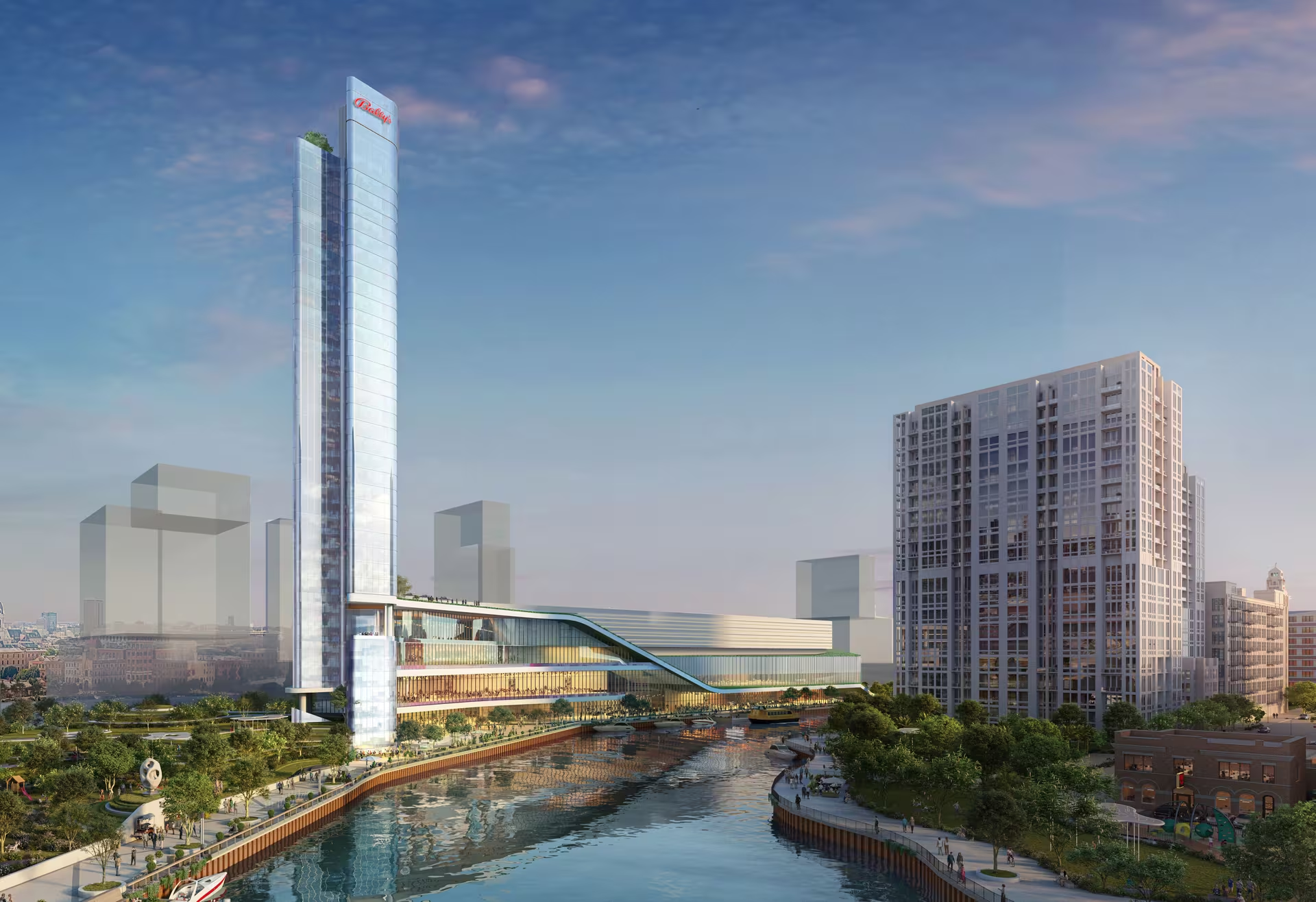
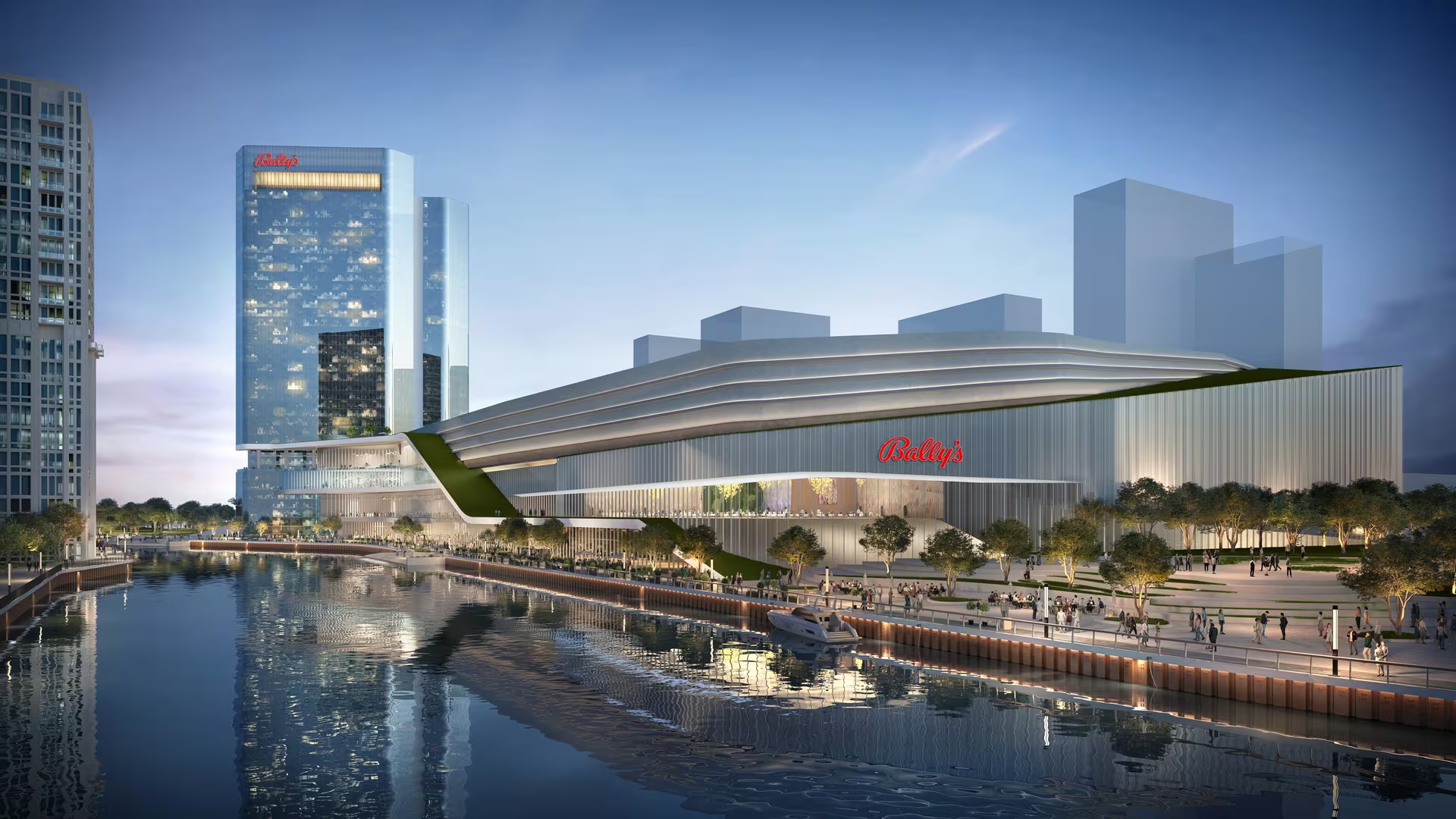
Chicago city fathers, particularly vacillating Mayor Brandon Johnson (D), ought to be turning cartwheels at the news. They get a credible owner with strong borrowing capacity for a casino that looked like it was about to founder. Further good news is that GLPI/Bally’s are recommitting to a September 2026 launch date. They hope to achieve this by dint of scrapping a phased buildout of the property and by relocating the troubled hotel tower to the opposite end of the site, slimming it to a mere cigarette of a building. Below is the original design for the megaresort, which now goes into history’s circular file.

As for the rebuild of the Tropicana Las Vegas site and the hoped-for casino on the former Trump Links, well, those are further exposed for the pipe dreams that they always were. Bally’s borrowing power is feeble. It still has 11 casinos it could sell but that would not only leave the cupboard bare but they’re mostly low-return assets. For instance, Bally’s Atlantic City is the lowest earner on the Boardwalk and the company picked it up from Caesars Entertainment for pocket change. Unless bankers start snorting happy dust (i.e., cocaine), the Bally’s empire is over before it began.
But don’t count them completely out. Like Max Bialystock in The Producers, Bally’s has found creative ways of closing any funding gaps remaining in the Second City project. For one, it’s talking about floating an IPO of the megaresort (which it no longer owns), grandly suggesting that this is the entrée for the would-be minority investors it is mandated to have: “Bally’s Chicago, Inc. will offer individuals and minority-owned and women-owned businesses that meet the qualification requirements contemplated by the Host Community Agreement with the City of Chicago to participate in 25% equity ownership in the Bally’s Chicago project.” But that 25% may be diluted: “Bally’s may also pursue other complementary financings at Bally’s Chicago to supplement the project financing as market conditions allow.” Can you say ‘Cost overruns’? We thought you could.

Although July is supposed to be better than June in Macao, so far it hasn’t been and the next big holiday doesn’t roll around in China until October. Which means the Macanese casino recovery is losing momentum while still almost 25% short of pre-Covid-19 amplitude. All of this is bad news for Las Vegas Sands, which has already seen the competition—especially MGM Resorts International—eroding its market share. The bad thing about being Number One in the market is that you have almost nowhere else to go but down.
The jitters are being felt on Wall Street. Yesterday, J.P. Morgan analyst Joseph Greff reduced his estimates on Sands’ Macanese performance in April through June. He lowered his cash-flow projection from $599 million to $574 million. This was predicated on, among other things, 23% market share for Sands (still plenty) and more anemic performance by the company’s non-gambling attractions, never a Sands strong suit. Greff blamed lower-than-expected June casino action, as well as construction-related disruptions at The Londoner (still evolving from ill-branded Sands Cotai Central).
The good news for Sands was that Marina Bay Sands estimates were bumped up from $463 million in 2Q24 cash flow to $494 million, a sizable leap. Greff wrote that the old number was “probably too conservative given solid overall international tourism trends and increasing Chinese visitation” to Singapore. Sands definitely isn’t the play for short-term investors: Greff says the company is five months away from a Macao boost, which is when construction eases up at The Londoner. At that point, cash flow should grow faster than for any of Sands’ five Macanese peers. He added, “We continue to believe that Singapore remains healthy and see capex here driving medium-to-longer term EBITDA growth. In terms of capital return, we see LVS in steady share repurchase mode in the neighborhood of $500m per quarter. ” Since New York City and Texas are but distant prospects for Sands, probably even further off than Thailand, leaning on Singapore and (to a lesser extent) Macao isn’t a bad crutch to have in the interim.