

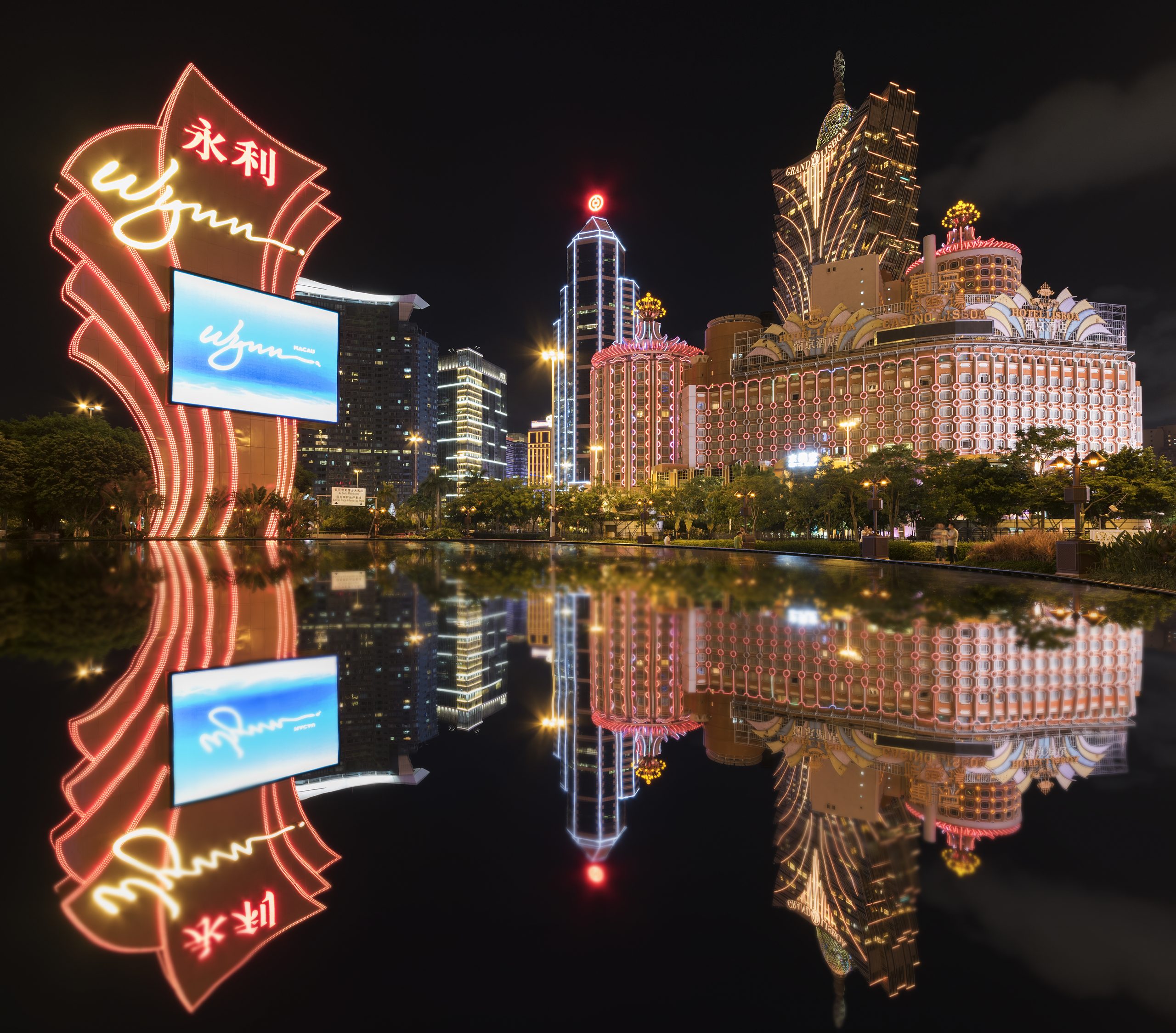
Due to a variety of pressing issues, such as Big Gaming’s rebuff by the 2024 electorate, the last round of earnings season got pushed onto a back burner. Time to make amends. Let’s start with Wynn Resorts, whose results were described by J.P. Morgan analyst Joseph Greff as “mixed.” Which is never what you want to hear from Wall Street. The news from Las Vegas and Boston was good, that from Macao less so (an 8% undershot). In the latter, Wynn missed projections but was still better than the competition.
Table games were somewhat of a disappointment at Wynncore but slots and amenities carried the day. Opined Greff, “we don’t think there was that much of a negative surprise in the 3Q results or a generally stable to slightly better outlook” in Sin City, where high-end play was said to be holding up. Still, Greff noted “slowing trends in the Las Vegas market” as well as “ho-hum expectations,” shaving $6 million off his $230 million cash flow projection for Wynncore’s 4Q24. By contrast, the stock boffin said he was “optimistic that Macau can continue to grind higher, though there was nothing in this release to be gangbusters bullish.” As for Wynn’s United Arab Emirates development, Greff didn’t think it was being properly appreciated by investors.
We’ll scant some of the fine points in favor of the overall view: “In Las Vegas, demand has remained healthy, with strong growth in slot handle, stable drop, and solid non-gaming demand reflecting a stable high-end customer against tougher comparisons. Management also reaffirmed its positive outlook on the upcoming F1 event in Las Vegas at the end of November … In Boston, demand has been healthy through October, led by strong y/y growth in slot handle and stable non-gaming revenue against tougher comparisons.” So far, Wynn has plowed $18 million into Wynn Al-Marjan, with another $800 million-$875 million on the way. So far, 34 floors of steelwork have been erected and Wynn isn’t having trouble scaring up interest from banks to finance the rest. And in case you thought the whole thing was a big prank by the sheikhs, Wynn got its UAE casino license last month. Whew.
In other Wynn news, the company bought back $117 million of stock and spent $101 million toward various enhancements on the Las Vegas Strip and in China. Meeting the diversification goals set by Peking overlords will cost Wynn as much as another $425 million through the next 14 months, while a variety of Wynncore renovations will set them back another $300 million (money well spent, mind you). Wynn Resorts is also carrying only $1.2 billion in debt, refreshing in these days of groaning balance sheets.

Going from the global to the domestic, analysts professed themselves unsurprised by outcomes at Penn Entertainment. Even so, cash flow was down 10% to $472 million for 3Q24 and the Southern/Western divisions were particular underperformers, sliding -22% and -13%. The Dixie disappointment was chalked up to property renovations and hurricane season. Still, construction projects in Columbus, Aurora, Joliet and Las Vegas remain on schedule for 2026 rollouts.
According to Penn itself, it was “mitigating ongoing pressures from known new supply in Nebraska, Louisiana, and Chicagoland by continuing to reimagine our properties to improve the customer experience… During the quarter, we rebranded seven ESPN BET retail sportsbooks and accelerated our planned hotel room renovations at L’Auberge Casino Lake Charles. We are seeing higher value per customer from guests staying in the renovated rooms to-date, with the remainder expected to be completed through January of 2025.”

ESPN Bet contributed to a $91 million interactive loss, on revenue of $244.5 million. Terrestrial return on investment was $457 million and Penn promised an even better 4Q24, teasing higher slot performance (+3.5%). Jefferies Equity Research analyst David Katz decreed that the outcomes were “generally in-line with expectations, with the Interactive segment performing better-than-expected [sic] for the second consecutive quarter, which should be a modest positive for shares.” Penn’s $1.6 billion of revenue was $40 million ahead of Katz’s expectations and land-based business was pronounced “relatively stable.” ESPN Bet is outperforming in New York State, where it enjoys 228% average daily betting per user, compared to other states in which it operates. Penn is also aggressively moving to deploy ESPN-branded sports books (seven of them). Katz was sufficiently impressed to add a buck to his $20 price target for Penn.
Deutsche Bank analyst Carlo Santarelli agreed that Penn’s earnings call was “largely uneventful,” noting that the company had done a good job of managing expectations during Global Gaming Expo. Encouragingly, Penn execs said that customers were coming more often and spending more per trip since September. Santarelli observed that “either guidance is conservative or October is expected to be somewhat of a favorable blip, after a tougher than expected 3Q24, with a tougher Election dynamic and holiday calendar largely offsetting the strength to date.” He stood by his $18/share price target but trimmed 2% off his future cash-flow projections.

Greff was less mellow about Station Casinos, which he said was “uneven” both in the last quarter and going forward. When you only operate in one market and one market alone, you can’t afford to be less than steady. Station’s $468 million in revenue beat Greff’s estimates (it was a 14% improvement from 3Q23) but cash flow of $203 million was a slight miss. Trends, even for megahit Durango Resort, were said to be normalizing and sports books took a $7.5 million hit last month from player-friendly outcomes. Greff lowered his cash-flow projections for the rest of the year and for all of 2025 to $201 million and $792 million, respectively. Perhaps in acknowledgment of cooler consumer trends, Station is pulling in its horns on new-casino development, prioritizing upgrades to existing properties instead—no small investment ($325 million), especially as it will mess with cash flow and revenue. But we think Station has learned from the errors of 2007-8 and is charting the wisest course of action.
Katz was a bit less clement than Greff, calling Station the “owner of some scarce growth.” He divided the quarter into strong (Durango) and mixed (everything else). He noted that Durango was producing a 15% ROI (which is well above average for an expensive casino property) and that Station is fronting the North Fork Band of Mono Indians $785 million toward a California gambling palace. Santarelli didn’t mince words, calling 3Q24 “tough … its most challenging quarter in some time. While our forecasts were below Consensus and Consensus migrated lower over the course of the last month, the results were a hair weaker than expected, from our perspective.” He blamed Durango-derived cannibalization of revenues, a softening Las Vegas market and higher expenses, led by wages.
The Deutsche Bank analyst noted that other Station properties were seeing as much as a 6% cash-flow decline, thanks to Durango, but that this was better than the competition was doing. There’s even a silver lining for megabuck Red Rock Resort (“a Strip property for locals,” as a friend calls it), in that its cash flow should get a bump from players displaced by construction activity at fast-expanding Durango. Customer behavior was described as “stable,” ditto spending. Still, Santarelli ratcheted down his projections for 4Q24 and 2025, and cut his price target to $62/share, down from $65. “We continue to view the longer-term development story as incremental, unique, and attractive.”

Neither Santarelli nor Greff deigned to cover Golden Entertainment but Katz had a few pensées on that subject. “The company appears to be actively looking for a potential targets or suitors while also indicating its willingness to engage in sale leaseback transactions,” he wrote, gauging the priorities to A) reducing leverage and B) juicing capital returns. Revenue was $161 million and cash flow $34 million, slight misses both. Working-class customers were said to be spending less, especially at Arizona Charlie’s Boulder. While tavern revenue with right in line with expectations, it fell short of cash-flow expectations by a good measure. As for increasing the company’s value, Golden is looking a smoke-and-mirrors approach whereby it sells assets in order to buy back stock (thereby artificially inflating its value) and paying dividends, essentially bribing the shareholders into unjustified optimism.
The Strat may be a tough sell, since it continues to underperfom. (That Atomic Golf misfire didn’t help the way it was supposed to.) Midweek business subsided 6%. Katz concluded that “absent a clear path of growth or value capture,” he would stick with his “Hold” rating and $31/share price target, which is pretty ritzy, given Golden’s portfolio and financial performance. Remember, you can get stock in far-more-diversified Penn Entertainment for a fraction of that.

That leaves the enfant terrible of the industry, DraftKings. Santarelli chose to see the DKNG glass as half-full, given that the $26 million revenue miss and $58.5 million negative ROI were better than he was expecting. Still, he felt that investors wouldn’t completely buy into management’s narrative of a largely unchanged 2025 projection, given that cash-flow guidance for the current quarter has plunged from $500 million to $260 million. Santarelli wrote “we expect to find the market, and ourselves, talking about hold rates. And, again, we remind investors that unlike casino games, sports hold can be volatile. Sports wagers are not subject to table game math or a set pay table like a slot machine, the bets come in, many focused on single events, and if a book gets lopsided on one side, as is often the case, and the wrong outcome occurs, the result is a headwind and an earnings miss.” Which is what’s happened to the Boston-based company,
After the earnings call, Santarelli was both amused and bemused by DKNG’s counterintuitive performance in the stock market. The lower the 2024-5 guidance goes and the poorer the ROI, the higher the stock price moves. Management’s narrative skills, he thought, were trumping reality. What’s driving this market Pollyanna-ism? “Simply, if you are a gaming investor, or even a broader consumer investor, regardless of what happens fundamentally for DKNG in 2025, there simply is a scarcity of names that have prospects for even modest growth in 2025, no less the type of growth DKNG will undoubtedly exhibit.” A stock like DraftKings, he concluded, “often changes on a dime, and we don’t, and have never, enjoyed recommending these types of stocks.” He opted for a $33/share target and a “Hold” rating. (Santarelli has never been a Kool-Aid drinker where OSB stocks are concerned.)
Katz was less bothered, deeming the 3Q24 results in line with expectations and seeing the October wipeout as a blip in the narrative. He wasn’t even fazed by managerial reductions in anticipated 2025 revenue (down $400 million) and cash flow (as much as $100 million lower). When one is talking about numbers of that magnitude, what’s a few hundred million among friends? As for the negative return on investment, ‘We expected much worse’ (-$82 million) was Katz’s alibi. Isn’t that comforting? On the plus side, average monthly users are growing fast and “the reduction is entirely driven by sports outcomes rather than execution.” Katz was also copacetic with DraftKings’ projection of a 31% revenue increase next year.
After the earnings call, he termed management’s narrative “compelling,” dismissing volatile betting outcomes as a passing phenomenon. He argued that “promotional optimization and expense efficiency” would more than make up for the vagaries of sports wagering. Acquisition of the Missouri market was further cause for optimism. Ditto “opportunistic” repurchases of stock. Lose money, initiative share buybacks? Stop using logic, dear readers! Bullishly, Katz stood by his “Buy” rating and $54/share target.

Greff deemed CEO Jason Robins‘ outlook “reasonable.” He noted that third-quarter revenues rose 39% and handle jumped 25%, with hold a healthy 10.5%. Those customer-friendly sports scores (we’re playing the world’s tiniest violin for the OSB giants) led to revenue losses of $250 million and adverse ROI of $175 million. DraftKings execs say October-early November was the worst stretch of luck they’ve ever had. “Given weekly reports out of New York and comments from OSB operators who have reported 3Q24 results thus far, this is not surprising,” Greff concurred. On the upside, less promotional spending was translating into an additional $55 million in ROI. So there’s that.
Perhaps as a consequence of more sucker, er, parlay bets DraftKings is anticipating an 11% hold next year and even more in 2026 and beyond. Nor has the oncoming Missouri impact been quantified yet. The future looked bright enough for Greff to predict $7.2 billion in revenue and a positive investment return of $1.5 billion (increases both) for 2026. Greff took what seems an unduly sanguine view of OSB volatility, dismissing it as now worse than what he witnesses in Las Vegas and Macao, which he called even worse. If you’re strictly framing the discussion in terms of baccarat, sure. That didn’t prevent him from chopping $7 off his price target, taking it down to $47/share. “We view these multiples as not so overly rich and pretty appealing for a (the only) pure-play, high-growth U.S. digital OSB and iGaming operator,” he concluded.

Finally (!), without leaving DraftKings, we note a new development in the Water Seeks Its Own Level Dept., that department being the septic tank of gaming. We refer, of course, to DKNG sidekick Barstool Sports, whose fertilizer content has been enriched by the addition of failed Las Vegas Raiders coach Jon Gruden. At last, a ‘Stool sample as disgusting, petulant and fragrant as Stool Fool Number One, Barstool founder Dave Portnoy. It’s another metric that racism, misogyny, and homophobia (preeminent Gruden values) are alive and well in today’s America. DraftKings must be so very proud of its bastard child.