

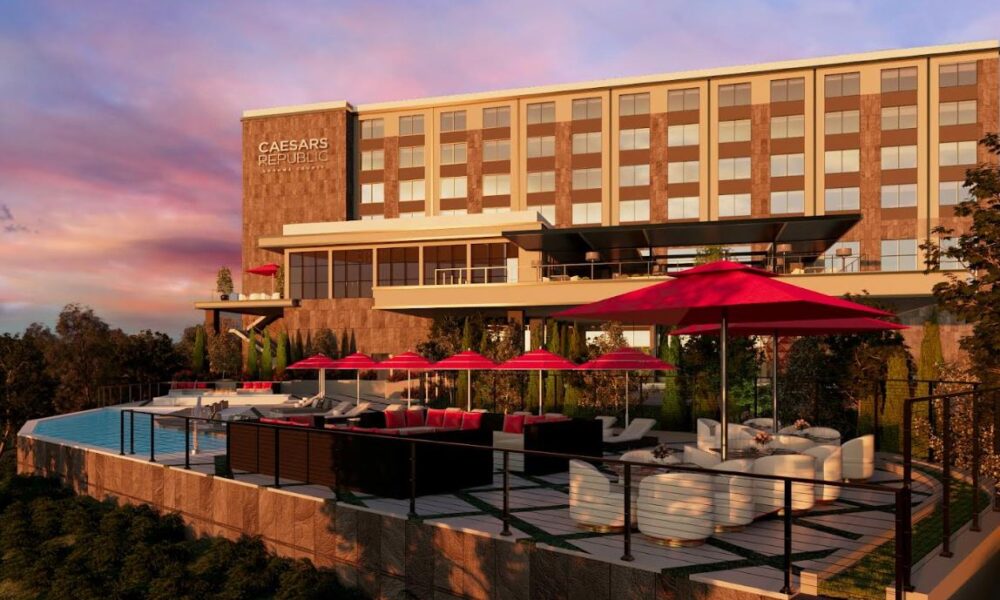
What doth it profit a tribe to gain a casino but forfeit its birthright? The Dry Creek Rancheria of Pomo Indians just made a Faustian pact with Wall Street, for the sake of underwriting a Caesars Republic-branded casino near Healdsburg, California. In return for $225 million in construction financing, the tribe agreed to lease the casino until 2070 to “an affiliate” of financier Gaming & Leisure Properties Inc., which will magnanimously sublease it back to the band. Any guesses to who the friend of GLPI might be? Corporate PR simpering aside, it’s obviously going to be Caesars Entertainment at the helm for 45 years.
To add insult to injury, the Pomo Indians are having to pay a blended, 12.8% interest rate on their loan, which is pretty stiff. (The second of two loans carries a 14% rate, ouch.) GLPI CEO Peter Carlino (below) will surely say those were the best terms the Pomo could have gotten on The Street and he’s probably right. That should tell us a couple of things. One is that tribes are still considered a poor credit risk (you can’t seize their assets should they default). Another is GLPI, like Vici Properties, is willing to wade into tribal waters, but not without covering its ass generously. Ironically, GLPI only charged the Ione Band of Miwok Indians 11% interest on an earlier casino project, while Vici’s underwriting of a Station Casinos-led development for the North Fork Rancheria of Mono Indians of California carries an 11.4% rate. So the Dry Creek Band really was up a creek, comparatively, and GLPI let them know it.

Another reason GLPI was covering its butt is twofold. Not only is nearby Graton Resort & Casino plowing $1 billion into an expansion, the even-more-proximate Koi Tribe of Pomo Indians has gotten the green light to build Shiloh Resort & Casino, with 2,750 planned slot machines 20 miles from Caesars Republic-to-be. Graton’s enlargement should come on line in 2027, the same year that Caesars is slated to debut. Pressure much? Even though we frown upon the terms of the Dry Creek loan, at least GLPI (like Vici) deserves props for putting its money into tribal gaming at a time when high finance is still leery of it.
At a time when Washington, D.C. is engaged in full-speed dereliction of the things big government is best suited to (like transportation safety, disaster preparedness, veterans’ affairs, etc., etc.), it’s running blindly into something about which it knows fuck-all: iGaming. The buffoons currently in charge of the Commodity Futures Trading Commission are letting inmates like Robinhood run the asylum, especially when it comes to online sports betting. Prediction-market firms are exploiting the narrowest of loopholes to present unregulated, untaxed OSB across all 50 states (much to the umbrage of 34 attorneys general). When the Supreme Court OK’d sports betting in 2018, it clearly didn’t foresee a situation whereby Kalshi and its ilk would be able to force OSB upon states where the legislature doesn’t want it or where it’s blatantly illegal. But such is now the case. We’re going to have a good laugh watching the CFTC fall on its ass trying to regulate OSB, for which it has no preparation or evident expertise.
It’s a black farce, especially when Kalshi advisor Donald Trump Jr. also takes a stake in immediate rival Polymarket. Talk about divided loyalties (among other things)! However, Native American tribes find nothing amusing in the situation. The previous Interior Department—and Florida Gov. Ron DeSantis (R, below)—gave tribes free rein over cyberspace with the latest Seminole Tribe compact, which redefines the Internet as “tribal lands.” Current Interior Secretary Doug Burgum isn’t on board with that, but hasn’t done—and may not be able to do—much about it.

One group that really isn’t laughing is Wisconsin‘s Ho-Chunk Nation, which sees prediction markets as poachers on tribal land. Kalshi is a particular target of Ho-Chunk ire and has nobody to blame but itself. As far as Kalshi, etc., are concerned, what they offer is “betting” when they want to sell it to you, but a “financial service” when the courts call them on their bullshit. Kalshi has been particularly prone to run its yap in this manner. Who does it think it’s fooling with blat like “The First Nationwide Legal Sports Betting Platform” or “Sports Betting Legal in all 50 States” (no, it ain’t, but we digress). But the biggest mouth belongs to CEO Tarek Mansour, who explicitly and repeatedly described a Kalshi contract as a “bet” last October. Sure, it’s a “prediction” that an event will happen thusly … but so is our wager with Lefty that the Buffalo Bills will make it to the Super Bowl next February. At least Lefty isn’t a hypocrite. (Speaking of hypocrisy, Kalshi is now rolling out multi-leg parlay wagers.)
As Ho-Chunk President Jon Greendeer says, “It’s very profitable for them to make this argument as long as they can, even though any court of competent jurisdiction is going to see right off the bat, as they have in the past, that this is clearly a gambling platform.” We wish we had as much confidence in the courts as Greendeer does. A couple of activist judges have already let Kalshi et. al. skate, using pretzel logic to twist the Murphy v. NCAA ruling and Indian Gaming Regulatory Acts into nonsensical knots. Our favorite is the Nevada judicial hack who constrained the Nevada Gaming Control Board from regulating prediction markets on the grounds that Kalshi would probably prevail at trial, not only prejudicing the outcome but begging the question of why a trial would even be held.

In the non-tribal realm, the state of Georgia (where we live) is in serious danger of having its lunch eaten by fast-moving prediction-market operators. While the inept Lege moves toward sports betting legalization at walrus-like speed and with plenty of ambivalence, not only Kalshi and Robinhood and Polymarket, but DraftKings and FanDuel may be swooping in with “event contracts” in their sweaty little hands. J.P. Morgan analyst Daniel Politzer takes the prospect quite seriously, arguing that Georgia, Florida and Texas represent the most tempting targets of opportunity, to the tune of $23 billion in handle. Like lies, prediction markets get around the globe in less time than it takes for state legislatures to get their pants on (unless they’re passing tax increases on gambling). By the point some of these Dixie backwaters get around to legalizing OSB, the prediction markets will have snagged all the booty … unless kiboshed by the courts.
Leaving the South to its own devices, we’d like to take this opportunity to announce a 180-degree change of heart (or flip-flop, if you prefer). We now think the Seminole compact should stand—sorry, Doug—and tribal OSB and iGaming should flourish throughout cyberspace, at least in those states where it comports with IGRA. Hell, we stole an entire continent from Native Americans. It’s the least we can give them in return.