

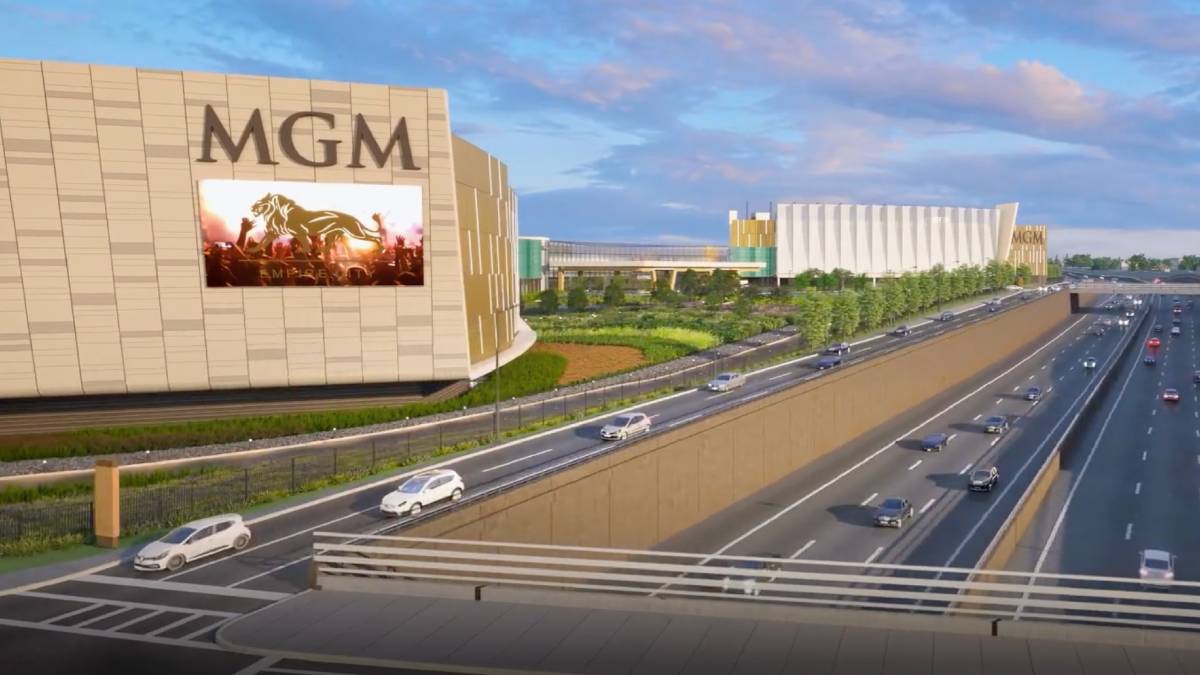
See that fancy-schmancy vision of an upgraded MGM Empire City? Well, it ain’t happening. In the shocker of the year, MGM Resorts International yanked its New York City casino bid from consideration yesterday. What the company said was less interesting than what it didn’t say: It’s essentially pulling the plug on casino operations in the Big Apple altogether.
Yonkers Mayor Mike Spano (D) cut to the chase, saying, “MGM has publicly acknowledged that Empire City cannot survive without a full gaming license, so why are they signing their own death warrant?” He’s quite right. Once a rival, Class III casino gets up and running, MGM’s video lottery terminals will be uncompetitive by definition, sending Empire City into a death spiral. Or will the company try to blackmail New York State into giving it Class III status as-is, citing self-inflicted job losses as an excuse?
As Spano said, MGM’s reasoning doesn’t quite add up. The company’s alibi is twofold. One prong is that the casino concessions have been halved from 30 years to 15. MGM would have to screw up royally not to get renewed come 2040. But let’s give them that one. The other was that the $2.3 billion investment no longer penciled out. We’re calling B.S. on that contention. If it takes more than 15 years to monetize an upgraded Empire City, how good an investment could it be? Besides, MGM is essentially saying that $12 billion (and climbing) in Osaka brings a good ROI but $2 billion in the biggest city in the United States is too risky. Nope, not buying it. Could this be the same MGM CEO William Hornbuckle (below) who was singing zippydy-doo-da at Global Gaming Expo last week?

While we’re skeptical of Spano’s intimations of a backroom deal between Hornbuckle and Donald Trump to help the latter land a $115 million kickback from Bally’s Corp., the latter is sitting in the catbird seat now. Its borderline insolvency aside, Bally’s is one of three remaining contestants for a trio of licenses. Although the ability to actually pay for $4 billion Bally’s Bronx is supposedly a key criterion for getting tabbed, that may be more Bally’s problem than the state’s. After all, should Soo Kim falter, others (except for MGM) will gladly step in.
This brings us to MGM’s most-legitimate grumble, namely that the Community Advisory Committee process ended up bunching four casino bids together in a tight concentration: the Bronx, Queens and Yonkers. We sympathize … but that never hurt MGM on the Las Vegas Strip—or in Detroit. We think Hornbuckle doth protest too much. Scared of a little competition, Bill?

Whatever the case, MGM’s withdrawal was enough to give Genting Group watchers cold feet. Fretted Nomura boffins, “Given that some of Genting Malaysia’s Resorts World assets like Resorts World Catskills, Resorts World Bahamas and Resorts World Las Vegas also have sub-par returns, one might also question the economics of a multi-billion dollar potential Resorts World NYC expansion.” The stock-pickers also worried that Genting was being hyper-aggressive in its bid, overpaying for the license (by 20%), and being willing to be taxed 56%(!) on slots and 30% on table games. Nor was the lack of distance (10 miles) from Steve Cohen‘s Metropolitan Park unmentioned. In Resorts World’s favor, they pointed out that it would be the first to market with Class III games (July 26) … at which point the death watch for Empire City commences.
What would Nomura have Genting do? Fall on its sword? It’s a bit late for that. Plus, Genting has the top-performing casino in the NYC area already. They’re holding a hot hand and ought to play it, especially with Leo the Lion having committed hara-kiri.

“Stop spreading the news,” reacted Truist Securities analyst Barry Jonas, ringing a change on a Kander & Ebb anthem. He wrote, “This is the end of a frustrating and lengthy chapter for MGM in the downstate NYC casino licensing process. We actually saw risk of a ‘winner’s curse’ here, and see this as a positive for MGM who now frees up capital for potentially better uses. We have questions as to whether all, some or none of the remaining three applicants (including Hold-rated BALY) will be awarded one of the three potential licenses, and what respective ROI ultimately looks like.“
Jonas went on to explain “management’s decision to withdraw is the end result of a frustrating project timeline, including multiple lengthy delays, changing project economics and an altered competitive environment.” He argued that the potential ROI was diminished by usurious tax rates and that, had MGM not quit before counter-proposing a workable impost, it would have been potentially stuck in Gotham. What will MGM do with the $1.8 billion it would have spent on Empire City (plus $500 million for a license)? Jonas predicts stock buybacks.

“At this point, we could see all three bidders, or two bidders, or one bidder, or even none awarded a license,” Jonas warned. In the case of Bally’s, it has a lengthy string of demerits, mainly its (in)ability to fund prior commitments to Chicago, Las Vegas and Australia, never mind the politically loaded Trump connection. Still, if Gaming & Leisure Properties doesn’t exercise its right of first refusal to pay for Kim’s $4 billion pipe dream, Jonas thinks others will step up to the plate. He also raised the question of whether MGM would stick around to get in on potential Empire State iGaming, as it is doing in Michigan. After all, most observers think cannibalization fears are overstated, although they were enough to send Las Vegas Sands packing. In that instance, would Empire City stay open as a ‘loss leader’ to keep MGM in good odor with New York State power brokers? Jonas implies yes.
Unlike Jonas, David Katz of Jefferies Equity Research was taken by surprise by MGM’s sudden volte-face. Still, he thought the move demonstrated prudence. He argued, “the reduction in the license term to 15 years from 30 dramatically alters the underwriting of what had already been expected to be a speculative process based on the tax rate bidding aspect. Second, the advancement of Bally’s proposal in the South Bronx could have an impact on MGM’s opportunity in the Northern Bronx.” … and we can remember the days when you didn’t venture into the South Bronx if you valued your life.

Katz concluded that “MGM’s location bordering on the Southern Westchester County, was superior to most of the others which had been placed in Manhattan, Long Island and the southern Bronx, given its highway access and convenience to appropriate customers.” He applauded MGM for turning to “growth projects elsewhere” without naming any names. Thailand is a closed book now and Japan makes New York City look like a bargain proposition. Of what could Katz be thinking? Unfortunately, he does not say.
As for us, we believe MGM blew it and its employees will ultimately pay the cost. Let’s hope they are given preference when other Big Apple casinos start hiring.