

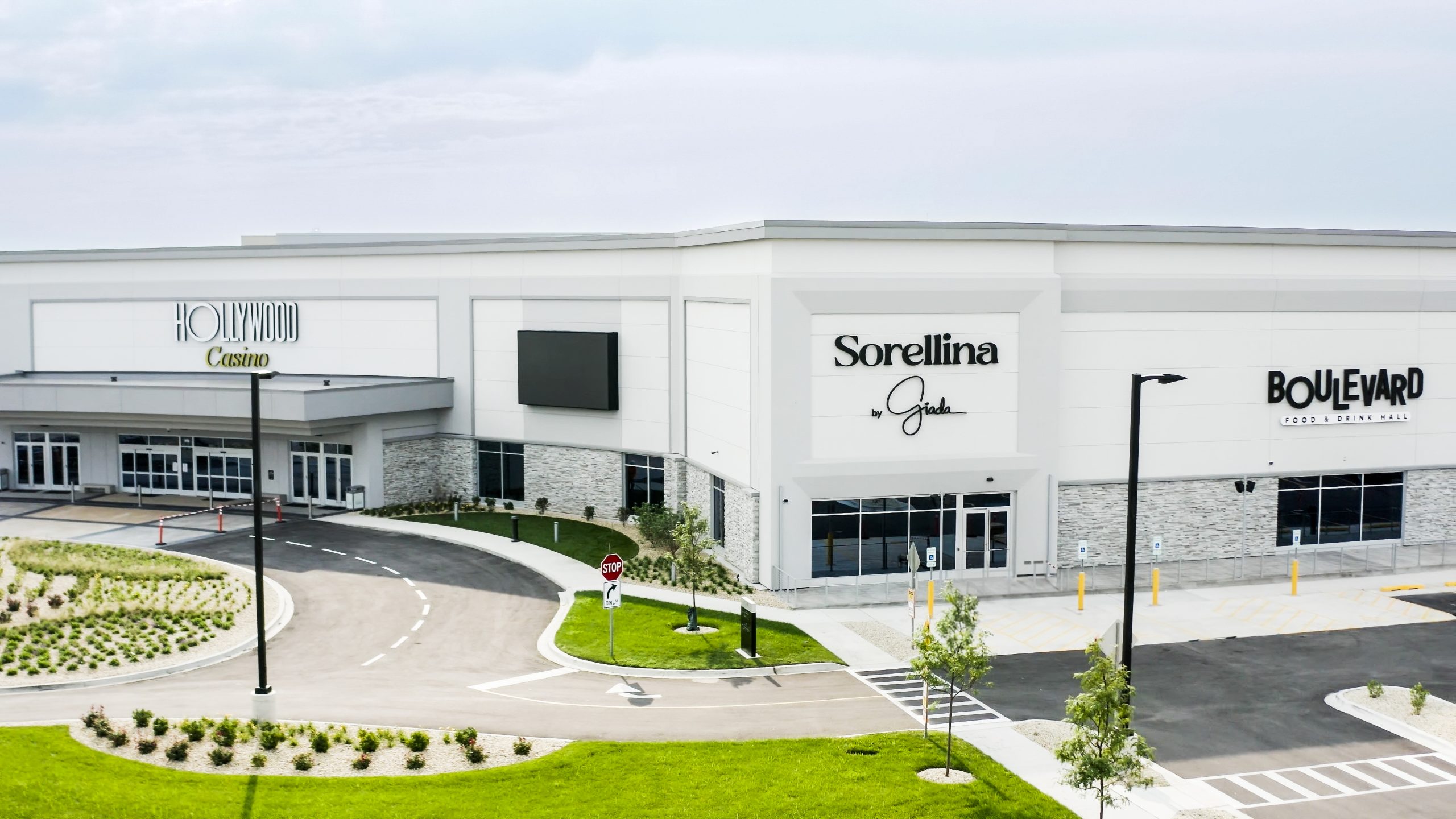
Illinois casinos were booming in October, up 21% … or 7.5% once second-place Wind Creek Southland and last-place Fairmont Park were subtracted to make an apples-to-apples comparison. The headline for J.P. Morgan analyst Daniel Politzer was the loss of the novelty factor at Hollywood Joliet, which has trended downward from August through October. Darn, the sheen came off that casino fast. Normally we don’t put much stock in sequential comparisons, but still … dang! We had hoped for better.
New H’wood Joliet chipped in almost $11 million, a 46% improvement over old Hollywood Joliet and money that embattled Penn Entertainment surely needs. Wind Creek hauled in $17 million, dwarfing most of the competition, while Fairmont Park eked out $1.5 million. Best of the incumbents, of course, was Rivers Des Plaines. It climbed 2.5% to $43 million. The Temporary at American Place leapt 21% to $10 million, validating the claims made for it by Full House Resorts, while Hard Rock Rockford jumped 12.5% to $12.5 million and third place statewide. Bally’s Casino slipped 2.5% to an underwhelming $10.5 million. One Wall Street analyst recently claimed that $1.7 billion, in-progress Bally’s Chicago will gross over $34.5 million per month. Nothing we’ve seen to date justifies such optimism … unless one is snorting “happy dust.”

Paying the price of age, Harrah’s Joliet slid 6.5% to $9 million, but ancient Hollywood Aurora jumped 7.5% to $8.5 million. Likewise, venerable Grand Victoria hopped 12% to $11.5 million. Bally’s Corp. had a great month at Bally’s Quad Cities, leaping 20% to $5.5 million, as Par-A-Dice bounced 11% to $5 million. Harrah’s Metropolis was flat at $4.5 million, Golden Nugget Danville was up 3% to $3 million and Walker’s Bluff Casino vaulted 26.5% to $3 million. DraftKings Casino Queen sagged 9% to $6.5 million but Argosy Belle gained 5% to $3 million.
Across the river and despite a 3% sag in table winnings, Missouri casinos were up 9%. Caesars Entertainment continues to be synonymous with heavy promotional action, in this case clearly driving a 24% catapult at Horseshoe St. Louis … albeit insufficient to get the casino out of distant fourth place in St. Lous with $13 million. Ameristar St. Charles doubled it up with $25 million (up 7%), while Penn Entertainment successfully competed with itself at River City ($22.5 million, 6%) and Hollywood St. Louis ($23 million, 6.5%). One of only two revenue-negative casinos in the Show-Me State was Bally’s Kansas City, slipping 1% to $11.5 million. Ameristar Kansas City accelerated 9.5% to a market-leading $17 million, whilst Harrah’s North Kansas City ($14 million, 4%) edged Argosy Riverside ($13 million, 7%).

Downstate, Century Casinos went in two directions at once. Century Carutherville experienced a 61% moonshot to $5 million but Century Cape Girardeau slumped 5.5% to $5.5 million. Slots-only Mark Twain Casino rebounded 18% to $3 million, St. Jo Frontier Casino jumped 12.5% to $4 million and Isle of Capri Boonville (another Caesars venue) vaulted 20.5% to $8 million.
Casinos in the Free State managed a 1% gain last month. A 2% slump at the Maryland tables nearly canceled out better slot action. Horseshoe Baltimore apparently remains on promotional life support, up 12.5% to $15.5 million. MGM National Harbor dipped 2% to $68 million and Maryland Live was up 1.5% to $59.5 million. Ocean Downs leapt 11% to $8 million, Hollywood Perryville slid 10.5% to $6.5 million and Rocky Gap Resort was flat at $4.5 million, as Century Casinos continues to reverse its fortunes there.

ESPN Bet no more. Gaming’s most overpaid executive, Penn Entertainment CEO Jay Snowden had vowed to see Penn’s contract with ESPN out, at least through the August 2026. Snowden being Snowden, the frat boy-in-chief panicked and pulled the plug on ESPN Bet after Week Nine of the NFL season. Ah yes, another well-thought-out Snowden decision. Penn will now dust off its third OSB brand, theScore (previously confined to Canada) in hopes of succeeding where ESPN Bet and unmourned Barstool Sports have failed. With his so-called “digital strategy” in complete disarray, Snowden would be better off getting out of OSB altogether, but he remains determined to throw good money after bad (and worse).
We thought ESPN Bet would be a sure winner—and we were wrong. While you can evidently parlay an apparel and souvenir business (see Fanatics Sportbook) into OSB success, media-driven OSB enterprises have been a graveyard. Not even ESPN, which had much wider cachet than douchebag-oriented Barstool and none of the negative baggage, could reverse the jinx. Now Penn will have to pull down all its shiny ESPN signage and try to gin up the cachet-free theScore brand. Good luck with that.

ESPN wasted no time and immediately got into bed with DraftKings. Clearly they were prepared for Snowden’s perfidy. Daniel Politzer of J.P. Morgan thought that standing up ESPN would cost DraftKings $20 million more, coming off a weak 4Q25 outlook, but that would offset money DKNG would otherwise have spent elsewhere. Penn, meanwhile, missed damn near all of its 3Q25 revenue and cash-flow targets, so canning ESPN Bet was one more kick in the patootie. Penn gets to keep the three million digital users obtained during its ESPN deal but has to pay the broadcasting leader $43 million in breakup fees.
Opined Deutsche Bank analyst Steven Pizzella, “this was most likely the right decision, as the market share has come in materially below the expectations that were laid out at the onset of the relationship, especially in the context of spending ~$150 mm per an annum for media marketing services and brand and other rights.” Market share was below 3%, whereas Penn had hoped for 10% or even 20%. Pizzella forecast the loss of both OSB and iGaming players, “and we don’t believe it will be an easy road to gain back the potential lost market share.” ESPN Bet may have been an underperforming brand but just try making traction with brand-equity-challenged theScore.

Politzer called Snowden’s decision “premature,” saying ESPN Bet was on track to break even in 2026. But “our valuation already ascribed zero value to Interactive.” Ouch! Penn shook a metaphorical fist at Caesars Entertainment, telling analysts it “saw increased competition/promos in certain markets but expects the environment will normalize.” (It shows few signs of so doing.) The company also “views prediction markets as a threat to the industry but thinks the industry needs to do a better job playing offense to avoid risk of prediction markets becoming an existential threat to the entire gaming industry.” We quite agree, although with DraftKings CEO Jason Robins touting “event contracts” on slot pulls and card turns, the iGaming genie may be well and truly out of the bottle.
Penn has certainly shown little or no aptitude for playing in the online sphere, with Politzer noting that OSB “has been a distraction for investors and management for several years (back to Barstool), overshadowing a fairly solid land-based business and project pipeline.” Activist investors in Penn certainly aren’t going to be mollified by this latest debacle. ESPN has the option to buy more Penn stock—but why pay an inflated $28.95/share for a stock that is trading below $15.75?

Taking a contrarian view was Truist Securities analyst Barry Jonas, who wrote that Penn’s path to online break-even next year looks better with ESPN in the rearview mirror. His argument was that Penn “now has complete control of its digital cost structure and marketing budget and will target its highest-margin markets and customer cohorts moving forward.” There will be some short-term pain, he conceded, probably $75 million or less in red ink next quarter. He also discerned a silver lining in the former of a younger Penn player base (average age 46), thanks to a heavy infusion of digital-first customers. Penn “will work diligently to cross-sell these younger players into its land-based casino business as it has been doing successfully thus far.” Jefferies Equity Research analyst David Katz also felt that falling back on theScore (four million customers) was “a positive outcome.”
Kudos to SCOTUS: The Supreme Court, without dissent, basically and politely told detractors of its gay-marriage ruling to fuck off. This preserves a substantial tranche of Sin City’s wedding business (and that of casinos across the United States), in addition to being a blow struck on behalf of personal liberty.

Gridiron Grumbles. Dear NFL: Thursday-night football sucks. No, we don’t mean Thursday Night Football the TV show (well, maybe that too). The idea of being able to present NFL-quality games in midweek is simply crackers. Instead of late-night excitement one usually gets slipshod play from insufficiently rested players, almost invariably resulting in dogs. Case in point? Last Thursday’s stinker between the Las Vegas Raiders and the Denver Broncos, a stultifying non-event. Despite appallingly sloppy execution, the Broncos somehow prevailed over a surprisingly competent Silver & Black squad. But—at least in the half we were permitted to see—it was Dullsville, ending up a 10-7 snoozer. Oh, and the subpar Amazon Prime signal permanently crapped out seconds before halftime. Thanks a lot, guys.
Penn shaking a metaphorical fist at Caesars is goddamned hilarious since Penn’s two Nevada properties (M Resort in Las Vegas, Cactus Petes in Jackpot) have William Hill sportsbooks on site. William Hill, for the uninitiated, is owned by … Caesars! Who are these clowns, exactly?