

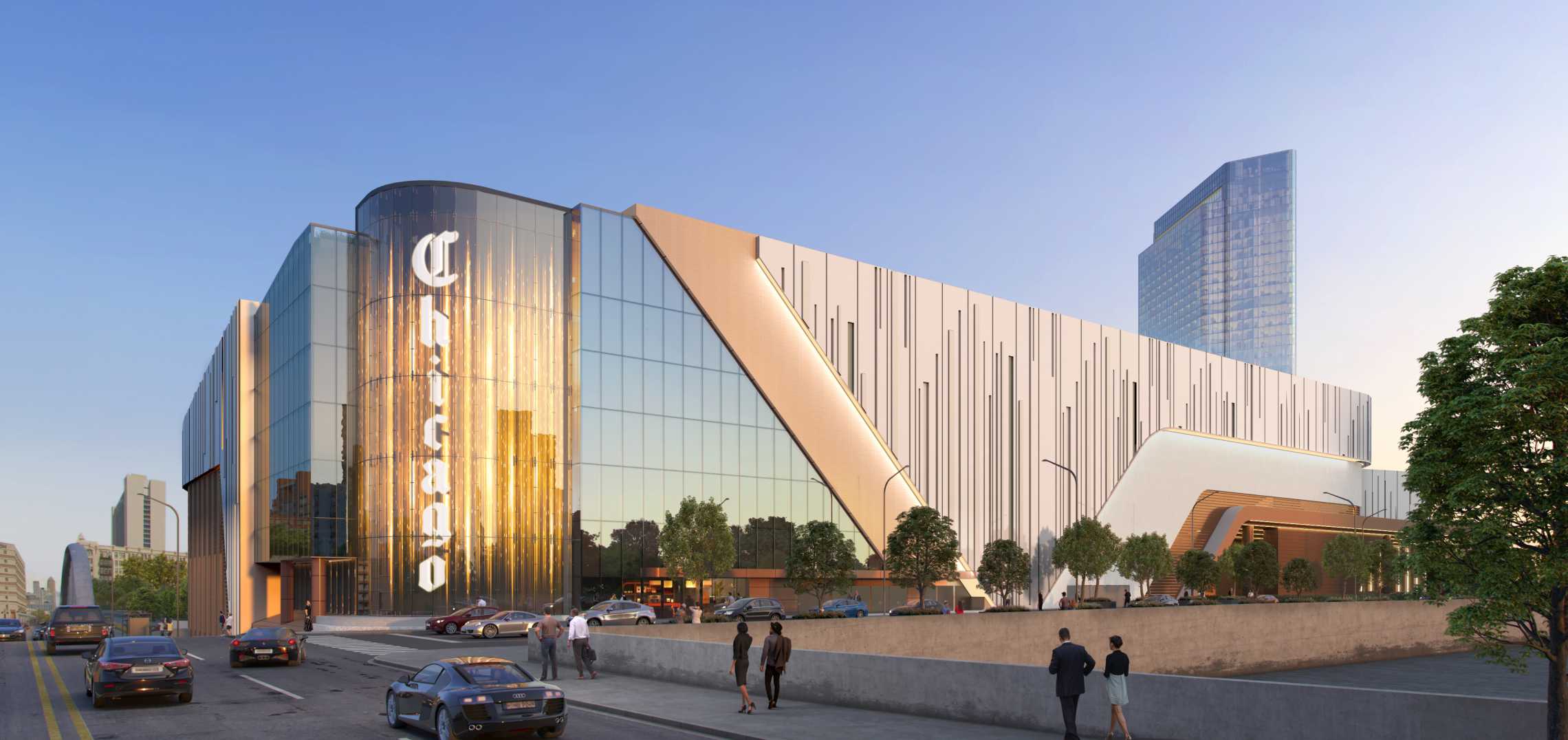
It was recently our pleasure to interview Gaming & Leisure Properties Inc. President Brandon Moore at length for a forthcoming issue of Casino Life Magazine. Indeed, Moore was interviewed at such length that we wound up with 4,700-plus words of transcript! As a service to S&G readers and a coming-attractions trailer for the print interview, here are outtakes from our conversation. But we don’t here address the rampaging elephant in the room that is Bally’s Corp.—we have to save something for the printed version!
Is New York City a market that can sustain the size of investments being discussed, of which Bally’s would be the smallest at $4 billion?
It sustains Bally’s at $4 billion, in that location. It sustains the project that Resorts World is proposing. Steve Cohen is getting up there when you’re talking $8 billion, $9 billion. You have to have a really significant return on that: That’s double what everyone else is paying. The demographics suggest that yes, it probably does support that.

The key thing you have to think about is limited-license jurisdictions. You look at a state like Pennsylvania. They’ve added licenses. They’ve added Category Fours [satellite casinos]. They’ve added truck stops. There’s a lot of gray machines in this market and so far the Legislature hasn’t done much about that. If you take that to downstate New York, will these three be the only three for the next 50 years? If you told me ‘yes,’ I’d say ‘Absolutely, that pencils.’
I’ll take the under. If these facilities all do really well, the next time New York needs to raise some tax dollars is a fourth or fifth license possible? You have to assume it is, if you’re looking at a long-term time horizon like we do. If you’re a bank and you’re going to get repaid in five years, you’re relatively safe. If you’re looking at a 40- or 50-year investment, you have to assume their will be more competition in that market. You’d have to be foolish to think otherwise.
GLPI is heavily into regional gaming at a time when it is on the upswing. What are the advantages of not being Las Vegas- or Atlantic City-heavy?
Las Vegas and Atlantic City are unique in a lot of different ways. Las Vegas, on the Strip in particular, is very dependent on fly-in and drive-in business, and you’ve seen some softness. It can be a little more cyclical than the regional gaming can be. The other issue with Las Vegas is those properties are just enormous. They require a tremendous amount of capex to keep them fresh. When you have 300 hotel rooms in a regional facility and 4,000 in a Vegas facility, simply keeping those properties relevant and competitive is much more expensive than it is in regional gaming.

In addition, Las Vegas is generating somewhere upwards of $3 of non-gaming revenue for every dollar of gaming revenue. Las Vegas is very much an entertainment type of destination-type place. Regional gaming is still generating the majority of their cash flow from the casino floor. It is just a very different business, Las Vegas to regional.
Atlantic City is starting to feel more regional. While it still requires a lot of drive-in business, it’s not the same type of vacation-resort visit Las Vegas gets and it’s turned into a more local/regional-oriented business. It’s a tough market. There’s still a lot of supply. Now you have Philadelphia and downstate New York coming, so Atlantic City will continue to be challenged, and investing more would take a lot of underwriting work and a lot of confidence that you’re investing in the right properties.
What is your expectation regarding the $500 million Bally’s Lincoln acquisition and its completion?
We recently pushed out that option to 2028 with Bally’s. We did that for two reasons. One, Bally’s needs a release from their lenders in order to release that collateral for GLPI to buy it. The impending deadline for that was putting undue pressure on Bally’s to solve that. They were looking for some relief to not have that brick wall headed for them. Quite frankly, we were fine with that because that Lincoln facility has seen a little bit of deterioration in the last year, both from a bridge closure in the area and then the Mashpee First Light project in that market.

We’ve done a lot of work on the EBITDA of that facility as it sits today. Having a little bit more visibility into what the Mashpee will do at First Light and how that bridge closure ultimately impacts the facility is beneficial for us, before we’re forced to make a decision as to whether or not we’re forced to acquire that asset. We saw the extension of that as a win-win.
How is your work in the tribal sector progressing?
Our Ione Band of Miwok Indians project should open in the first quarter or beginning of the second quarter of 2026. That one’s coming along pretty nicely. The Dry Creek Rancheria project that we recently announced is still with the National Indian Gaming Commission. Too early to really tell. The tribe had an existing, temporary facility and cash flow. They’ve already started work on the expanded, new facility. But we still haven’t entered into the loan and long-term-lease agreements, pending NIGC review of our documents.
GLPI has helped pioneer Wall Street investment into tribal casinos. Why was this important to do?
It was important because, as you look at the total addressable market in commercial gaming, clearly the more facilities that are acquired by REITs, the less there are to acquire. The opportunity set becomes less and less as these move into OpCo/PropCo structures. Quite frankly, there are some tenants who are never going to sell into an OpCo/PropCo structure.
The tribal gaming market, CBRE put out a report that it’s about 40% of the total gaming market. So it’s a very, very large market that is really untapped. Finding a way to marry what has become mainstream in the commercial-casino world with the tribal-casino world was something we thought was important. We worked for the better part of seven years to come up with a structure, and we finally found a tribe in California that was willing to take the structure to the NIGC and have the long-term lease approved as part of the financing package.

How much of that we’ll do, how much of it will change from Ione to Dry Creek? Those deals are different and it’s evolved a bit. I suspect there will be some evolution from 2.0 to 3.0. We may settle into a structure that we think can be replicated over and over. I’m not sure we’re quite there. But I will say there’s a lot of interest in the tribal communities for our type of financing, given the stability and predictability of the cash flows required.
It’s early innings and we’ll see if this ends up being a really big opportunity or a nice, little, tuck-in type of financing structure. That story is yet to be told. But the market and the opportunity is so big, we thought it was incumbent on us and our shareholders to at least explore that world.
What would you say to those politicians who still publicly argue that tribal gaming is financed by cartels and other unsavory entities?
To my knowledge, they’re not being financed by cartels. “Unsavory” can be in the eye of the beholder. Tribal gaming financing has historically been served by folks that charge pretty high rates of interest and pretty high fees. They’ve also found ways to participate in the slot leasing. All those things put stress on the tribal-gaming structure.
What we’re offering is somewhat unique. We’re offering financing where there are no bells and whistles. There are no hidden fees. There’s no requirement that you lease machines from us. We’re truly underwriting a 50-year lease and the tribe’s ability to pay that over that term. We’re uniquely situated in that their success is our success. Their failure is our failure. So we align quite nicely with the tribes in trying to make sure they have a healthy operation that can sustain our rent.

Traditional financing sources have been in and out: five years in, clip a lot of fees, a lot of interest and you’re out, and your primary focus is on getting your money back. That’s put stress on a lot of these tribes. If you look at Foxwoods or Mohegan here on the East Coast, those structures have a lot of debt on them. Competition has come into those markets and their ability to generate the revenue necessary to service that debt has become difficult.
So it’s important for our purposes to not let that happen. Not let it get over-levered. Not let it get into a situation where the debt service eclipses the revenue that’s being generated by the facility. It’s an area where they’ve paid exorbitantly high rates that don’t necessarily reflect the credit quality of what they have and are offering.
Any worries about overexposure at Sunland Park, in New Mexico, your newest asset?
I don’t think there’s a tremendous risk of new competition in that market. As you know, there’s no such thing as a limited-license jurisdiction anymore. If you think you have been granted some sort of a monopoly by a state, all you have to do is look at places like Pennsylvania and Indiana. There’s been a lot of additional supply added to those markets.

This was announced at the time as GLPI’s 69th property. Do you have number 70 lined up yet?
[laughs] No. We have a lot in the pipeline that we look at. As you are aware, gaming properties are often for sale. What that means and whether the expectations of sellers and buyers are aligned is not always quite clear. We’ll continue to dig, as we do all the time. I’m sure Number 70 will come along but not sure when it will be.
Has GLPI looked at assets outside gaming?
We’ve also looked at cannabis facilities, movie theaters, essential properties—CVS and car washes, and things like that. For a variety of reasons, none of those things have risen to the level of being a platform we thought we could acquire and grow, and have a sustainable growth trajectory. The things themselves have all been neutral or negative to the point where it didn’t make sense for us to invest. That being said, we continue to look at them. We look at portfolios all the time outside of gaming. If we find the right kind of platform and durable portfolio that can bring the durable cash flow that gaming brings, you might see us do that. We haven’t found that yet. It doesn’t mean we’re not looking