

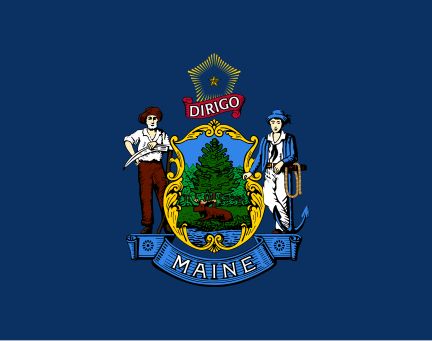
For the second time in a month, we have a major civic leader diving under the table instead of making a firm decision. After dithering for seven months, Maine Gov. Janet Mills (D) opted to let LD 1164 become law without her signature. Not exactly Profiles in Courage stuff. Why is this bill important? Because it opens up the Pine Tree State to iGaming, via the four tribes of the Wabanaki Nation. Three of them are aligned with Caesars Entertainment and one with DraftKings. Pouting on the sidelines are a variety of interested parties, including FanDuel, BetMGM and Fanatics, all of whom find themselves on the outside looking in.
Playing Indian giver is the National Association Against iGaming (NAAiG), which aims to repeal iGaming in the next Lege, citing 64% public opposition. Contrary to what you might think, it’s not a front for the Adelson Clan. Rather it’s a coalition of small-to-mid-sized gambling companies, ranging from Monarch Casinos & Resorts to Churchill Downs and including REIT behemoth Gaming & Leisure Properties Inc., plus sundry labor unions. Amusingly, the NAAiG spuriously swells its ranks by listing individual casinos owned by Monarch, Churchill Downs, Cordish Gaming, etc., as separate “members.” As for its dark threats against legislators who voted for iGaming, will the public really want it gone after it’s had a taste of online gambling? We strongly think not.
Also sulking are Hollywood Bangor and Oxford Casino, which are prophesying doom, gloom and hundreds of job cuts once iGaming goes live. Wall Street analysts, who were surprised by Mills’ indecisive decision, aren’t buying it. They note that A) Bangor and Oxford are minor revenue generators to their parent companies and B) they don’t believe cannibalization will occur. Then again, Big Gaming is only to eager to sacrifice jobs at any excuse. Meanwhile, prognosticator who expected complete iGaming inaction in an election year are now thinking that other dominos (Virginia, Nebraska, New York State) may topple as well.
As for Mills, while she has earned our admiration by standing up for her transgender constituents, her lack of resolve on this issue is another reminder why the 77-year-old governor should be discouraged from national aspirations. The similarly fossilized Sen. Chuck Schumer (D) has talked her into a senatorial run. Think about that. The ancient Mills would be 79 when she took office, if she won. If there’s anything this country doesn’t need, it’s more superannuated “leadership” at the top.
Sticking with tribal gaming for a moment, the disgraceful refusal of Polymarket to pay out wagers on the recent military incursion into Venezuela shows just how renegade prediction markets are. Or, as Indian Gaming Association Chairman David Bean said, “They’re making it up as they go along.” Bean darkly intimated that insiders were getting rich off the Venezuelan caper (it was probably Pete Kegsbreath), citing heavy action on the recent deposing of Nicolas Maduro. He’s hoping that Congress finds its testicles and amends the law to rein in event contracts (read: unregulated iGaming on demand).
As Bean said, “We have to keep up with the same message that this is illegal and unregulated. This is probably the biggest threat in the last decade and we have to take it seriously.” He’s absolutely right and the private sector needs to be as alarmed. As for people who wager on events that involve death and violent injury, they ought at the very least to be ashamed of themselves.

It’s not just the prediction markets who are not so much pushing the envelope as much rupturing it altogher. DraftKings is the focus of a seven-state lawsuit about some pretty sharp practice. It seems that while Jason Robins’ company has ostensible safeguards to prevent compulsive betting, those curbs can be circumvented at will. “Court records show that [Michael] Koester opened his DraftKings account in late 2021. He set initial spending limits on December 31 that year. Over the next two years, he deposited more than $25,000 and repeatedly increased his self-imposed limits without any enforced delay between request and activation,” reports Gambling Insider.
Whether through this sort of misconduct or limiting intelligent bettors, the OSB giants have made it amply clear that rules are for chumps and they’ll do what they like. Thus it falls upon individual punters like Koester and vigilant regulators (like those in Massachusetts) to hold the big boys to account. According to DraftKings’ interpretation of Michigan law, “a player could set a daily cap, wait for it to lapse, then request and receive a higher limit without any cooling-off period.” Like we said, sharp practice. By contrast, BetMGM and FanDuel have three-day cooling-off periods. So not everyone is exploiting bettors.
Shame on Michigan’s regulators for not taking action on Koester’s behalf, forcing him to go the lawsuit route. DraftKings has a long history of, at best, sailing close to the wind. It’s what you’d expect from a company that made its bones by offering sports betting under the paper-thin guise of “fantasy” wagering. As Gambling Insider reports, the Koester case “could shape DraftKings’ exposure across seven states and influence broader industry standards around betting limits and player protections. Beyond responsible gambling policy, the case threatens to redefine when sportsbooks can legally accept wagers.” Sounds good to us.