

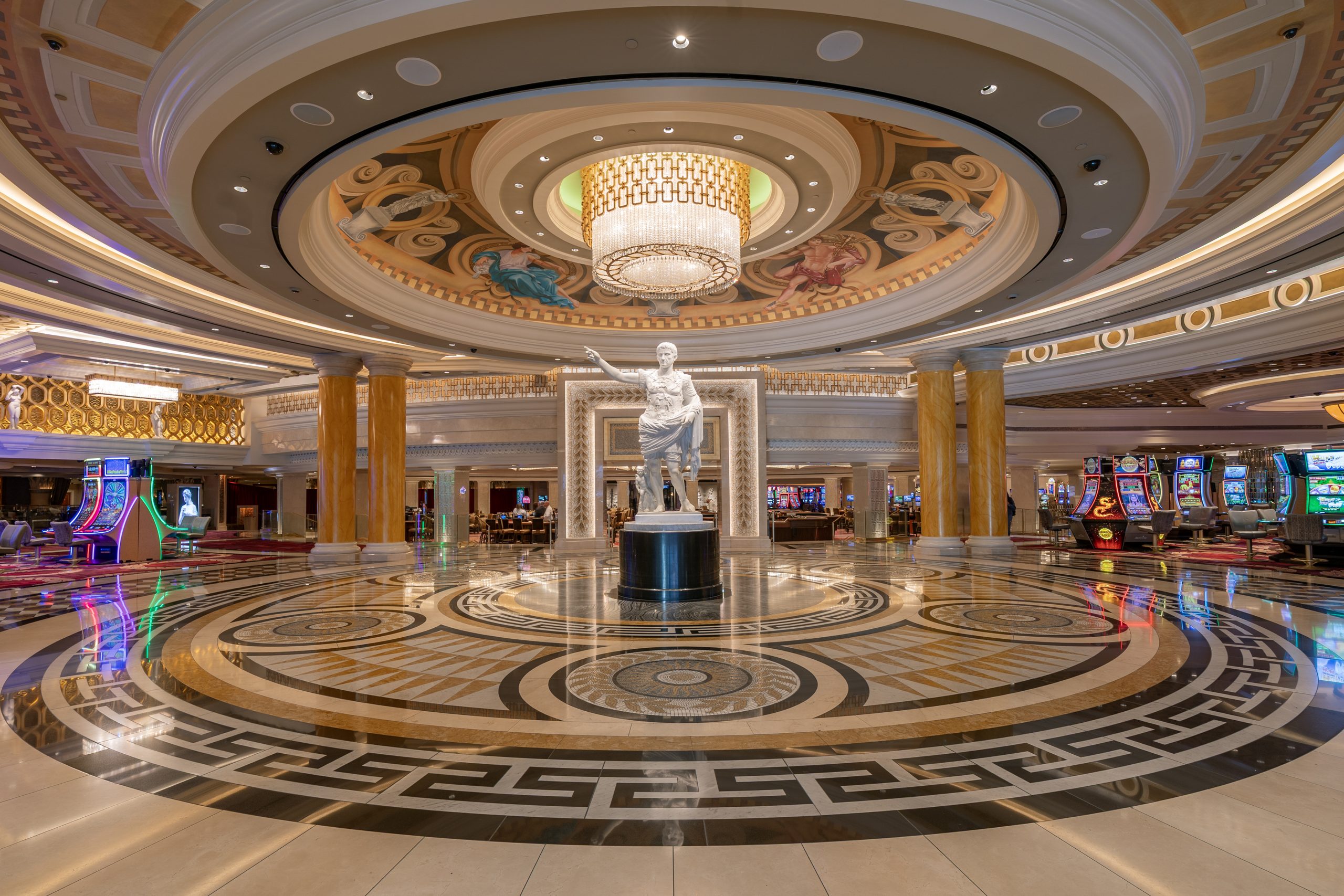
Coming in slighty ahead of Wall Street‘s expectations, Caesars Entertainment delivered cash flow of $887 million in the first quarter. (The Street anticipated $883 million.) J.P. Morgan analyst Daniel Politzer attributed the beat to “modest upside,” both online and in vexed Las Vegas. Caesars’ bread and butter, its regional casinos, were merely in line with forecasts. And management was keeping mum on the possibility of a Tilman Ferttita takeover or an insider LBO.
Execs described the Las Vegas Strip as “increasingly healthy,” business travelers as continuing to improve and leisure custom “firming up.” Added Politzer, “but absent large groups, there’s still some softness,” plus poor Strip hold is going to dampen 2Q26. The company, however, projects 20% iGaming growth this year, which would be impressive. Caesars brass “noted the market is strong when large groups are in town, but a toss up when they’re absent” from the Strip. A State Farm convention should help May business, just as the Con-Agg Expo lifted MGM Resorts International earlier.
If regional casinos weren’t outperforming, nonetheless Caesars forecast “healthy growth,” driven by the acquisition of Caesars Windsor, upgrades on Lake Tahoe, new Harrah’s Oklahoma and bowling business in Reno. Truist Securities analyst Barry Jonas was downright exuberant, saying, “The Strip feels better every quarter, with group strong and leisure improving.” He noted that Caesars’ $2.9 billion in quarterly revenue was a 1% outperformance to Wall Street’s forecast. Occupancy on the Strip exceeded 95% and ADRs were up a point. Looking ahead to 2Q, Caesars “now expects to be just short of last year’s mark, though overall is pleased with an increasingly healthier business as it cycles into easier comps.” Group business was also said to be pacing at record levels, compensating for average-Joe softness.

Nor is the new all-inclusive package-deal policy a loss-leader according to CZR. Jonas was told that the Roman Empire was running to profitability on the deals. Great! Furthermore, Caesars “is looking forward to the opening of the OMNIA Dayclub in May, the opening of Category Ten by Luke Combs at Flamingo later this year, and the full remodel of the Augustus Tower at Caesars Palace in early 2027.” Regionally, the company “continues to see positive results in its targeted marketing reinvestment strategy, as this drove increases in rated play Q1. Strong trends have continued into April as the regional customer continues to be resilient,” with no sign of gas-pump pain.
Unlike the unmourned Gary Loveman regime, the current one at CZR believes in aggressive reinvestment in its properties. Once Caesars Republic in Lake Tahoe wraps, the firm “will have successfully completed all major large planned regional capex projects since the completion of the 2020 merger ($3B+ invested in the last five years) and management expects to benefit from this investment moving forward.” Digitally, the Roman Empire still feels it is on track to a $500 million ROI. Last quarter, OSB handle was down 3% but company win still rose 9%. iGaming handle was a boffo $5.4 billion, with Caesars winning 18% more. Jonas reported that Caesars Digital “continues to improve its iGaming product, notably through content, better bonus capabilties, cross-play incentives and land-based tie-ins.” Good on them.
One dissenter from the overall celebration was David Katz of Jefferies Equity Research, who saw only “limited near-term improvement.” He added, “By contrast, market-specific tailwinds across the Regional portfolio should support stronger results through the balance of the year.” That’s in spite of Caesars beating his cash-flow projection by $21 million. Hard to figure.

Katz was even less clement to MGM Resorts International, downgrading it to “Hold” status. He questioned its growth prospects and “business model quality … Near term, Las Vegas leisure volatility and increasingly tougher Macau comps should mute growth prospects.” Deutsche Bank analyst Steven Pizzella took up the narrative: “Las Vegas was ahead of consensus forecasts, while all other segments were modestly below estimates.” Cash flow was $1.3 billion, a $21 million miss, with a Vegas outperformance largely sapped by a regional shortfall. Macao was also a $10 million miss. Highlights of 1Q26 were “solid group and convention business … including record convention ADRs and banquet revenue.”
Looking ahead “management noted Las Vegas has been named a target city for the NBA and are in active discussions with the league and team owners, in addition the College Football National Championship is in Las Vegas in 2027 and the Final Four in 2028.” Of course that doesn’t help with the here and now—but strong table hold and (pre-Spirit Airlines collapse) no cutbacks in flight capacity to Sin City certainly did. Looking ahead, Pizzella wrote, “we would expect shares to continue to be volatile, as the debate over the direction of Las Vegas continues.” Positive signs include continued China momentum (with Japan on 2030’s horizon), strong convention business in Las Vegas and BetMGM pivoting to profitability. Management continues to pine for a casino in Dubai, although the timing looks absolutely stinktastic. (Our view, not Pizzella’s.)
J.P. Morgan‘s Daniel Politzer saw Sin City as “slowly rounding the turn,” despite staying neutral on MGM stock. “While we don’t think the Strip is night/day vs. a few quarters ago, management commentary suggests it has stabilized and is on an encouraging trajectory.” According to MGM brass, the year has progressed from “tough” (January) to “looking good” (May). One positive augury of some note is that 33% of those customers buying all-inclusive packages were newcomers to Sin City. So what is MGM doing by closing its MGM Grand buffet to all those newcomers? Leo the Lion takes with one paw what he gives with the other. Revenues on the Strip rose mainly on non-gaming spending, as gambling revenue was down 4.5%. “Cost control remains a bright spot,” one stock boffin cheerily reported.

Truist Securities‘ Barry Jonas elevated his price target on MGM shares to $42, up from $39, explaining, “We continue to view MGM as well positioned to capitalize on a sustainable Strip inflection but remain Hold rated as we wait for more evidence.” MGM was drafting well off Consumer Electronics Show and Con-Agg business, as well as new initiatives at Mandalay Bay and the Green Monster. The company “also noted that MGM delivered record Q1 convention ADRs and drove increased production from its strategic relationship with Marriott,” one of the best moves the company has ever made.
MGM continues to look to “a resilient high end demonstrating strong spend in both gaming and non-gaming experiences.” As for the low end, Jonas expressed some doubts about the ultimate efficacy of all-inclusive pricing, observing that the affected properties represent less than 6% of MGM’s cash flow. Out east, Borgata and MGM National Harbor experienced some weather-driven adversity. In Vegas, management managed to blow $20 million on a single VIP party, so that had to be debited from the mostly good news as well. Still, the company “continues to believe that the increase in non-gaming amenities should help drive visitation and market growth over time.” Here’s hoping they’re right.

“Disruption” (as in construction) seems to have been the operative word for Station Casinos’s 1Q26. It diminished results in the early part of the year and David Katz of Jefferies Equity Research forecast some overhang stretching into 2026’s remainder. But the pain was thought temporary, leading to revenue gains from all the capex investment. Station eked out a revenue beat, $507 million rather than Wall Street‘s expected $505 million. Cash flow was a minsicule miss. Station did $10 million better than Katz expected in the casino and bit worse in hotel rooms. “The miss in room revenues was attributed to the ongoing renovations at Green Valley Ranch which are expected to finish this summer,” he explained.
Katz continued, “The company also announced the next phase of Sunset Station upgrades which includes enhancements to the movie theaters, relocation of the bingo area, and conversion of the buffet space to a high-end steakhouse and high-limit table games room. The project will begin in 2Q and are expected to end in early ’27,” for a tab of $87 million. He also expected a new-casino announcement soon, with an eye toward a 2027 start date. (Station’s various projects come on and off the back burner at a dizzying pace.) Katz added, “Fundamentals in the [locals[ market remain solid despite low macro visibility … Performance of the Durango high-limit area and parking are generating at least as-expected performance.“

Daniel Politzer of J.P. Morgan was more expansive in his blame of a soft March at Station, citing the Iran War, higher gas prices, TSA upheaval and insurance claims. He added that “Locals trends seem to have inflected positively, but we did not get the sense there’s much more to come re: tax refunds, the macro backdrop/war remains uncertain, and construction disruption continues to be a headwind (particularly at GVR, where the room renovation is behind schedule).” Politzer further pointed out, “it’s less appreciated that this market is effectively one of the last frontiers in brick/mortar gaming. There’s low risk of online cannibalization (Nevada has been among the most successful states fighting online/prediction markets), de minimis brick/mortar gaming supply risk (RRR owns most of the remaining gaming-entitled land), and minimal risk of higher taxes.” Given all those factors, he felt Station was worth 11X cash flow … although it once went private at 14X and THAT was a disaster.
For Barry Jonas of Truist Securities, it was a “rocky” quarter and the long-term prospects were no Hail Mary pass. He applauded a $38 million share repurchase and thought the stock a good buy on a depressed price. He noted that 1Q26 saw Station’s best-ever net revenue for that quarter and second-best cash flow. The gambling floor was one of the best “in company history, with continued strength in carded play, robust spend per visit and strong theoretical win across local/regional/national customer segments.” Profitability in F&B was also said to be near-record. Jonas furthermore reported that “April is on track to be one of the company’s best on record, notably seeing gaming strength and greenshoots in hotel ADRs.”
But don’t look for any bargains: Management “reiterated it is not in the promo business anymore as the market has changed in recent years. Management sees itself as serving higher-end customers, and thus are somewhat insulated from the value-seeking taking place in Vegas“
Sorry to be the bearer of such bad news, folks.
I was in Las Vegas as a participant for the Indie Vegas Film Festival which was held at the Aliante in North Las Vegas and the festival was lots of fun. Plenty of good films as I went to some on both Friday and Saturday. Out of all the local casinos I visited I was most impressed with The George at Durango.
The indoor/outdoor sports bar was amazing with multi giant TV screens.
Unfortunately I rented a car from Budget Rent A Car for 3 days and they tried to rip me off. The Base Rate was $163.48, Taxable Products/Services was $75.96 and the Rental Sales Tax is $20.05 so the total was $259.49 which is expensive but everything today costs more. But Budget added one more charge: Non-Taxable Products/Services was $263.15! I mean just to make up some random charges and hopefully the customer will not notice is not a good way to do business. What a joke. I complained on their website so I should get my money back.
Regarding my above comment I did get $120 returned on my credit card out of the $263 dollars so I wound up paying about $400 to rent a car for 3 days from Budget. They said an agent would call from the Las Vegas location but I doubt that will happen.