

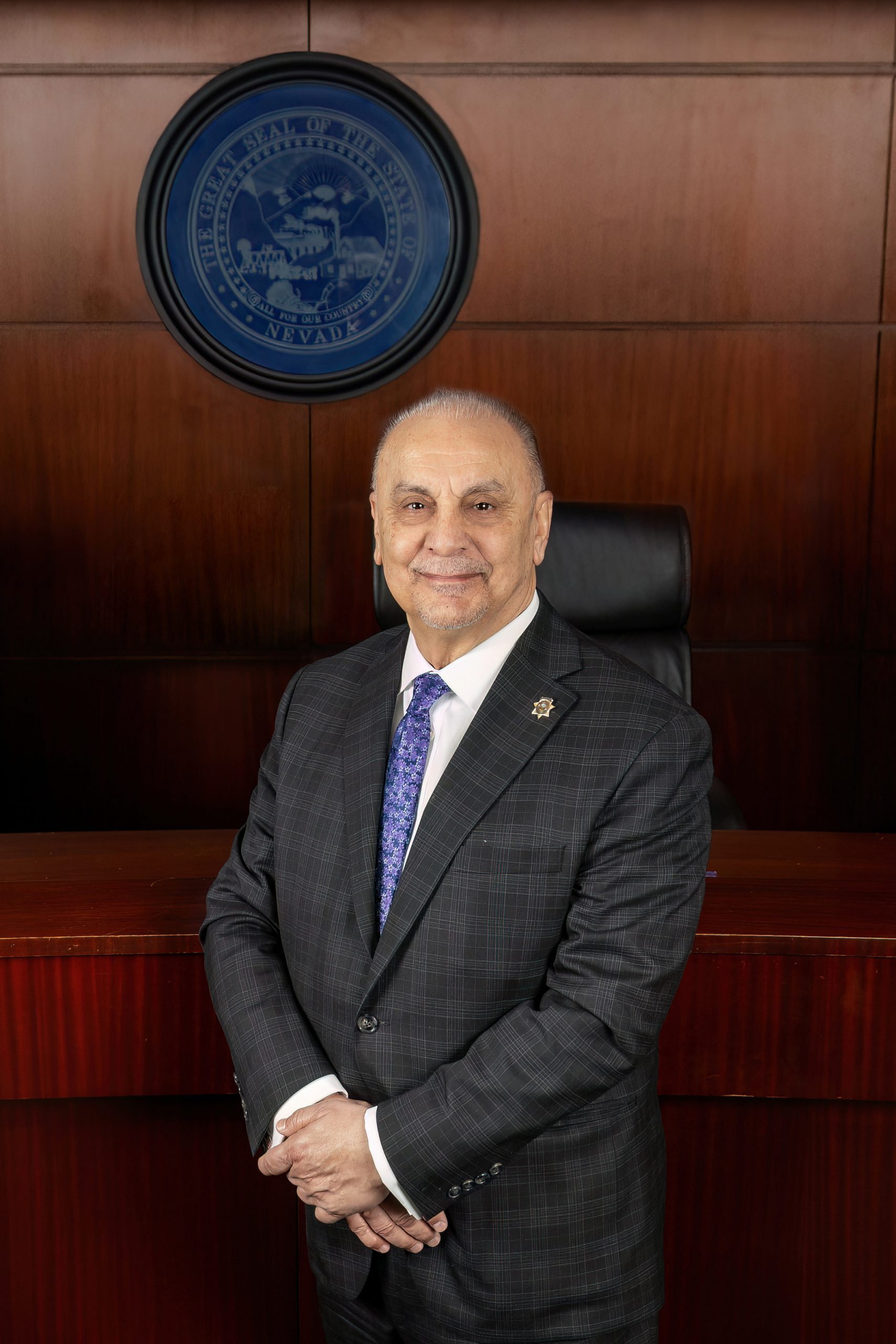
The Nevada Gaming Control Board‘s resident embarrassment, George Assad, would evidently like gaming stockholders to bend over and quietly take it in the shorts. Yesterday, the ancient Assad berated a Penn Entertainment activist shareholder for having the temerity—what sauce!—to defend the value of his stock against mismanagement by CEO Jay Snowden and others. The nerve of the man! Shareholder Parag Vora, that is. You’d think shareholders had rights or something.
Assad’s conduct was so egregious that NGCB Chairman Mike Dreitzer had to publicly reprimand him. The judicial reject and sexist fossil (Assad, that is) also berated fellow member Chandeni Sendall for daring to oppose him. It’s time this senescent troll vacated his seat on the NGCB. His installation there appears to have been an unfunny practical joke by anti-regulatory Gov. Joe Lombardo (R). This is the second time that Assad has abused his position to dump on Vora and accuse him of being untruthful. Never mind that Assad himself gives every appearance of having engaged in unethical, ex parte communications with Penn insiders. How else to explain the charges he flung at Vora the last time the unfortunate man appeared for licensure.

Mind you, per ace reporter Buck Wargo, 5% shareholder Vora has been licensed in several other states without anything untoward having emerged vis-a-vis his Penn activities. Then again, Nevada regulators make a practice of publicly fellating CEOs and—it would now seem—besmirching anyone who questions the high and mighty. We sure hope Vora got an apology to go along with his hard-won Silver State license. Dreitzer didn’t exactly cover himself with glory either, extending only a limited and highly conditional license. He also lectured Vora (and by implication, other activist shareholders) at length. Sample quote: “We don’t like it when investors are opportunistic toward licensees in ways that are unfair, not quite direct, or cute.” In other words, shut up and don’t you dare question The Man.
Given Dreitzer’s and Assad’s plantation mentality, you’d hardly blame Vora for throwing that new license back in their faces. He certainly showed saintly forbearance in the face of insulting verbiage from two of the three people charged with Nevada’s alleged “gold standard” of gambling, which sure looks like pyrite to us. The only appropriate conduct was Sendall’s. Per Wargo, she “said the Board is staying in its lane and would not support any motion where regulators are overly inserted between Vora and its business relationship.” (Assad’s lengthy and potentially slanderous remarks are so mind-boggling that we recommend you follow the link above and read them in their ghastly entirety.)
In sum, nobody puts the “ass” in “Assad” like old George.

Those of you who get your Depends in a bunch when we ponder the intersection of gambling and politics can stop reading here. Why? Because we spent a full 30 minutes this week discussing—gasp!—politics with American Gaming Association prexy Bill Miller (above). It was for a forthcoming Casino Life feature. However, we have a few excerpts to whet your appetite for the complete conversation. If you’re allergic to political issues, faint away …
We’re seeing a backlash against gambling, especially sports betting. Why is that and what can be done to counteract it?
The system is working when the system is flagging people that are trying to game the system. It’s unfortunate when some college kid is caught unwittingly in a sports betting scandal. But it is the system working. The system is flagging people that should not be betting on their own teams. Or, in the case of professional sports, violating league rules.
In these cases, like Jontay Porter, the legal, regulated system worked. It flagged anomalous behavior. It sent that to regulators, law enforcement and the leagues, and they took action. We are still in a reasonably new phase of this where, particularly for the athletes, some of them have been the face of deterrence.
What is the likeliest avenue for resolution of prediction markets (state legislators, lawsuits, Congress, the courts) and what do you see happening eventually?
We’ve been active in all of those. We have 41 state attorneys general that wrote to the Commodity Futures Trading Commission and said, ‘Hey, you’re violating our jurisdiction. Stop it!’ We now have legislation that has been introduced and socialized, in both the House and the Senate in Washington. We’ve had multiple states that have either outright made prediction markets illegal or sued the platforms in state courts, and been dragged into federal courts as well. I don’t think that this thing gets solved at the state level, simply because on a state-by-state basis it would become a pretty difficult process.
We’re now in eight or nine federal circuits, in court. There’s a pretty strong belief that this is the type of case that the Supreme Court would take up, because it involves the conflict of laws between state and federal governments, as well as tribal sovereignty versus the federal government taking that away. And there is the federal utilization of a federal statute in contravening other federal statues, including the Wire Act and IGRA. This becomes very appealing to the courts and it has been so far. Ultimately, if we’re not able to resolve this at the congressional level, we’ll fight this thing all the way to the Supreme Court — and win.

Then you have the curious case of congressional candidate Chuck Park (D), who would represent New York State‘s sixth district, in place of Rep. Grace Meng (D). We simply had to interview Park after he rolled out his proposed Game Over Act. It would, among other things, ban advertising of gambling. What anti-gambling nostrums does Park propose besides that? Read the full monty. You’ll find plenty of characters like Park at the crowded intersection where politics and gambling constantly collide (and which we’ve been covering right here for 19 years, for those who only just now are noticing).
Despite pushing sky-high prices until recently, casinos in Nevada have seen their profits shrivel by 81%. Eschatologists will take note of the fact that profitability fell by $666 million. Buck Wargo doesn’t speculate on the causes. However, at a time of 4.2% inflation, per the Department of Labor, of gasoline that is 41% higher than last year and of airfares (we almost wrote “air farces”) that have jumped 27%, the road to profitability for 2026 doesn’t look any easier. On the Las Vegas Strip in particular, the outlook seems precarious, with operator optimism sustained mainly by convention traffic. Even locals casinos are feeling the pinch. It hardly seems like the moment for morally hazardous LBOs … but try telling that to Barry Diller and Tilman Fertitta.

On a lighter note, a casino golf course in Louisiana got a surprise visitor this week. “Massive” alligator Big Daddy went out for a stroll, perhaps hoping to sate his appetite for some gambling—or some gamblers. Since Big Daddy has squatter’s rights to the area, L’Auberge du Lac personnel left him be, as well as showing a good sense of humor about it. Some casino execs would have had Big Daddy shot and then serve him for lunch at the buffet. Thankfully, these Penn Entertainment employees brightened our week with their enlightened live-and-let-live approach. Bon appetit, Big Daddy.