Less than a decade ago, the word “Vegas” couldn’t be uttered in the same paragraph with the words “Super Bowl,” and this month the city hosts Super Bowl LVIII. That’s a WOW for those who’ve seen the transition. Money talks. Yep! Anyway, the city that’s always been the next best thing to being at the game will be all that and more on February 11 whether you’re in the stadium or not. Not to mention the two weeks of hoopla in the lead-up. Of course, with an estimated 330,000 coming to town, we’ll have to deal with the traffic annoyances and flex pricing that come with all the big events, but that’s part of the deal. Every day there’s related news and we’re compiling it here.
As for where’s best to watch, you can monitor this blog, which will include as much information we can get (or link to) for parties and events. And as a failsafe, you pretty much can’t go wrong setting up in any casino sports book or bar.
Now that the Big Game is behind us, we’re continuing this post until all the post-mortems have been covered.
According to a story in the Guardian, nearly two in three bets made on this year’s Super Bowl were placed “illegally,” meaning with offshore sports books. Read the details in our Super Bowl blog, which so far seems to be the never-ending story.
Two-thirds of Super Bowl Bets Made Offshore?
According to a story in the Guardian, nearly two in three bets made on this year’s Super Bowl were placed “illegally,” meaning with offshore sports books. The Guardian cited research commissioned by the Campaign for Fairer Gambling from the gambling-analysis company Yield Sec, which determined that Americans bet $5.4 billion on the Big Game via 350.5 million wagers, of which 228.2 million for $4 billion were on offshore platforms. The Guardian wrote, “In its fight to overturn a federal ban on sports betting, legalization’s supporters argued it would ‘critically weaken’ illegal gambling platforms across the United States,” but comparing last year’s Super Bowl handle to this year’s, “the black market lost no ground” between the two. The article notes that the legal sports books take issue with these numbers. Indeed, American Gaming Association research found that 77% of bets on the 2023 Super Bowl were made legally. One thing seems clear: Many sports bettors, especially younger ones who live on their phones, don’t or can’t distinguish between “legal” and “illegal” sports books. The Guardian’s conclusion: Though the legal industry “is in this fight for the long haul,” it’s questionable whether the black market can be stopped at all.
How Soon Can the Super Bowl Return?
With the next three Super Bowls lined up for New Orleans, San Francisco, and Los Angeles, the earliest the Big Game could return to Las Vegas is 2028.Roger Goodell, the NFL commissioner, hinted at a second date during the official handoff of the Super Bowl football to New Orleans yesterday, saying, “The NFL looks forward to coming back.” And with everyone from broadcasters and players to Nevada Gov. Joe Lombardo agitating for a second go-round, Goodell said, “I got the message about having another Super Bowl in Las Vegas.” It’s safe to assume that Las Vegas officials will put in a bid for the 2028 game as soon as they can.
Super Bowl Handle Sets New Record
To no one’s surprise, Super Bowl LVIII set a new record for bets made in Nevada. The $185.6 million in wagers handled by the state’s 182 sports book broke the previous record of $179.8 million, set in the 2022 Super Bowl between the Cincinnati Bengals and the Los Angeles Rams. Upwards of 330,000 visitors came to Las Vegas for the weekend, according to analysts, 30,000 or so more than the typical Super Bowl weekend, helping boost the handle. The books won $6.8 million, a 3.7% hold, falling way short of the $18.7 million record set in the 2020 game between the Chiefs and 49ers. The Las Vegas Review-Journal reported that five of the eight $1 million bets placed on the game nationwide were booked in Las Vegas, three at BetMGM and two at Circa. Three were bets on San Francisco to win or cover the spread and two were on Kansas City to beat the spread. The Super Bowl also made television history; it was not only the most watched telecast of the Big Game, with 123.4 million viewers, it was also the largest television audience in 55 years, second only to the Apollo 11 moon landing in August 1969 seen by 125 million to 150 million around the world.
Super Bowl Line
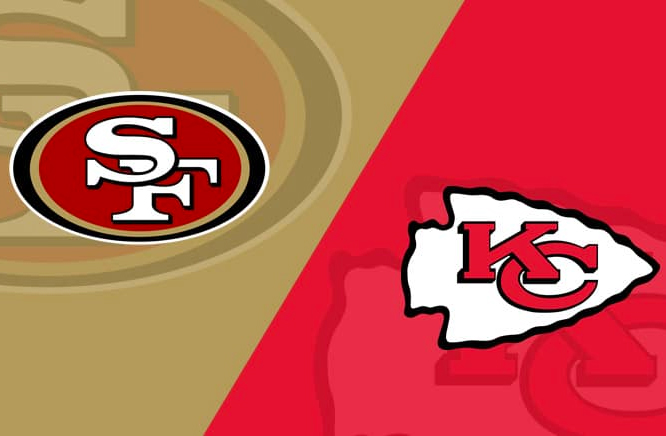
The closing line is the San Francisco 49ers -2 over the Kansas City Chiefs. The total is 47.
Last-Second Betting Deal
Westgate is dealing -105 today on the side only (not on the total). This promo was unannounced and just popped up today. And you can bet it in-person or on the Westgate app. Get some!
National Anthem Prop
The National Anthem proposition bet has become a Super Bowl fixture. This year’s line on the length of time it will take Reba McEntire to sing the Anthem is 1:30.5. It’s a low mark considering that last year’s time was 2:05 and the previous 16 years have gone over that time. In fact, in the 34 years that the prop has been tracked, the performance has gone under 1:30.5 only three times (Aaron Neville, Jewel, and Billy Joel). You can’t bet it in Las Vegas or the sports books in any other state; it’s put up in offshore books only. But it’s fun to track to get the game started.
Numbers Solid
The line for the game has been rock solid, with the 49ers -2 favorites and the total 47.5 almost everywhere. Circa has -1.5, but overall the line has seen the least movement of any we recall in recent years. With a day to go and late money coming in, however, there should eventually be some disparity for shoppers to grab.
6,000 Media Accredited by NFL for Super Bowl
According to the Las Vegas Review-Journal, 6,000-plus media representatives from 26 countries have been accredited to cover the Super Bowl 58 and related events here. They include sports writers, editors, and columnists, broadcasters, photographers, cameramen, influencers, and others. Luxor is the main hotel for media, Excalibur is handling the overflow, and “radio row” is at the Mandalay Bay Convention Center. Media interviewed for the story say they appreciate how “centralized the media access, practice fields, and stadium are compared to previous host cities.” Other than the 49ers’ practice field at UNLV and the Chiefs’ in Henderson, everything is walkable. The R-J notes that for the Summer 2024 Olympics in Paris, the IOC has capped accredited media at 6,000 and representatives in Las Vegas who’ve covered the Olympics are, reportedly, amazed that roughly the same number is covering a single game. And for better or worse, this all means a ginormous worldwide commercial for our humble little town.
Locals Paying the Price — Again
Though preparations for the Super Bowl have been going on “only” a month or so compared to the six-to-nine months for the Las Vegas Grand Prix and they’re mostly focused on the Strip and around Allegiant Stadium, local residents are again feeling the pinch from all the commotion. Newsweek has a story on Friday, “Las Vegas’ Super Bowl Headache.” It pegs the number of visitors at 450,000 and discusses the new traffic disruptions for the load-in that started January 3 and is culminating this week, along with the load-out that will last until next weekend. It also focuses on the homeless people who live in the storm drains and tunnels and are being forced to move, while the city isn’t providing any extra services. In fact, police are sweeping the encampments for security purposes, but according to a local advocate, “They come into these areas with dump trucks and backhoes. They literally dump their sleeping bags, tents, IDs, medications, and clothing into trucks and head for the landfill.” Finally, the economic impact, estimated at $600 million, will, according to Newsweek, barely filter down to Las Vegans; instead, as usual, the casino corporations post record profits and everyone else suffers. You can read the story here.
Crowd Number Rises to Half-Million
From the original estimate of 300,000 Super Bowl fans flooding Las Vegas this weekend, the number rose a couple of weeks ago to 400,000 and a CBS News story Friday morning upped the ante again to a solid half-million visitors. Most are flying in from all over, with 60 extra flights added by airlines, while 1,100 private aircraft have reservations to land and park at Reid, plus Henderson and North Las Vegas airports. That’s 100% capacity for the first time in history and the estimates we’ve seen are 400,000 people passing through Reid. And because no story about flying in can end without a mention of Taylor Swift, here it is.
Where Should You Watch the Game?
If you have a ticket, go to Allegiant Stadium and ask an usher to show you to your seat (careful of those steep stairs). Of course, most won’t have that option and will be looking for a good place to go to watch. As mentioned in the intro to this blog, you can’t go wrong just going to a sports book or any bar, especially the many non-casino pubs and taverns around town. But there will also be events and tailgates, many charging a fee, that you can attend. Following are several lists we’ve found that were compiled by other media entities with lots of options.
https://vegasmagazine.com/super-bowl-lviii-events
https://vegasmagazine.com/super-bowl-lviii-2024-events-game-day-allegiant-stadium-guide?
utm_source=newsletter&utm_medium=email&utm_content=READ%20MORE&utm_campaign=VEGA_Marketing_E-Newsletter_02052024
https://www.rotowire.com/article/beyond-the-big-game-the-best-super-bowl-week-events-in-las-vegas-79226
https://vegas.eater.com/2024/1/31/24055015/las-vegas-super-bowl-2024-tailgates-watch-parties-events?ueid=3ddffb0200b106e6cd61f79f953a6893
https://www.thrillist.com/lifestyle/las-vegas/super-bowl-guide-las-vegas
https://lasvegassun.com/news/2024/feb/04/not-going-to-the-game-a-weeks-worth-of-activities/
https://vegas.eater.com/2024/1/31/24055015/las-vegas-super-bowl-2024-tailgates-watch-parties-events?ueid=3ddffb0200b106e6cd61f79f953a6893
Kopper Keg Chili Cookoff
Here’s a good one you won’t find in these lists. The Kopper Keg bar on Rainbow is running a chili cookoff on game day. Patrons of the bar bring in their homemade concoctions, there’s a judging with prizes awarded, then everyone eats the chili while watching the game. Other prizes will be handed out. Shelly makes the best Bloody Marys. We’ll be stopping in.
$23.1 Billion To Bet on the Super Bowl?
The $1.3 billion estimated to be bet on the Super Bowl via legal channels is positively stunted compared to the total projection to be bet via all channels. That number, according to the annual survey by the American Gaming Association, is $23.1 billion. It comprises the bets on legal apps and at sports books, with illegal bookmakers and offshore betting sites, in pools and squares contests, and casually with family and friends. (Slightly more than 2,200 adults were surveyed.) By comparison, Iceland’s entire domestic economy is a couple of billion more than the projected handled at $25.6 billion and last year’s survey estimated a total handle of $16 billion (up 44.4%). The survey also indicates that a record 67.8 million American adults (26% of the adult population) are expected to bet on the Big Game, a 35% increase over 2023. Survey respondents were split on the bets, with 47% planning to wager on the Chiefs and 44% on the San Francisco 49ers.
Reduced Juice at South Point
As it does every year, South Point is dealing -105 for the Super Bowl, meaning you have to bet only $105 to win $100, as opposed to the standard $110/$100. It’s offered for sides and totals only, currently 49ers -2 and 47.5. There’s also a 10¢ straddle on the money line (20¢ at most other books), currently 49ers -125/Chiefs +115. The betting deal is also available in South Point-affiliated books at Rampart, along with CasaBlanca and Virgin River in Mesquite. Bets must be placed in person.
The Big Question
What’s the Super Bowl BQ? Who will win? How much will be bet? Who’ll be MVP? How will it impact Las Vegas in the coming months? Nope. None of the above.
The Big Question is whether Taylor Swift will make it back from Japan in time to appear at the game. Oh, and related to that, will her private plane be able to land and park at Reid International, given that the airport will reportedly be choked with private planes and all the landing and parking reservations are taken.
Swift’s ERAS tour is in Tokyo for four shows, but no less an authority than the Japanese Embassy has released the following statement. “Despite the 12-hour flight and 17-hour time difference, the Embassy can confidently say that if she departs Tokyo in the evening after her concert, she should comfortably arrive in Las Vegas before the Super Bowl begins.” Phew! One BQ answered.
As for landing and parking, no less an authority than Fox Business writes, “Swift and her team probably made [reservations] when Taylor and Travis [Kelce, the Kansas Chiefs’ tight end] first started dating, with a good chance the Chiefs were going to the Super Bowl. And even if Swift did have to settle for a last-minute plan, people out there would pull strings for the immensely popular singer-songwriter.”
We can all rest easy now.
Super Bowl Visitors: The Number Keeps Climbing
Up until today, estimates for the number of people deluging Las Vegas for Super Bowl weekend have been between 300,000 and 350,000. But in this morning’s edition of USA Today, that number seems to have risen to 450,000 or as the story puts it: “nearly half a million Super Bowl fans.” If it comes even close, it will be the most out of towners here for a single event in our memory, which stretches back nearly 45 years. The USA Today story concerns getting to, from, and around Las Vegas if you’re among the swarming multitudes attending the game itself or the watch parties up and down the Strip and downtown. It’s all common sense, with the advice boiling down to, “Plan ahead, keep your cool, and stay focused to be the winning quarterback of your team’s travel game.”
Super Bowl Room Rates and Ticket Prices through the Roof
Are you sitting down? Here some recent room rates and ticket prices for Super Bowl weekend, as researched by L.A.’s FOX 11.
Most hotels close to Allegiant Stadium are sold out, but for a low low $1,225 per night, you can stay at Staybridge Suites, directly across Russell Road (normally $145). That’s something of a bargain compared to rooms available at Aria ($1,300) and Fontainebleau ($1,447). Farther away, you can bunk at M Resort ($1,066) or Green Valley Ranch ($1,169) and the Best Western Plus in North Las is a mere $332 (normally $135). Head out to Pahrump or Primm to pay the usual $75-$99.
To see the Super Bowl live, the average ticket price on TickPick was just shy of $10,000 on Monday, with the lowest price $8,188. On StubHub, the average price was $9,300 on Monday. Last year, you could see the game in Phoenix for an average $5,800 and the previous record of $7,046 was set in 2021 in Tampa during COVID protocols when the stadium was at 33% capacity.
Super Bowl Betting: $1.3 Billion
LegalSportsReport is estimating that betting on the Super Bowl will reach just under $1.3 billion, breaking the single-game record for a sporting event in the U.S. Last year’s $1.08 billion will, if LSR’s prediction comes even close, easily be broken. Upwards of 175 million people of betting age will be able to make legal wagers on this year’s game in 39 different U.S. jurisdictions. Nevada is expected to boast the highest handle, $169 million, though it probably won’t break its own record of $179.8 million (bet on the 2022 Super Bowl when the L.A. Rams beat the Cincinnati Bengals 23-20), with New York following at $139 million and New Jersey $115 million. Interestingly, Florida, booking Super Bowl bets for the first time, comes in at fourth place with $90.4 million.
Hotel Rooms: Highest Ever for Super Bowl
According to a survey by STR, which provides analytics and marketplace insights for the global hospitality industry, visitors coming to Las Vegas for the Super Bowl will pay the highest room rates in the history of the Big Game. STR pegs the average daily room rate at $573 (each for Friday, Saturday, and Sunday nights) compared to the $559 in Miami in 2020, just before the pandemic. STR also projects that the Strip casinos will earn an additional $504 in revenue per available room, surpassing F1’s $390 by a full 25.5%. All in all, the Super Bowl is expected to generate $600 million in revenue for Las Vegas.
Super Bowl Teams Banned from Gambling
A recent QoD about where the teams playing in the Super Bowl here next month will stay noted that both hotels are way out at Lake Las Vegas. One commenter wrote, “Lake Las Vegas is 23.8 miles away. There have to be hotels closer to the stadium that meet the criteria.” Well, the NFL has laid out those criteria, which are all about gambling and the reason the teams are staying in non-casino hotels 23-plus miles from the city. “While in Las Vegas, players participating in the Super Bowl are prohibited from engaging in any form of gambling, including casino games and betting on any sport.” Other NFL players in town for the game can gamble, but not make sports bets, or even be in a sports book, until after the Super Bowl. Another QoD commenter wrote, accurately we believe, “Secluding the teams away from the the madness that will overtake Vegas enables the NFL to control the narrative and actions of the players. Staying closer increases the chances for problems to arise.”
Free FSE Super Bowl Party with the Starship
Downtown’s “Excessive Celebration Bowl Bash” will take place over four days leading up to the Super Bowl, starting on the Thursday prior and running right up to game time. The four-day party will include 25 live performances on the three Fremont Street Experience stages. Two acts got our attention: the Offspring, the long-time southern California hardcore punk band, and the Starship, featuring the original lead singer Mickey Thomas. The Starship will play Thursday and the Offspring Saturday, both at 8 p.m. Country singer-songwriter Chris Lane will perform Friday, also at 8 p.m. All the events over the long weekend are free.
Downtown Events Center Watch Party
As it does every year, the Downtown Las Vegas Events Center will host a watch party for the Super Bowl. It starts at 11 a.m. and is free, but you have to be 21 to attend. The game will be shown on two 22-foot LED screens with a half-dozen food and drink vendors and private spaces available for rent.
Reba Sings National Anthem
Country music icon Reba McEntire will sing the National Anthem at the Super Bowl next month. The 68-year-old Country Music Hall of Famer and three-time Grammy winner joins rapper-singer-actor Post Malone and R&B-soul singer Andra Day in performing in the pre-game ceremony. Usher, of course, will headline the half-time show.
Wanna Attend the Super Bowl?
The NFL playoffs are here and we’ll know who’s playing in the Super Bowl in a few weeks. As of this moment, the San Francisco 49ers and Baltimore Ravens are the favorites to face each other in Vegas on February 11. Both are number-one seeds and have byes in the wild-card round this weekend. Whichever the two teams in the Big Game are will be allotted roughly 11,000 seats each. The other 29 teams get 750 seats apiece, just under 22,000 total, and as the host team, the Las Vegas Raiders get 3,000 seats. That leaves around 15,000 seats for everyone else, including the general public. Currently, seats for sale on Ticketmaster, the NFL ticketing partner, are currently ranging from $10,250 to $36,750, depending on where in the stadium they are. Those prices should come down the closer the game gets; tickets for last year’s Super Bowl in Glendale, Arizona, settled between $5,500 and $6,000 at game time, but that was in a stadium with 11,000 more seats than Allegiant. Also, walking distance from the Las Vegas Strip is a much bigger draw than the boonies of the Valley of the Sun. So prices aren’t expected to drop too much from current levels.
Las Vegas Gears up for Super Bowl
CBS, this year’s Super Bowl broadcaster, will launch a week-long “residency” in front of Bellagio in anticipation of the Big Game next month. The multiplatform coverage will include sports, news, and entertainment originating from four outdoor sets on the sidewalk overlooking the Bellagio fountains shared by the likes of the pregame show “The NFL Today,” “CBS Mornings,” “Super Bowl Live,” “The Talk,” “CBS Evening News With Norah O’Donnell,” even “The Drew Barrymore Show,” and more. If you’d like to see the staging set-up, there’s a rendering here. Also announced: “Homecoming Series and Taco Bell Innovation Summit,” a weekend-long party will take place on the vacant lot across from the Wynn (and owned by the Wynn) where the Frontier used to be. On four nights starting at 9 p.m. (Feb. 8-11), a live performer or DJ will provide entertainment for 2,500 to 4,000 guests in a 41,000-square-foot main tent and a 12,000-square-foot Taco Bell sponsor tent. Details on how to attend forthcoming.
Super Bowl Construction on the Strip Begins
Lane disruptions at the intersection of the Strip and Flamingo will start tomorrow in preparation for the Super Bowl on February 11. CBS, which will air this year’s Big Game, will require two southbound lanes for the load-in of construction materials and broadcast equipment; 100 hours of Super Bowl weekend programming will emanate from atop the Bellagio fountains on four stages. The sidewalk will also be closed, though at some point, one of the traffic lanes will reopen to pedestrians. Road closures around the stadium begin next Monday, but go into full gear toward the end of the month, with full roads closed to traffic through February 15.
Super Bowl Tailgate
Guy Fieri is sponsoring a major tailgate promotion prior to this season’s Super Bowl in Las Vegas. Touted as “part food festival, part music festival,” the celebrity chef and TV personality is putting on Guy’s Flavortown Tailgate next to Caesars Forum and the High Roller observation wheel at the LINQ Promenade from 10:30 am to 3:30 pm on Super Bowl Sunday. The party will provide food and drink (including alcohol) from more than two dozen pop-up stations, along with performances by entertainment artists. Admission is free, but you have to secure a ticket to get in. [LINK https://guysflavortowntailgate.com/freeticket/] Tickets for VIP tables are also available for a mere $7,500.