

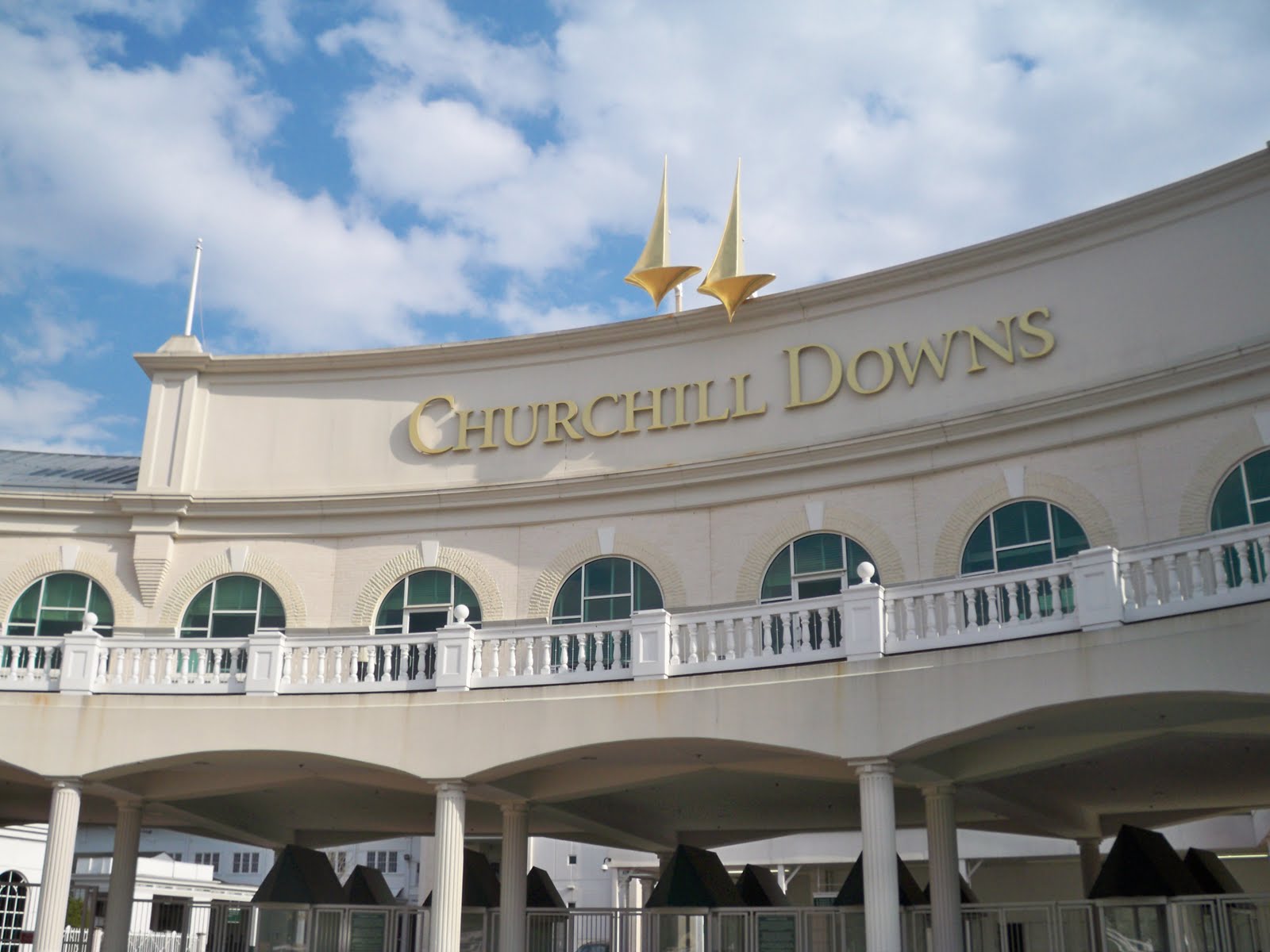
In a coup that did not take Wall Street completely by surprise, Churchill Downs revealed last week that it had obtained the IP rights to the financially troubled Preakness Stakes. This gives CHDN control over two of the three legs of the Triple Crown. For $85 million, Churchill Downs gets the Preakness and Black-Eyed Susan Stakes, as well as 2% of handle therefrom. The state of Maryland remains in control of the track, in which it plans to invest $400 million. “In short, CHDN will generate fees from the Preakness and Pimlico under new state operation, with little formal operating influence, although, given the state’s intended investment of $400M to reposition the track, we expect CHDN to be involved,” summarized Jefferies Equity Research analyst David Katz, noting the obvious synergistic benefits to owning both the Kentucky Derby (which continues to prosper) and the Preakness.
The Preakness had been sold to Maryland by Stronach Group for $1 two years ago. Its TV ratings had been sagging over the past three years, even as the Kentucky Derby did so well it is moving to prime time. (17.7 million viewers for the Derby vs. fewer than six million for the Preakness.) Also, in-person attendance was shattered by Covid-19 and now is a shadow of its pre-pandemic self. As Katz put is, “With a relatively limited upfront investment and viewership and attendance levels 30-40% of its historical peak and of the Derby, CHDN has acquired a premier horse racing asset with visible upside potential.” In other words, it’s hard to see a downside.
On top of that, Churchill Downs slightly beat Wall Street expectations for 1Q26 earnings. It had revenue of $663 million and cash flow of $257 million. (The Street anticipated $661 million and $254 million respectively.) Casinos came up a bit short but wagering services made up the gap. Weaknesses at CHDN casinos in Mississippi and Florida were blamed, as was the removal of some slot machines in Louisiana. Live racing and “historical racing” (read: slots in drag) were on the money, pretty much.

In its earnings call, management (naturally) highlighted a third consecutive year of strong Kentucky Derby revenue, augmented by the completion of its Mansion Suites and Finish Line suites at its eponymous racing oval in Louisville. Not only is a total sellout projected, a day of racing was added yesterday and the Kentucky Oaks race was moved to primetime. Elsewhere in Kentucky, CHDN’s casinos are that now in everything but name, as the company continues to add electronic table games. Understandably, the market is far from mature and plenty of room for growth is foreseen.
Churchill Downs also went two-for-two with Virginia Gov. Abigail Spanberger (D), who thankfully nixed “skill” games and a Fairfax County casino, while the Lege failed to act on iGaming legalization, also to CHDN’s relief. In return, Churchill Downs will keep investing in the Cavalier State. The temporary casino in Petersburg, a Cordish Gaming project, has made serious inroads into several of CHDN’s Virginia markets but management either pooh-poohed or ignored the issue. It did note that low-end, unrated play continued to be soft, a problem that is extending into its second year. One thing CHDN didn’t do this quarter was to repurchase shares, something into which Wall Street puts too much stock … pun intended.

David Katz also applauded the conservative course and “appropriate strategies” charted by Boyd Gaming. To see the glass half-full, Boyd was buoyed by its Midwest/South regional casinos. The empty half of the glass would be Las Vegas, where Katz saw “challenging destination trends” and construction upheaval. Boyd hit its 1Q26 numbers on the head: $997 million in revenue and cash flow of $317 million. Explained Katz, “Continued growth in play from core customers offset weakness in the firm’s destination business and construction disruption from ongoing renovations at Suncoast.” Favorable weather propelled a 5% increase in regional biz. Las Vegas locals and Downtown business were as much as Katz expected but he remained disappointed in them.
For Deutsche Bank analyst Steven Pizzella, the good regional news seemed to be outweighed by the Sin City disappointment. Fortunately for Boyd, its butt is covered when customers stay closer to home, as they are doing now. Also, core players are said to be playing strongly. The debut of Cadence Crossing was described as having been met with an “enthusiastic response.” The consensus seems to be that no one is going to miss 33-year-old Joker’s Wild. Obsolescence comes so fast in Vegas. Sigh. In any event, Cadence Crossing and a revamped Suncoast are expected to goose flat locals business, while Downtown continues to languish (-4%), although customers from Hawaii are said to be still steadfast. At least the company is already counting on a $45 million-$50 million federal tax refund. Isn’t that heartwarming?
Looking ahead, Boyd plans to spend as much as $700 million this year, largely in Norfolk ($300 million), as well as enhancing new Cadence Crossing ($50 million) and rejuvenating The Orleans ($75 million), which could use it. The latter was identified as Boyd’s weakest link, as tourist business continues to suffer. ($4.93/gallon gas ain’t helping.) At least The Street could take comfort in $155 million in recent stock buybacks, the kind of spending it likes best.

Sometimes it’s better to be lucky than good, as in the case of Penn Entertainment CEO Jay Snowden. In spite of Snowden’s shambolic online strategy and thanks to its legacy of strong terrestrial casinos, Penn beat 1Q26 estimates. theScore Bet is performing better than expected (and better than ESPN Bet, go figure). A two-week closure of Hollywood Aurora in Illinois will cause a 2Q revenue hiccup, as will the startup costs of iGaming in Alberta. But none of that dimmed was said to be a strong first trimester, with M Resort‘s relaunch successful and Ameristar Black Hawk being singled out as a star performer. Bossier City and Council Bluffs were said to be absorbing new, rival products. Solid results were hailed out of the two St. Louis casinos, as well as outperforming Hollywood Joliet, “even despite higher gas prices and other macro uncertainty,” as Truist Securities analyst Barry Jonas framed it.
Reinvestment in Penn’s products is paying off, with a new hotel at Hollywood Columbus next up, along with a brand-new Hollywood Aurora, plus Hollywood Council Bluffs coming in 2028. theScore Bet lost $11 million but that’s $78 million less than ESPN Bet blew a year earlier. Online Hollywood Casino experienced record levels of play, jumping 15%, while marketing costs for both OSB and iGaming were curbed by two-thirds. Maybe Snowden is finally getting a handle on this digital thing. Not only is Penn leadership unfazed by imminent slot routes in Chicago, it’s planning to carve itself a piece of the action via its Prairie State Gaming subsidiary.

Penn’s stock price leapt 17% on the good news, as the company “is executing well against meetable/beatable targets,” according to J.P. Morgan analyst Daniel Politzer. Although Penn’s share price is currently languishing around $15, Politzer thinks that if Caesars Entertainment is worth $32/share or more, Penn merits $27/share. Although he thinks the company could come hunting for assets cut loose by the Roman Empire, he also believes management will “remain disciplined.” (Penn? Disciplined? That’d be a first.) He projected full-year revenue of $5.8 billion and cash flow of $1.9 billion.
David Katz, by contrast, remained skeptical of Penn’s online schemes, noting a third downward revision of its guidance in the past year. He observed that Penn outperformed Wall Street‘s revenue projection by $30 million (nearing $1.8 billion for the quarter), as well as its cash-flow one ($429 million, a $16 million beat). We congratulate Penn on a job well done and hope that a corner truly has been turned.
Wonder how much the cost of gas in CA ($6.00 for regular) is affecting the number of trips there and back. $4.93 would be nice in Los Angeles. It will come back down again, but how long it will take is anyone’s, and I mean anyone’s guess. They underestimated how much the murderers running Iran do not care about its people.