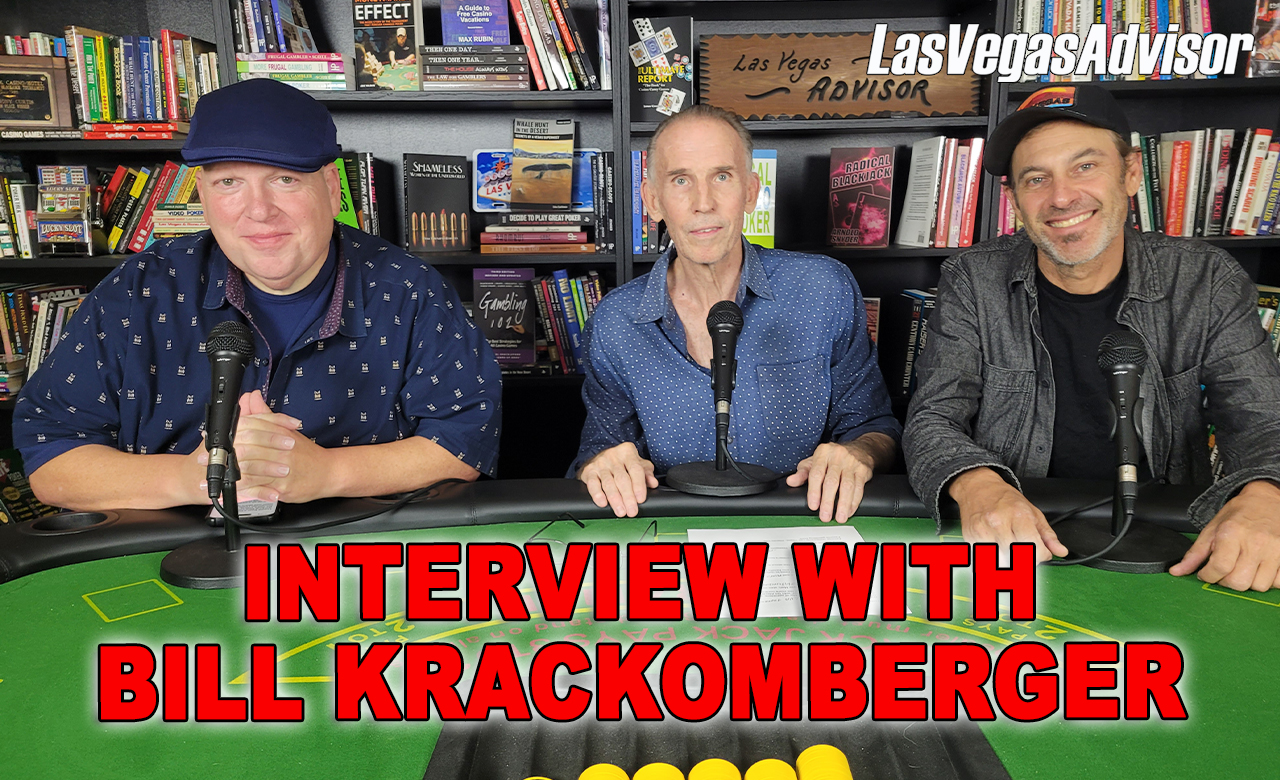
Not so long ago, Huntington Press published Michael Kaplan’s Advantage Players, and I was given a review copy so Richard Munchkin and I could interview Kaplan on one of our irregularly scheduled episodes of Gambling With an Edge.
I took the book along to an out-of-town casino promotion to read during the plane rides and some other downtime. After reading about how many different gamblers and others use their wits to increase the odds in their favor, I came up with my own — on the spot.
We were on the right side of variance this weekend and were leaving our hotel room at 6:30 in the morning in order to catch a shuttle to the airport. I had just under six figures of cash and unredeemed slot tickets packed away.
As it turned out, there was a body building competition in the same hotel that weekend, and approaching Bonnie and me were two huge guys — both well over six feet tall — possibly 280 pounds of ripped muscles stretching their form-fitting T shirts. I don’t know why, but these guys didn’t look happy.
I’m 78 years old, pushing a walker, with my right hand in a splint (actually a “spica”) due to recent thumb surgery. Bonnie is older than me by a few years, and time has bent her posture some. It was like we were wearing signs saying “Easy Targets,” or maybe “Easy Pickin’s,” and I was carrying way more money than I wished to part with.
I gave a grim smile at the guys and said, “Good morning. I hope the casino is nicer to you than it was to us.” The guys laughed and let us pass easily — apparently sizing us up as two losers who were down on our luck. Not worth messing with. Which was definitely some more positive variance from my point of view.
Were we ever in danger from these guys? Probably not. (Obviously, to me at least, I was giving up everything if they demanded. We had no relevant defense, and resisting could get us hurt – or worse.) Logically speaking, these guys had spent multiple years and thousands of hours of hard work to create their “perfect” bodies, and beating up old folks would be stupidly putting that at risk. But I couldn’t know that for sure until it was too late, and something was irritating them. So, I acted preemptively. And it worked.
Most AP plays work only some of the time. Most of them shift the odds a bit – say from 49-51 against you to 51-49 in your favor. Still, plenty of room to miss any particular time, but if you constantly work with such an edge, you very likely will prosper. (If you don’t go broke first. There are definitely bankroll issues here that we’re avoiding talking about at the moment.)
One of the parts of the book that reminded me of my own past was in a section about Phil Ivey — who is certainly in the conversation for being the greatest poker player of all time. Phil grew up in a lower-middle class neighborhood, and experienced going broke more than once when he had to sleep outside under bridges because he couldn’t afford anything better.
Paraphrasing, Ivey maintains he learned to play with an advantage because he had to win. He had no safe landing spot. In a sense it’s like being a cornered dog — hyper-alert and ready to pounce on any opportunity. While he is quite well-off financially these days, he remembers when that wasn’t true. While he doesn’t need that extra edge today for survival, he has those skills to fall back on — which takes him to the next level.
For me, it was similar, but not identical. My family wasn’t rich, but I did get help going through college (the undergraduate years, anyway), and so I had solid educational degrees and some job skills when I went broke playing backgammon in 1980. Had I not succeeded at the time, there was some family money I could access, probably. There would have been recriminations and a whole lot of being forced to eat humble pie — which I really wanted to avoid if I could, but that strikes me as a lot less onerous than being forced to live outside under bridges.
For me, it was the fear of going broke that drove me — not the actuality of being broke. I got very nervous when I didn’t have sufficient dollars in the bank, “in case.” I knew the machines gave and they took away and I didn’t have the knowledge or tools to properly calculate bankroll. I usually could figure out if I had the advantage, but I never knew if that advantage was enough.
So, when I moved to Vegas in 1993, I was obtaining and consuming $10-for-$5, $7-for-$5, and even $3-for-$2 table game coupons by the hundreds each month. They were a lot more plentiful back then and $200-$300 per month came from those. I would drive ten miles to pick up $10 in free play and thirty miles across town to pick up $25. I specialized in finding ways to double up on promotions — sometimes day of the week, sometimes time of day, sometimes two or more drawings, miles apart, in the same night. Sometimes partnering up with others — you pick up my free play at here and here and I’ll pick up yours at there and there.
One casino (the Sahara) had a “slot club” where if you bought so many red racks of dollar tokens you would get a free meal. So, I’d buy them from one change booth and sell them at another. (One poster a few weeks ago said he did a similar thing at about the same time with quarters at the Gold Coast. He said it struck him as a “Dancer” thing to do. He was right, although the Gold Coast wasn’t on my radar at the time. But the Sahara was.)
I specialized in examining the rules of most promotions. Often there were loopholes — sometimes pertaining to starting and ending times — where the alert player could gain an edge. Since I had at least some computer programming background, I was able to understand do-this-and-then-do-that versus do-this-only-if-that versus do-this-only-if-two-other-things-happen-first. Understanding that sort of logic was often very effective against marketing departments who would put out a new promotion this month while only tweaking slightly the rules from last month. It was a lot of work on my part, but I was scared of going broke, so I did it.
Gambling is applied math, and the design of promotions requires being good in left brain thinking. Many casinos, fewer than before, like to hire right brain “people people” to work in their marketing departments. For me, this has always been exploitable.
Today the fear of going broke doesn’t drive my actions, but I still read rules and look for loopholes. Age has diminished some of my smarts and skills (and I never was in Phil Ivey’s league smarts-wise), but the skills I learned years ago still seem to be working.