Posted on 4 Comments

This Game Tonight

Bob Dancer

The following incident happened while a friend of mine was playing slots, but there’s enough in common to gambling at video poker that I think it’s worth discussing.

“John” was scouting a casino in Las Vegas looking for slot machines in positive conditions. There are many, many slot machines that are sometimes positive — but most of the time, on each of these machines, the house has the advantage. Most players, however, are not aware of when the game is positive or not and simply play the game, quitting whenever they feel like it. Sometimes they quit when the game is positive, and then when the next knowledgeable player comes by, that player typically sits down to play it off. 

John has “strike numbers” on perhaps 20-30 different slot machine titles. That’s nowhere near all or even most of the beatable machines, but still, it’s more than most players know.

He found a game for $25 a play that he thought might be positive. This is a much larger game than usual for slot players. Most players can’t afford to play this game, but the size of the game was not a showstopper to him. He shifted the denomination on the machine so that it showed the $10-per-play game and consulted his notes. The $10-per-play game was nowhere near a positive play at the moment, and other pros seeking games would walk right by. He wanted time to think about this situation without drawing attention to the game.

His notes said that the game was a play when a certain meter was at 15 or higher — and sure enough this meter was at 16. So, it was a play. His notes also said the game is highly volatile. He knew that on a volatile $25 game, he could easily win or lose several thousand dollars. If he played this game in this situation several dozen times, he figured he’d make a sizeable profit. But there was no way to tell at the outset whether this time would be positive or negative.

He had $3,500 on him. He figured that would cover the swings most of the time. He wouldn’t likely run out of money, but if he did there were people he could call. He didn’t like making these calls — partly because that meant others would have the right to call him when they ran out. He trusted himself to run out of money very rarely, but some of the people he called wouldn’t have the same discipline. But if he asked for help, he had to be prepared to give help to others in the future. He didn’t want to open that door.

He actually called me to ask my opinion. John and I respect each other’s knowledge and have helped each other out occasionally. I know him well, know how he handles swings, and I thought he should go for it. I wasn’t in Vegas at the time, and he was, so there was no way I could get money to him if he ended up needing some.

He was just about to start when another pro, “Peter,” approached him and asked if he were going to play the $25 game. John knew Peter vaguely. He’d seen him checking out machines but wasn’t sure how knowledgeable he was.

John said yes. He thought it was a good play and he had the bankroll to play it. Peter said he had the bankroll too, but wasn’t in the mood to risk his daily score on such a volatile play.

Peter, it seems, had been losing recently and was sort of gun shy. He didn’t trust his own judgment, so he didn’t want to play such a big game. He could likely find a sizeable number of smaller games where he could increase his bankroll by dribs and drabs rather than making a big jump one way or the other all at once.

Peter said he had a few thousand dollars on him and suggested they partner up for this one game. John thought about this. It had some positive aspects to it. It essentially guaranteed he wouldn’t run out of money. 

At the same time, John had never done business with Peter before. Was he trustworthy? Who was going to eat the W-2G if there was one? Peter was friendly now, but what if Peter was the one playing when the bonus round hit and denied making a deal? So John passed and played it by himself. Peter wished him luck and left.

As it happened, the bonus round went off rather quickly and John ended up making $900. This was a nice result, but it certainly didn’t have to be that way.

I want to look at Peter’s reaction to this. Peter had actually seen the game first and passed on it. He had the financial bankroll — but not the emotional bankroll — to play the game. So, I believe he was right to pass.

Everybody has his own emotional bankroll. Respecting your bankroll parameters, both financial and emotional, is critical to long term success at gambling. I also think that Peter suggesting they be partners was a move that made sense for him. This would lower the swings and lower the risk. So now it might have been within his comfort zone. 

It couldn’t have been too much of a surprise for Peter that John turned down his offer to partner up. That’s probably the usual result. But you don’t know unless you try. 

All in all, the situation was well played by both men.

Posted on Leave a comment

Coctel de Camarones (Longhorn/Bighorn)

Coctel de Camarones (Bighorn)

We’ve written on many occasions about the Longhorn on Boulder Highway, but not often about the Bighorn on E. Lake Mead Blvd. in North Las Vegas. They have the same owners and are similar, including both having restaurants with good deals that are a big part of their success. However, we pay more attention to Longhorn, which is bigger and more accessible for most. Both have a camarones special. Bighorn caters to a predominantly Hispanic customer base; hence, the coctel de camarones probably started there, then replaced the shrimp cocktail at Longhorn. It’s available 24/7 in the restaurants for $7. We tried it at Bighorn.

Served in a big glass bowl, it’s made the traditional Mexican way with cucumbers, tomatoes, lime juice, and chips on the side. There are about 10 medium-sized shrimp and you can drink the broth when you’re done. Same as the Longhorn, the food in this restaurant is good and just about everything on the menu qualifies as a bargain.

Posted on Leave a comment

Delilah (Wynn Las Vegas)

Delilah (Wynn Las Vegas)

The dinner show. It was a big deal in casino showrooms a few decades back. You bought tickets to see a headliner and dinner came off a prix fixe menu and was served during the performance. With a few exceptions — Tournament of Kings at Excalibur, for example — that version of the dinner show is long past. Supper clubs with live music were also a thing. Those, too, are rare these days, though more easily found in some non-casino restaurants. Recently, two casino venues have headed back down the dinner-and-show road: Mayfair at Bellagio and Delilah at Wynn Las Vegas. We tried Delilah. Note that photos and video aren’t allowed there. We snuck in a couple, but had to go with mostly stock photos from Wynn for this review.

Room

The room is a big part of the overall experience. It’s designed as a 1950s’ Vegas showroom, but it also has a speakeasy feel, with a bar in front and a big dining area and show stage. We’ve heard complaints about it being too dark inside, but we didn’t find that to be the case. Cool place.

Dinner

Fancy. Expensive. Good. What else would you expect? We were on a comp with a big group that opted to order for the table, so we were able to try several dishes. The seafood tower was ridiculous, featuring lobster, king crab, shrimp, and oysters. It cost $299, but easily served seven, so really a $43-per-person appetizer. The big deal here is Delilah Beef Wellington. We weren’t blown away and at $189 (serves two), you can go a less-expensive route, e.g., grilled branzino ($59), ora king salmon ($53), or roasted heritage chicken ($47). Steaks start at $79 for an eight-ounce filet. Sides run $19-$37 for dishes such as carrot soufflé, broccoli di ciccio, black-truffle mashed potatoes, buttermilk-ranch chicken tenders, and a decadent mac & cheese — excuse us, macaroni gratinée made with mimolette cheese fondue & black truffle béchamel. Fancy. Expensive. Good. Here’s the menu. There’s late-night dining with a small less-expensive menu (nothing more than $49) Thurs.-Sun. from 11 pm till close.

Show

“Dinner show” is a misnomer here. You won’t see a show. The entertainment consists of a main stage with a live jazz band and singer doing classics. There’s a raised platform in the center of the room where female dancers perform, along with dancers near the stage. The performances by the singer and dancers are low-key and non-interruptive, with neither hindering conversation at our table. It makes for a pleasant dining atmosphere.

Reservations

Make them as far in advance as you can As mentioned, we were with a comped party, so we don’t know how difficult it is to get a seat off the street. However, Delilah was included on a list from Vegas Luxury magazine of the “8 Most Sought-After Reservations in Las Vegas.”

Summary

Delilah isn’t for everyone, but it’s certainly an option for something different and if the prices don’t bother you, it’s a worthwhile experience. The food wasn’t on a level of Vegas’ best, but neither was it disappointing. The whole thing seems to go best with a group rather than just two on a date. The weekend late-night option might be a good way to check it out on the “cheap.”

Posted on 1 Comment

UnCommons — UnCommonly Inferior

The Sundry — Latest Overpriced Food Hall 4

In the December LVA, we wrote the following:

Bar Oysterette and Center Bar in the Sundry Food Hall at the UnCommons complex (I-215 and Durango Rd.) has a happy hour Mon.-Thurs. from 4 to 6 pm, with $3 beer, $8 wine and cocktails, and $3-$5 appetizers, including $2 oysters.

Two-dollar oysters is something we always review, so we did. Guess what? The oysters are $3, not $2. That’s not a good happy-hour special, although the bartender thought it was, because they’re $4 non-happy hour.

The one good part of the experience was the oysters. They’re served six for $18 and the presentation is beautiful: Three Blue Points and three Arcadians, accompanied by cocktail sauce, a mignonette, fresh horseradish, and lemon.

It’s a good plate, but $3 per isn’t a deal. On top of that, the whole UnCommons/Sundry thing is just plain odd. Despite a trainload of hype and what seemed like a compelling dining program, our experience at UnCommons was uncommonly more bad than good.

Way Out There

UnCommons is located directly across Durango Rd. from Durango Casino about 10 miles west of the Strip. You can get there relatively quickly taking the I-215 freeway or going west on surface streets, but it’s a trek.

Hard To Find

Yes, it’s directly across from Durango Casino, but it’s still almost hidden. Look for a small street off Durango called Maule to access.

Hard To Get In

Bar Oysterette is in the Sundry Food Hall. There’s only one sign outside over the main entrance that’s not on the main street, but faces the parking garage, but it’s fairly obvious which building it is. The problem is getting in. We walked to three apparent entrances (not the main) that were locked, then finally found a small unmarked door that was open. Are they trying to keep people out of there?

Cafeteria-esque

The space looks like a big warehouse. But not a chic New York-style industrial space. More like a big cafeteria.

Not Cool

Maybe we were expecting too much, but for whatever reason, we thought there’d be kind of a hip vibe, with the cool upper-crust of the southwest valley hanging out. No. We were there during happy hour and nothing could be described as cool going on. The bar itself is underwhelming.

Uncommons — Uncommonly Inferior

Mediocre HH

In addition to the dollar bump on the oysters, the rest of the happy hour is nothing special—$3 sliders, $5 tacos, $4 beer, plus PBR and a shot of Jameson for $11! At Downtown Grand, a PBR and a shot of Evan Williams (the “Joe Special” at Furnace Bar) is $3.50.

New-Age Menu/Ordering

This is another no-paper-menu QR code ordering system. If you’re over 40, you probably don’t like it. Get the whole story on that in this earlier review.

Parking

There’s a garage with two hours free. So that’s good. After that, it’s $3-per-hour up to a 24-hour max of $15. There’s also some street parking, but with 30-minute time limits.

Summary

We’re not sayjng don’t go, we’re simply pointing out what you’re in for if you do. Heck, you could parlay with a visit to Durango Casino, which is worth at least a one-time visit. Park at Durango and walk across the street. But there’s not much reason to go just for UnCommons.

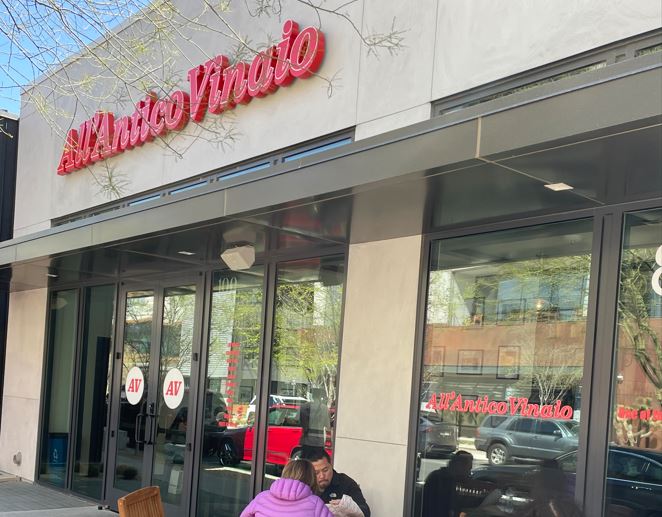
Or maybe there is, at least according to that hype train. The latest buzz is all about the “world’s greatest sandwich shop” from Italy, All’Antico Vinaio, coming to Vegas. It opened yesterday at … UnCommons.

Posted on Leave a comment

Super Bowl Vegas update

Bobby Vegas: Friends Don’t Let Friends Play Triple-Zero Roulette

What I’ve learned? AFGE. AFGE? That’s “Another Effing Growth Experience.”

So we’re sitting at the bar at Circa last March and my client, a national sales manager, tells me my Encore Villa gig (see previous post) was the best corporate event in the company’s history.

I already knew that. I saved them $100,000 and launched their new EV-charger line, selling a million simoleons’ worth in 90 days. But I’m cool, so I say, “Let’s do it again. For the Super Bowl! Upstairs at Stadium Swim.

He’s cool too. “I’m in for fifty K.”

“Great!” (Lesson One: Stop talking after you close the deal.) And we go to dinner at Barry’s Prime.

Lesson Two: Get it in writing.

Lesson Three: Get my fee upfront.

A month before the event, he cancels.

Now, I’m a guy who grew up in very unstable environments, so I always have back-up plans. Yes, plural: sometimes back-up plans to my back-up plans.

So it was good I’d made a completely separate set of reservations and, since I’d been greasing palms, I flip the deposit. Phew. But wait! What?

My casino host quit? Ruh roh.

Okay, but are my reservations still good? Yes? Pass the CBD, please.

See, I still have a dozen folks flying in and those rooms I booked last August? They’re gold today, literally half-price for Super Bowl weekend. Should I have resold the cancels? Hmm.

Then the corporate guys are on the fence. “Well, we might go.”

Lesson Four: Bang head on desk. Repeatedly. ’Til numb.)

“Wait. The other sales manager is going and he wants two extra rooms.”

Oh! The ones I cancelled because of you? ARGHHH.

Well, it’s a good thing I’m on a first-name basis with the entire reservations department, so I take three back and they give me my original rate. How good? $875 for Super Bowl weekend Downtown Grand Gallery Tower kings, Friday through Monday, taxes and resort fee included. Today those rooms are $1,600. And I still have 11 reservations.

And did I mention that I employed my Super Bowl futures strategy? (Lesson Five: Hedging is a good bet.) I’ve won on the Super Bowl three years in a row (Bucs, Rams, Chiefs). I expected to blow this year, but guess what? Even though I had the Lions and Ravens, I’m still carrying the 49ers and am a 100% Brock Purdy fan. I am, however, nervous about the Taylor Swift effect and the very dangerous Chiefs juggernaut. Well … we’ll see.

To be continued …

Posted on 5 Comments

Sick at sea (but not seasick)

As I write this, I’m off the coast of Florida, aboard the Icon of the Seas, presently undergoing a somewhat shaky shakedown cruise. Unfortunately, Yr. Humble Blogger has been stricken, not with mal de mer, but with the aftereffects of what was probably undercooked food, of unknown provenance. As such, I’m ill-positioned to provide any more industry news and analysis until we dock on Friday. Wednesday’s dinner was spent surrounded by loathsome, loudmouthed Wall Street fatcats. Now I now what Hell is like and really don’t want to go there. Perhaps that’s what made me ill.

Posted on 4 Comments

Shin Lim Limitless

Shim Lim Limitless 1

Shin Lim is a 32-year-old Canadian-American magician. At age 24, he won the prestigious Fédération Internationale des Sociétés Magiques award for close-up card magic. He’s also the only contestant ever to win the “America’s Got Talent” competition twice, the first for Season 13 and the second for AGT’s first “The Champions” tournament, beating out 50 winners and notable acts from a number of previous seasons.

So we’re not exaggerating when we say that Shin Lim might be the best card magician of all time. His show at the Mirage demonstrates his skills so well that you can hardly believe that what you’re seeing isn’t actual magic.

But it’s not just Lim’s show. He shares the stage with a Scottish magician-comic, Colin Cloud, a fast-talking young Scot with a lilting brogue. He opens the show and immediately launches into his interactive shtick. His first trick with audience members’ cell phones alerts you to the fact that Cloud might be to mentalism what Lim is to sleight of hand.

When Lim does his first card trick, you know what the “AGT” hullaballoo was all about. He rips a card in two and puts it back together, right before your lyin’ eyes.

Three big screens broadcast Lim’s handiwork, a giant one toward the back of the stage and two smaller ones, though plenty big, on either side. We were sitting four rows up from the stage in the far-right corner, directly under the screen, and we watched in awe as Lim’s delicate fingers manipulated the playing cards, making them appear and disappear as if he had his own personal vacuum cleaner into oblivion.

Early in the show, Lim provides some backstory; he trained to be a concert pianist until he was diagnosed with a bad case of carpal tunnel at age 20, then determined to pursue his magic career. He plays “Fur Elise” on an onstage grand piano for a bit. He talks very little, allowing the magic and the ever-dramatic soundtrack to speak for themselves. The backs of cards change suits. A joker turns into a $100 bill. He turns all the cards in a deck into a single card of an audience-member’s choice, then thousands of that card drop from the ceiling. Smoking cards emerge from his mouth. Cards magically change places in a plastic bag. And those are just the ordinary tricks!

Meanwhile, Colin Cloud is reading people’s minds, complete with props: a word guessing game from a book about Sherlock Holmes, his idol; the celebrity-photo installment (Elvis, of course); an elaborate act with four audience members and a receipt; random numbers that when turned upside down spell out—well, we don’t want to spoil it. The combination of the two performers keeps the show lively and provides some welcome variety.

For these performances, you do want to sit close to the stage; the seats toward the back of the 1,100-seat Mirage Theater will present a challenge, even with the big screens. But the prices of tickets are certainly reasonable; for our seats in the far corner, we paid $52.29, plus a $12.82 service fee and $9.95 for order processing, a total of $81.06. Get as close to the screens as you can.

Considering the excellence and differences of the performances, the soaring production values, and this day and age of through-the-roof ticket prices, Shin Lim’s Limitless can, in our opinion, be considered a bargain.

Posted on 5 Comments

A Variety of Games

Bob Dancer

Today I play different video poker games at different casinos — usually the highest-returning games offered in denominations that interest me. It wasn’t always this way.

In the “good old days,” which for me were the mid-1990s, the best $5 and higher games almost everywhere were 9/6 Jacks or Better. With slot clubs and promotions, this game could be played with an advantage at a dozen or so different casinos in Las Vegas. I learned the game 100% accurately and it was just a matter of putting in the hours, assuming you had the bankroll to survive the swings. Borrowing the title of a Josh Axelrad book that was based on playing blackjack, this was a matter of “Repeat Until Rich.” And I did. And many others did. 

There was some strategy choosing at which casino to play, and when. Casinos offered point multipliers sometimes, or had a promotion where they invited a lot of players in and gave away lots of money over a weekend — usually by a slot tournament or by a drawing — and if you played then, sometimes you got a piece of that money. Not every time, of course, but when you’re already playing a game where you have the edge, these extra “pieces of money” add up. In a typical year, I’d play in maybe 75 events (meaning some weekends I played at two different events), and collected the extra money at 10 or 15 of them. 

Back then, mailer money in Las Vegas was rare, whereas today it’s common. Today, it’s rare when I play 9/6 Jacks or Better. At the five casinos I play the most (limiting the discussion to video poker and not including playing slots, which I also play), I play five different games. Actually, more than five, because at two of the casinos, there is more than one acceptable game. I “rotate” which game I play depending on the monthly promotion.

And the games I play vary in denomination. At one casino, I play dollar single line, meaning $5 per hand. I’d prefer to play larger, but the higher-stakes games at that casino aren’t good enough. And the dollar game, plus slot club, mailers, and promotions, provides me with enough benefits that I keep playing there. 

I’m no longer playing just in Las Vegas. No longer just in Nevada. Although I’ve mentioned some other places I play periodically, and there are some I haven’t mentioned, it’s still a surprise to me that a resident of Las Vegas can find better video poker out of town. Don’t expect me to announce exactly which game I play at which casino. At some of the places I play, the good situation would not last if lots of players were playing it.

Playing a number of games keeps me sharper than playing just one game. Plus, 9/6 Jacks or Better is arguably the simplest game to play well. Every additional game I learn has special one-of-a-kind sorts of situations that I have to master. And when I do master them, sometimes they provide inspiration.

There is also the issue of keeping the games straight in my mind. The combinations that are the toughest to keep straight are the 3-card straight flushes versus two high cards, suited or not. Every game has its own rules and going back and forth between games, it’s easy to get mixed up. It’s also easier for a senior citizen to get mixed up than it was when I was still “in my prime.” 

So I find myself practicing more today than I did before. Just before I go and play a game I haven’t played in a month or more, I’ll spend a few hours mastering it again. I can get so I can play a game 100% perfectly, but it takes regular review to stay at that level for a number of different games simultaneously.

And it is no longer, “Repeat Until Rich.” The available edges are smaller today. Casinos continually become savvier and savvier in what games and promotions they can profitably offer. Casino mistakes are still out there, and I still try to exploit them when I find them, but they aren’t as numerous, as large, and don’t last as long as they did before.

There are still some players who do well, of course, and I am one of those some of the time.  But I believe the number of players who regularly exceeded $100,000 annual profit was higher twenty or twenty-five years ago than it is today. 

Still, I’m out there trying. It’s what I do. It’s what I enjoy. It’s part of what keeps me as intellectually sharp as I can be at my age. Yes, I’ve shifted to also playing slots as well as video poker, but video poker remains my mainstay. And probably will so long as I can find good games — even if those games aren’t the same ones I’m playing today.

Posted on 1 Comment

Bally’s screws up; Nastiness in D.C.

Forget that handsome rendering up above. It’s ‘inoperative,’ as the Nixon administration used to say of statements that weren’t true. Why? Because Bally’s Corp. struck water in its plumbing of the future site of Bally’s Chicago. More specifically, it discovered that driving caissons to support a 500-room hotel would damage water pipes along the Chicago River. Oops. “We need to come up with a different way to build a tower because we can’t now put it on Chicago Avenue,” explained Bally’s Chairman Soo Kim. Funny, but it took 13 months for Bally’s to reach this conclusion.

Continue reading Bally’s screws up; Nastiness in D.C.
Posted on Leave a comment

Podcast – Nicholas Forte – Pastry Chef episode 14

Podcast - Nicholas Forte - Pastry Chef episode 14

Nicholas Forte is the corporate pastry chef for Tao Group – west coast. What drew me to Nick’s story is that straight out of pastry school he went to the only 3-Michelin-star restaurant in the state of Nevada, and said, “I want to work here.”  He got the job at Joel Robuchon. You can see examples of Nick’s work on his Instagram account. https://www.instagram.com/fortenj/

You can reach me at [email protected], or find me on Twitter @RWM21. If you like the show please tell a friend you think might like it, or if you are really ambitious leave a review wherever you listen.

Podcast – https://www.spreaker.com/episode/nicholas-forte-pastry-chef-episode-14–58384447