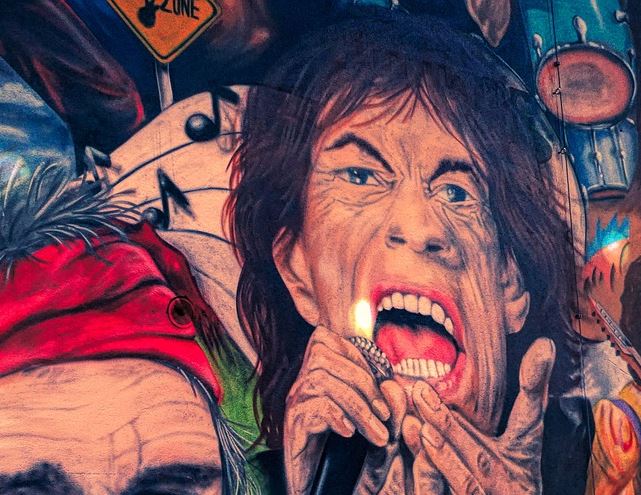
A million bands play rock and roll. Only one band is rock and roll. And since perhaps no city is more rock and roll than Las Vegas, I always make it a point to try and see the Stones in Vegas whenever they come through town.
The Stones played at Allegiant Stadium on Saturday. I’ve written previously about the benefits of staying within the Mandalay/Luxcalibur campus if you’re going to a game at the stadium. What I hadn’t realized before is how much the Delano improves on that.
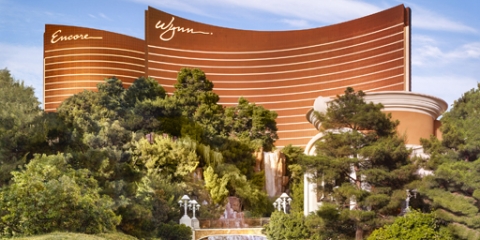
For those who don’t know, the Delano is the “extra” building that’s part of Mandalay Bay, just as Encore is for Wynn and Palazzo is for Venetian. The key here is that Delano is a half-block closer to the stadium than Mandalay itself, which makes the walk all the more easier. Not only that, but the elevators at Delano are on the stadium side of the tower, only a few steps from the exit. The elevator practically spits you out onto Hacienda Avenue, the street that goes over I-15 and connects the south Strip resorts to the stadium. It’s closed to vehicular traffic on event days and becomes a giant pedestrian mall.
I’ve seen the Stones before in an outdoor stadium (Giants Stadium) and indoor arenas (MGM Grand Garden, Madison Square Garden), but I never in an indoor stadium. The crowd was geared up and ready to party and the band didn’t disappoint; it never does! They came right out of the gate with classics like “Start Me Up,” “Let’s Spend the Night Together,” and “Get Off Of My Cloud.”
The large enclosed space gave rise to some echoes in the sound, which enhanced some songs and muddled others. But Mick’s vocals and Keith’s guitars were as solid as ever.
Every time I see the Stones, I think, this could be the last time (to quote a lyric to a song they didn’t play), as they can’t keep this up forever. Then, a few years later, I see them again and they’re stronger than before. Keep in mind that these guys are 80 years old! And they move around and dance in a way that I can’t do (30 years their junior) and what’s more, that I couldn’t do when I was half the age I am now. Mick definitely got more steps in, prancing around the stage, than I did on the walk to the stadium and back.
The backup performers were all top-notch and the Stones bring in a huge, crisp, high-def video screen that’s even bigger than the permanent screens in the stadium. The smell of pot (or any smoke at all) was practically nonexistent, which was a pleasant surprise.
There was an opening act that I’d never heard of and didn’t care about. The Stones went on at 9:15 for an 8 o’clock show and played two solid hours of hits. When the show was ever, exiting was a breeze and I was back in my room at Delano a mere 20 minutes after leaving my seat.
In a town full of world-class entertainment (on the same night, in fact, you could have also seen such huge draws as Carlos Santana or Justin Timberlake), there’s nothing like a Stones concert in Vegas. When they come around again in a few years at age 83 or 84 or even 85, I highly recommend going to see them. Just make sure you rest up beforehand and bring some extra energy. You’ll need it more than they will!
Casino revenues aren’t quite what they used to, at least not recently. It was inevitable. The casino business has been so supercharged for so long after Covid-19 that some customer pullback was bound to happen eventually. After all, the first law of economics is that what goes up must come down, sometime.
[Editor’s Note: This trip report was sent to us by frequent LVA correspondent extraordinaire, Peter B, who took advantage of his Platinum status at the Wynn, which includes a free buffet for two during the month of members’ birthdays. Platinum is the second tier in the Wynn Rewards system (between Red and Black); earn 7,000 tier credits and you’re in. Get the details here. Other Platinum benefits include free self-parking, $10 birthday freeplay, priority seating at the buffet, two Wynn Master Classes for two, and a $100 spa credit.]
I just enjoyed my Wynn birthday-month Platinum comped $150 comp at the buffet. It’s not as big as the Bacchanal at Caesars Palace, but as far as I’m concerned, quality prevails over quantity. There are no big Asian or Latino sections, but that’s not what I’m looking for at at high-end buffet. There’s a salad bar, but who wants to pay $75 for rabbit food? I go for the protein.
The Wynn is generously matching tier with Caesars Platinum (free with no annual fee VISA card) and Fontainebleau Silver. For MGM Pearl (no-annual-fee MasterCard)and Mirage Legend (free for NV locals), you have to make a little detour through Silver, but once you’re on the “upgrade tour,” you’ll be able to figure it out. This is good through the end of May. Here are Wynn’s rules.
The Wynn Platinum card is good until 1/31/2025. To get the birthday-month $150 credit, show your players card and driver’s license at the Rewards desk and tell them where you want to spend it.
The line for walk-ins was long and though the one for people with pre-paid reservations was shorter, flashing my Platinum card allow me to skip both and I got seated almost immediately. Good to be a VIP.
The seafood section was great: cold Maine lobster and Dungeness crab claws, steamed snow crab legs, large cocktail prawns, sushi, and much more. Even cute little caviar thingies. This is my little seafood appetizer with lobster claws, Dungeness crab legs and jumbo prawns.
Carving station has excellent garlic-infused prime rib, filet mignon, leg of lamb, all perfectly cooked. The filet mignon was very tender and lean, one of the best cuts of beef I’ve ever had at a buffet. Ask for medium rare from the center or more done from the end.
These are the cute little caviar bites. The orange is actually salmon roe on an edible spoon.
Tip: Most buffets have little plastic or metal cups for the cocktail sauce, jus, horseradish, salad dressing, drawn butter, etc. at the various stations. Not so much at the Wynn, but you can pick up an empty glass cup at the steamed crab leg station and fill it up from the big container.
I don’t care much about filling up on bread, pasta, and pizza, but it did all look good.
Unlike in previous years, the $150 birthday-month dinner credit now covers only the food, so it’s enough for two at $74.99 apiece (no sales tax on comps). Alcoholic drinks are extra. I opted for the endless pour, which came down to about $40 with tax and tip. When I asked for a drink with the nice birthday dessert surprise tray they gave me, burning candle included, the waitress told me I was two minutes over the two-hour time limit. But she asked her supervisor and got me a big cup of Prosecco to go anyway.
The Wynn is one of those few places where the customer is still king. You can get just about anything, as long as it’s a reasonable request.
At the end, they gave me a birthday dessert platter with gold-like glitters and a burning candle. No singing, fortunately!
Self parking: Insert your Platinum or higher card at the entry gate and it opens, no ticket. Do the same when you exit. Best to park on the second floor, so you don’t have to take an elevator to casino level.
Funny observation: Several guys throughout the place have big signs reading “Knowledge.” Apparently, they’re there to help first-time visitors find their way.
The Lake of Dreams has a bunch of new shows, every half-hour after dark. Not many people know about it. They’re free to watch from the balcony behind the front desk.
After a week of mostly shaky earnings reports, ‘business as usual’ from Wynn Resorts came as a benison to Wall Street. The company’s cash-flow results surpassed analyst expectations, by $17 million in Macao and by $7 million at Wynncore. “Overall, we found the commentary around both Macau, and, to a lesser extent, Las Vegas, to be constructive and favorable, despite tougher comparisons on the horizon in Las Vegas,” wrote a relieved Carlo Santarelli from Deutsche Bank. Wynn’s Macanese casinos delivered cash flow of $340 million, as they grew to 14% of market share. Hotel occupancy ran at 99% and Golden Week saw business improving still further.
With help from the Super Bowl and despite the absence of the CONAG conclave, Wynncore improved its cash flow 6%. Reported Santarelli, “It was a strange 1Q24 in Las Vegas, with non-gaming growth coming in at +16% Y/Y, while table game drop was up just 60 bps and slot handle fell 4.9% Y/Y … While the stagnation in gaming trends is worth monitoring, management noted that drop, handle, and RevPAR in Las Vegas were all up in April.” New renderings of Wynn Al-Marjan were also bandied about, with the $4 billion project still on budget. Elsewhere there was “excitement” about the tantalizingly delayed prospects in New York City (below) and “interest” in Thailand, though many moving parts there remain to come into focus.
Management went cheap on Encore Boston Harbor, scuttling a $400 million improvement due to a tax spat with the city fathers of Everett. The money instead will be spent on Wynncore, particularly on a rehab of the Encore tower. There’s also a food hall in Macao to be built and just getting underway. Santarelli was impressed … but not enough to move his price target above $132/share, although his rating remained “Buy.”
David Katz of Jefferies saw things slightly differently, writing that momentum in Macao was offsetting top-line weakness on the Las Vegas Strip. He stuck with a “Hold” rating and price target of $122/share. Joseph Greff of J.P.Morgan thought the numbers out of Wynncore “highlight its high-end positioning in LV, which in turn is allowing it to perform above its LV peers, particularly in non-gaming.” He continued, “Overall, we think investors should be pleased with these results … Management acknowledged that comparisons are getting more challenging but that market-wide attractions continue to boost demand.” His price target was also $122/share and his rating “Overweight.”
“Mixed results, poised for long term growth,” Katz wrote of Station Casinos. The company delivered $489 million in revenue where Wall Street had expected $492 million. Cash flow was off a hair, $209 million instead of The Street’s $210 million. Construction disruptions at Sunset Station dampened results slightly, as (more than slightly) did worse-than-expected gambling hold during the Super Bowl and March Madness. Katz reported that “Durango [Resort] operational performance continues to improve, attracting new consumers to the brand and increasing play from existing, and [leadership] remains confident the margin target and return goal will be achieved sooner than expected.” We don’t doubt them.
Durango Resort expansion and Inspirada are both “go” projects, as is the North Fork Rancheria tribal casino in California. At least $313 million will be spent on share buybacks and total leverage is coming down from 4.4X cash flow to something closer to 3X. Katz recommended a “Buy” on the stock, with a price target of $71/share.
Santarelli called the Station results “as expected.” Of the miss, he was relatively dismissive: “we struggle to imagine buyside forecasts were meaningfully north of Consensus, though the after-market stock action, albeit on limited volume, would say otherwise.” “Broadly uneventful” were his words for the earnings report, with a 20% ROI on Durango offsetting a 9% declivity elsewhere in the Station portfolio. As the analyst put it, “While [Station] properties do skew higher end, management did not note a distinction across the various assets, but we believe Durango is likely helping the aggregate, as it pertains to what management is seeing across the database.” Ominous noises, however, were made about “efficiency measures,” always a euphemism for job cuts. Like Katz, Santarelli rated Station a “Buy” albeit with a price target of $65/share.
Greff was the most clement of the three, saying the results were “in line” with expectations. Hey, what’s a couple of million among friends, really? (Station missed pretty marginally, unlike Boyd Gaming, which shook Wall Street’s confidence in the latter.) He noted that titular Red Rock Resort was suffering most from the Durango effect, something which that long-suffering property could do without. Station execs were quoted as saying “as we look ahead, we are seeing stability in the locals market and across our entire database … [the] low-end of the business, it’s actually up for the last two quarters in a row.” That’s cause for confidence, even if Greff was the most conservative in both is rating (Overweight) and price target ($62).
If Station knows where it is going, the same apparently can’t said for Golden Entertainment. Katz opined that the company was “Turning a page, but still searching for the next chapter.” Santarelli concurred: “Strategic direction thebig question now.” The latter was the more confident, rating GDEN a “Buy” against Katz’s “Hold,” with a $36/share price target. “In our view, as it pertains to locals gaming and or lower end Strip trends, the bloom has been off the rose in Las Vegas for a bit now,” Santarelli wrote apropos Golden missing his cash-flow projection by $2 million. Company execs echoed Boyd ones, saying that promotional warfare was up and low-end business is down. Although “well positioned for nearly any strategic action scenario” with an enviable 2X debt-to-cash flow ratio, Golden isn’t inclined to take on new acquisitions, especially after the divestitures of 2023. It appears that the company will concentrate upon stock repurchases instead.
Katz noted, in Golden’s defense, that revenues came in a bit ahead of where The Street expected, despite the cash-flow miss. “More importantly, the sale of the last non-core asset was completed, allowing the company to reduce leverage and focus on capital returns and future M&A opportunities,” he added. The low-end softness was felt most at Arizona Charlie’s, which saw sharp declines of both revenue and cash flow. Mind you, Golden no longer has slot routes to offset the variability of the brick-and-mortar casino biz. At least the tavern business, Golden’s bread and butter, came in slightly ahead of where Katz thought it would be. In other good new, occupancy at The Strat rose notably, hitting 78%, while the opening of Atomic Golf was expected to add as much as $5 million in annual cash flow. As for taverns, Golden just bought two more, bringing its flotilla to 71, with a family of 160 hoped for by 2027. Fore!
We’ve been writing all week and are getting rather blurry (and we’re not done yet), so we’ll see you on the weekend with a special edition.
This post is syndicated by the Las Vegas Advisor for the 888 casino group. Anthony Curtis comments on the 888 article introduced and linked to on this page.
A.C. says:
Certain decisions in video poker are particularly problematic. Among them are hold choices that involve high cards and suited 10s. The cost of these errors is often low, but players should strive to make as few mistakes as possible. The “Adjacent Rule” is a good crib for making the proper plays in these instances. And if you learn nothing else from this article, you should know now that, with the exception of a high progressive royal flush, you should never hold a suited ace and 10.
When playing Jacks or Better, one of the hands that usually confuse players is when there is a suited high card and a suited 10 along with another unsuited high card. For example, how would you play this hand?
Jh 3d Qs 10h 6c
You have two playing decisions to consider:
Hold the suited J-10 of hearts and discard the unsuited Q. Hold the unsuited J-Q and discard the 10.
The correct play (the one with the higher expected value, or EV) is to hold the unsuited J-Q and discard the 10. Here’s why.
The Vegas Golden Knights’ defense of the Stanley Cup ended with a 2-1 loss to the Dallas Stars on Sunday. Lindsey, Chris, and Eddie break down what went wrong for the VGK and what, if anything, they could have done differently. No excuses here. Just a real in-depth analysis!
Now that the season is over, attention is focused on what the salary-cap-strapped VGK will do with all of its UFAs and RFAs. In other words, huge changes are coming to the roster next season and the crew breaks down the hard truth about who they expect to stay and, unfortunately, who will no longer be a Vegas Golden Knight.
Some casinos do not issue coins at the change machines. If your ticket is $16.23, you will get the $16 in bills, and a voucher for the 23¢. Some casinos will give you the “opportunity” to donate that change to charity, and if you agree, the voucher isn’t even printed. Different states have different rules as to what the casinos can do with this un-collected money.
You can redeem these vouchers at the cage. But that takes time, and many people will often conclude that their time is worth more than the time it takes to collect a few pennies. So, they leave these tickets behind. Anyone walking by is welcome to take these tickets and cash them in. And I do pick them up, but I don’t immediately cash them in.
When I was strictly a video poker player, this rarely happened to me. After all, I usually play big enough machines so that there are no pennies in any cashout ticket I receive. This isn’t always the case today because sometimes I play quarter five play Multi-Strike 9/6 Jacks or Better at the South Point. While this is a $25-per-play game, the cashout ticket can print with an ending of 25¢, 50¢, or 75¢. When this happens to me, I generally keep playing. With the slot club paying 0.30% and the game I’m playing returning 99.79%, it is very slightly positive to keep playing and I do until the pennies disappear. On average, one in four of these tickets will end with zero cents, and I’ll quit then. On occasion I have lost more than $100 getting rid of the cents, but I have also won more than that. I’m playing a long game and those swings don’t affect me much.
South Point is one of the many places I play penny slots in addition to video poker. Almost always, when I cash out a ticket from such machines, the ticket includes some non-zero number of pennies at the end.
I will have a “master ticket” for the day, and any of the small tickets I accumulate get added in. When I cash in at the end of the day, I’ll collect some number of dollars and one ticket for change. If I have change in my pocket, I’ll frequently go to the cage and add enough change to my ticket to make it into an even number of dollars.
No ticket is too small for me to pick up. It’s all going to go into the machines. I once picked up a ticket for $3.16. I figured it was left behind intentionally, and kept it. Another time I found a ticket in excess of $700. I turned it in. There was no way somebody left that on purpose. Although tempting to keep it, the person who left it likely needs it more than I do. Plus, if it’s reported and they remember where they left it, the slot shift manager might search for it using surveillance cameras. I’m fairly well known in all casinos I frequent (because I’ve received W-2Gs plus I usually go back to the same casinos over and over again), so if I’m spotted on camera pocketing such a ticket, it’s almost certain I won’t like what happens next.
One year ago, more casinos paid off pennies in vouchers than do today. The vouchers are unpopular with customers, plus it encourages vagrants to hang around looking for and collecting these tickets.
I end up with one voucher of less than one dollar per casino. When I visit the casino next time, I’ll put the old voucher in at the start as a part of my “ammunition.” Sometimes I do not return to a particular casino before a voucher expires. No big deal. It’s a small amount, and overall, the practice of picking up and holding onto these vouchers pays off.
“King of the beat and raise,” proclaimed Truist Securities analyst Barry Jonas when DraftKings came out with its 1Q24 numbers. Jason Robins’ company “provided a bright spot in an otherwise dim Q1 earnings season so far.” How so? It delivered positive ROI of $22.5 million, which was 3X to 4X of what Wall Street boffins were anticipating. Not even lackluster March Madness hold kept DraftKings down. The company is projecting 3% higher revenue and 9% greater cash flow for the remainder of 2024, with a potential ROI of as much as $540 million.
They say almost is good only in horseshoes, horse racing, and hand grenades, but if you don’t even place third in a horse race, are you still a winner?
Imagine you have a stable of good and in some cases excellent horses. You keep plowing your winnings back into them and end up with one of the most famous trainers in racing and Derby history and a chance for greatness with a young horse, Track Phantom. He’s winning and winning and has the points to make the Derby. You’re a hard-working risk-taking American with several successful green businesses and an insane love of horses and racing and here you are, livin’ the dream.
Meet Jerry Caroom, co-owner of Track Phantom.
I’ve known and worked with Jerry in the lighting business for years. I follow Jerry’s horses through my long-time sports betting friend Joe T, who I’ve mentioned many times in my Bobby Vegas posts. Joe T is the reason I first came to Vegas. And Joe has worked for Jerry for years.
Joe told me two months ago that Jerry’s horse Track Phantom was on his way to qualify for the Kentucky Derby. And he did.
Jerry had bought a futures ticket on Track Phantom that would pay seven figures for a win. I started trying to buy tickets on the Derby when I was in Vegas for the Super Bowl and the Pinky Ring opening. I couldn’t find them. No one had any of the Derby futures. Not South Point, Caesars, or MGM. Finally, Circa did. A crummy return only 10-1 on Track Phantom when it should have been double that, but at least I had a C-note ticket in the race.
Last week when I returned to Vegas, Circa had it at 24-1. I bought another.
This wasn’t advantage play. This was gambling — on a friend and his incredible horse.
Well, if you watched the Derby, you know that Track Phantom jumped outta that gate and led the pack for most of the race until he took a serious bump that knocked him back to 11th place, out of the 20 horses.
On the phone today, I said to Jerry, “Injustice at the Derby!”
Jerry, being Jerry, replied, “Well, I don’t know about injustice, but yeah, that was a serious bump. And if my jockey had listened to me to stay on the rail, well …”
The good news is, one of Jerry’s other horses won a $250,000 purse in another race, not a bad consolation prize.
It’s all about bein’ in the game and givin’ it all you got. On my nine-day trip that ended Friday, even though I lost money chasing a $11,750 positive-expectation progressive, I have many stories to tell about my further adventures with Bobby Wilson and his connection to Bruno Mars, as well as workin’ the casinos like a pro to get the comps and credit I deserve and more. I even met four people who read my blog!
It’s a tough job, but someone’s gotta do it. If you’re not in the game, ya can’t win it. And if you are, something’s gonna stick. Nature of the beast.