[Editor’s Note: We received this trip report from Mike B, who goes to the lobster buffet at the Palms each time he comes to Las Vegas. In this, his second about the lobster feast, he relates his experience with the new reservations system and provides fabulous photographic evidence of the entire process and meal. Thank you, Mike!]
I went on a Wednesday. Luckily, a week before my trip, I read about the new entry procedure and made a reservationfor 4 p.m. I received a text confirmation that day and another a couple of days before my reservation.
I wanted to get there a little early to get the coupon validated at the Club Serrano booth; just as I arrived at the casino, I received a third text alerting me that my table would be ready a half-hour early.
I went to the rewards booth, validated my coupon, and headed over to the buffet.
When I got there, one person was ahead of me at the front where you see the greeter. I was quickly sent to the cashier where I paid and was immediately seated.
All I can say is WOW! What a difference from last September when I waited in line for a couple of hours. I’m not sure if this buffet has become less popular than then, but this time, it couldn’t have gone any smoother. I would say the seating area was about 75% full. No real lines at any of the food stations.
All of the food was as delicious as last time and the service was good.
Thanks to saturation of casinos in the Keystone State, gambling revenues in Pennsylvania were up but 1%. That’s actually a 13% decline from 2019, to $279.5 million. A nice haul, to be sure. Smoke-free Parx Casino fell off 4.5% but led all comers with $45.5 million. The next-best competitor in the City of Brotherly Love market was Philadelphia Live, surging 16.5% to $22 million. Rivers Philadelphia continued to fade, down 5.5% to $18.5 million. Charmless Harrah’s Philadelphia (above) plunged 18% to $11 million, ceding fourth place to Valley Forge Resort with $11.5 million, up 10.5%.
Today we continue our look at casino drawings. If you want to catch up and read last week’s blog, I’ll wait until you come back.
You usually have to plan for a drawing. While it is possible that you’re automatically entered into a drawing and your prizes are sent to you in the mail, the far more typical way is that you need to show up at the casino and activate your tickets at a kiosk. You then need to stick around until the drawing is held and, if you’re lucky enough to be drawn, claim your prize within some relatively short period of time.
This means that if you’re going to compete in one drawing at 7 p.m. on a given night, you can’t be at another drawing as well. So you need to pick and choose where you have the best chance.
It’s not trivial to get to a casino, park, and deal with the crowds in order to win at a drawing. Today, if I don’t have an expected win of at least $250 at a drawing, I won’t be showing up. Your number might be different from mine, but financially it rarely makes sense to show up at a drawing when you only have one ticket in the drum. Yes, it only takes one ticket to win, but that’s looking at “possibilities,” not “probabilities.” I actually look one more layer deep. I look at the probability of being called and the average size win.
In general, the more tickets you have in the drum, the better your chances of winning. If you’re a $5 player, you have a significantly better chance of winning than if you’re a 25¢ or $1 player. If you’re a 5¢ player, five coins at a time, you basically have no chance at all.
It’s usually not a good idea to play a negative game in order to get drawing tickets. Having an expected loss of $1,000 in order to have a 10% chance of winning $500 in a drawing doesn’t make financial sense.
It can make sense to play a negative game if it’s “close.” Playing 99.73% NSU Deuces Wild with a 0.20% slot club is a negative game. A drawing can make up the shortfall. If mailers and comps are given to you in addition to the 0.20% slot club, then this situation was probably slightly positive to start with.
If you’re going to be at a drawing, and Thursday is a 10x drawing ticket day, make sure you play on Thursday. Ticket multiplier days are a way for a casino to present something worthwhile to players looking for an edge and it doesn’t cost the casino a dime. It actually makes money for the casino because of the extra play generated on that day. The casino has already budgeted the drawing, say $20,000, and it largely doesn’t care which of the players win the money. Drawing ticket multipliers shift the odds from the players who don’t play on that day to those who do.
Don’t win drawings at the same casino too often. This is the “voice of experience” talking and it applies to players who play for relatively large stakes compared to most of the other people in the drawings. At small casinos, where the same people show up for drawings every week, it gets noticed if that one guy seems to win all the time. Players will complain, and when that happens, the casino will come up with a solution that the winning player doesn’t like. So if you win, take a month off or so.
Read the rules carefully. If it’s the same rules for every drawing, probably most of the kinks have been worked out of them. But if they modify the rules every time, mistakes can be made. Sometimes point multipliers are in effect from 3 a.m. to 2:59 a.m., but ticket multipliers are in effect midnight to midnight. Double dipping might be possible! And they might have a senior’s drawing on Tuesday and a “for everybody” drawing on Friday, and, if you’re old enough, your play can count for both drawings. There might be limits to consider.
It’s possible that for the amount you play, winning a drawing is essentially a zillion to one longshot. If that’s the case, don’t even try. Concentrate on other ways to win in the casino — or in life.
While most companies who were presenting at the J.P. Morgan Gaming, Lodging, Restaurant & Leisure Management Access Forum sent their CEOs and CFOs, Las Vegas Sands couldn’t be bothered. It kicked the matter downstairs to Senior Vice President of Investor Relations Daniel Briggs. We can only presume that Rob Goldstein had a pressing tee time. After all, Sands had almost nothing but good news to present to Wall Street analysts. Leaving aside Goldstein’s discourtesy, you may be wondering if and when Sands is returning to the U.S. The answer would appear to be …
This post is syndicated by the Las Vegas Advisor for the 888 casino group. Anthony Curtis comments on the 888 article introduced and linked to on this page.
AC says:
The information in this article is something all beginners need to know. Many start with the knowledge that 9/6 Jacks or Better is the gold standard (it is to some degree, but there are higher-returning schedules) and understand that the 9 for a full house and 6 for a flush are the key numbers. But then they assume that all 9/6 games are good. As pointed out in the article, the 9/6 on a Double Bonus game drops the return to 97.8%, about 1.75% below the JoB return, and other 9/6 variations drop similarly. You have to be sure you’re playing 9/6 JoB (or 9/6 Bonus Poker Deluxe returning 99.64%, which can be found), or the expected return is likely lower than you think it is. More good advice comes in the warning to look at the entire schedule, even on games labeled “Jacks or Better.” Some, especially on denoms below 25¢, have short-pay royal flushes, e.g., 2,500 coins instead of 4,000. No bueno!
BE CAREFUL THAT 9/6 VIDEO POKER IS WHAT YOU THINK IT IS
Many video poker players are aware that pay tables vary based on the type of game. Many video poker players know that the pay table for a specific game can also vary. They also know that most pay tables can be identified based on two lines in the pay table. These two lines are the pays for a full house and a flush. They represent the x-for-1 pay amount. For example, if a full house pays 8-for-1 and a flush pays 5-for-1, the pay table is commonly referred to as 8/5.
At one time – years ago – there were very few different video poker games. Jacks or Better was among the earliest video poker games available. Pay tables in the early video poker era tended to be quite generous. Almost all Jacks or Better games paid nine coins (yes, coins. Early games only took coins or tokens) for each coin bet for a full house and six coins for each coin bet for a flush.
Gaming executives showed the flag this week for the J.P. Morgan Gaming, Lodging, Restaurant & Leisure Management Access Forum, being held this week on the Las Vegas Strip. We’ve covered Caesars Entertainment and Boyd Gaming for CDC Gaming Reports, but will deal with a couple of the other majors here. MGM Resorts International sent CEO Bill Hornbuckle and CFO Jonathan Halkyard to impress the assembled investors and stock boffins. As summarized by Morgan’s Joseph Greff, Hornbuckle and Halkyard (henceforth H&H) said they didn’t see any consumer pullback on the Strip, although there had been some “modest degradation” in the lower price tiers. Excalibur, beware! So much the better that Marriott Hotels had arrived in force and its new alliance with MGM was showing “significant progress … performing well ahead of internal expectations.” Good for Marriott, good for MGM, not so good for online travel agencies, who stand to be displaced.
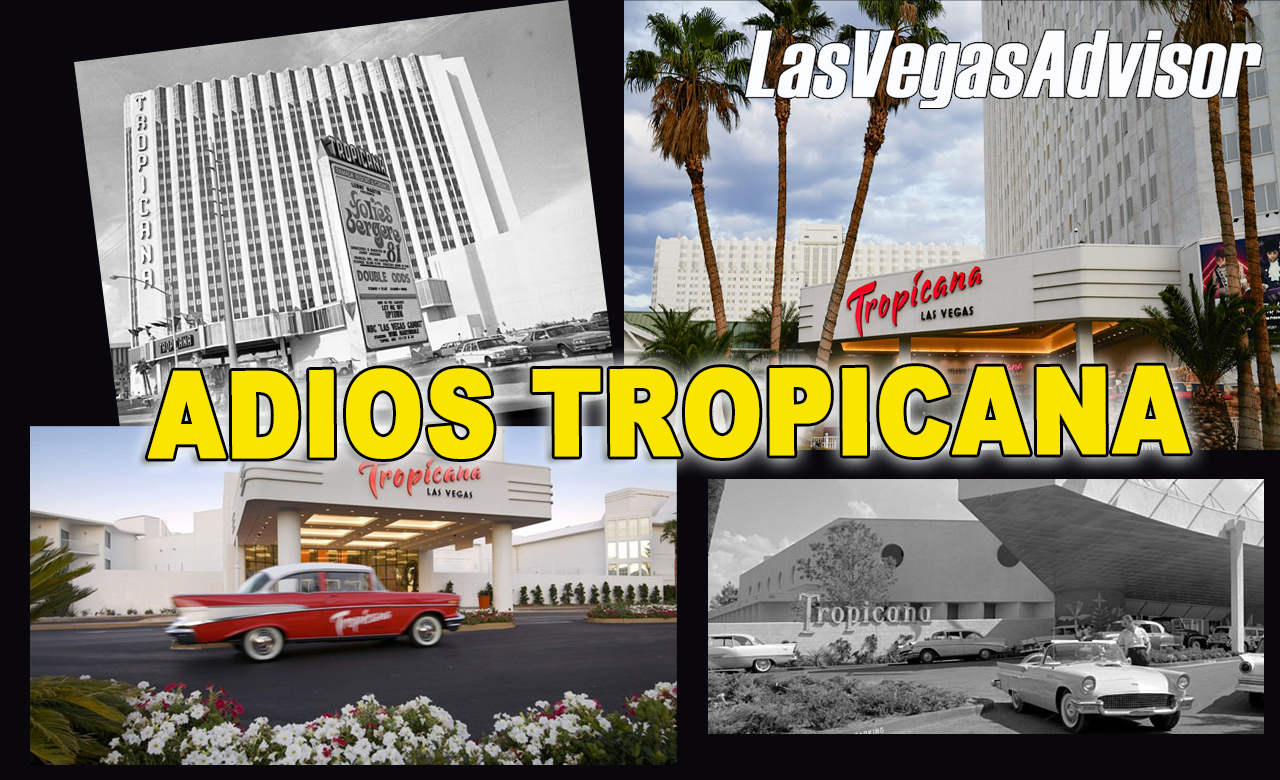
In this week’s video Anthony and Andrew are joined by Deke Castleman to talk about the Mirage volcano, the final days for the Tropicana, where to find a good Jewish deli, and more.
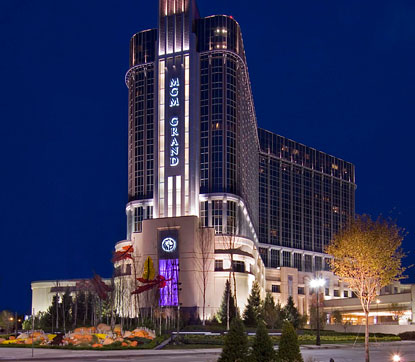
Since the Great Pandemic, gambling has never been quite the same for Detroit. Last month’s casino tally of $105 million was flat with 2023 and 9% down from the pre-pandemic pace of 2019, a recurrent theme in Motown. MotorCity beat the odds and posted a 1% increase, hitting $31.5 million for the month. Hollywood Greektown, which had been on a tear, was flat at $24 million, leaving $49 million (-1.5%) for MGM Grand Detroit. As J.P. Morgan analyst Joseph Greff reminds us, this includes a Leap Day, which probably kept Detroit’s casinos revenue-neutral for February.
It’s been a while since I’ve written about casino drawings. In Part I, I’m going to address a selective history of drawings. And Part II deals with how to improve your chances in drawings.
My personal history deals primarily, but not exclusively, with drawings in Las Vegas starting in 1994. The ways they did it in Atlantic City and other places are mostly a mystery to me.
While most casinos held drawings similarly to the way other casinos did it, any marketing director could say, “I’ve got a good idea. Why don’t we . . .?,” and you had a different twist on how to do it.
“In the beginning,” drawings used paper tickets on which you filled out your name and player’s card number. Sometimes you needed additional information like your address. If you had a lot of tickets, you had to allow considerable time to prepare them. Using rubber stamps or address labels made it faster than doing everything longhand, but it still required an effort.
Some players believed that folding the tickets was useful, and many players had their own techniques. Some casino executives drawing the tickets felt that folded tickets provided an unfair advantage, so they would intentionally feel around for unfolded tickets. I was never sure, so I folded half of mine and left the others au naturel.
The tickets had to go into some sort of drum. If the drum was large, say able to hold 20,000 tickets, and there were only 500 tickets in the drum, spinning the drum mixed the tickets pretty well. If that same drum was filled with 22,000 tickets, the tickets were so jammed that no matter how many times they spun the drum, the tickets stayed right where they were. In this kind of drawing, it was vital to place your tickets in the drum within the last half hour or so before the drawing. If your tickets were placed before that and are now at the bottom of the drum, you had zero chance of it being picked. Someone might dig down one foot or so into a batch of tickets to get one, but nobody could dig down six feet.
You usually received tickets based on your play — maybe every 1,000 slot club points earned you one ticket. Sometimes different tier levels received different numbers of tickets per slot club points. Sometimes video poker machines earned tickets at a different rate than slot machines. Sometimes there were “ticket multiplier” days. Sometimes everybody received free tickets.
Often, but not always, you had to be present to win. Often, but not always, if somebody called wasn’t present, they drew again. Sometimes you could win two or more prizes if your name were drawn more than once. Sometimes anybody could enter and win a drawing, but sometimes it was only for invited guests.
Sometimes the first name drawn gets the biggest prize. Sometimes they keep drawing until they get the right number of names, and then each of the contestants picks an envelope, spins a wheel, or does something else to decide how much they have won.
In Nevada, usually the drawings were fair — but more than once a casino was caught cheating. I have to assume that sometimes casinos cheated and were not caught. It isn’t that difficult for a casino employee to have a ticket palmed when he/she reaches in to pick out a ticket. If done well, it’s extremely difficult to catch.
I’ve entered many hundreds of Vegas drawings over the past 30 years — possibly more than one thousand. I don’t know the total amount of prizes I’ve won, but it easily exceeds $1 million, including cash, free play, and sometimes physical prizes like cars, jewelry, and even cruises. That’s not all profit, of course. Sometimes I had to play a negative game to earn drawing tickets.
Sometimes there were cash or free play options. For example, if your name were drawn for a $25,000 car, the casino would arrange for you to buy any car you wanted at, for example, Finley Toyota, or would offer you $20,000 if you didn’t take the car.
Sometimes casinos issued 1099s when you won at least $600. Sometimes they didn’t. Sometimes, if you won more than one drawing over the calendar year, the casino would sum up your prizes and present you with the tax form if your total winnings were at least $600. Sometimes casinos would treat each drawing as a separate event tax-wise.
Next week I’ll discuss how drawings are different today than they used to be and give you some pointers on doing well in these drawings.
[Editor’s Note: This review is written by Chris Kudialis, author of our recent book Weed and Loathing in Las Vegas — The Cannabis Economy Comes to Sin City. The book is a fun, colorful, and fast read that explores La Vegas’ explosion over the past several years as the Cannabis Capital of the U.S. It also spotlights the shady politics, regulatory corruption, casino clout, anointed players, and moneybags behind the new billion-dollar business. Chris is one of the leading experts on cannabis politics and practicalities in Nevada, so he was the perfect guy to review Las Vegas’ first state-approved cannabis consumption lounge.]
Smoke and Mirrors, located inside Thrive Dispensary on 2975 S. Sammy Davis Drive just one block west of the Strip, on Feb. 23 became Nevada’s first state-licensed cannabis consumption lounge to open for business.
The new “consumption club” is essentially a more upscale version of the tribal-owned Sky High Lounge (the revamped Vegas Tasting Room) on Las Vegas Paiute land less than a mile north of the Fremont Street Experience; that one opened way back in 2019, not needing state approval, since it’s on the reservation.
Smoke and Mirrors serves more expensive and more elaborate menu items in a better-ventilated venue with more nicely dressed and more courteous staff, better furniture, and less blasting of top 40 music. If Sky High is the PT’s Pub or PT’s Gold of weed lounges, Smoke and Mirrors is the Downtown Cocktail Room. No added frills or stuffiness, per se, S&M just exudes a more peaceful, comfortable, and welcoming vibe.
It has so far made a name for itself, perhaps surprisingly, with its unique variety of 12 THC-infused cocktails — not necessarily its array of more than 20 top-shelf marijuana flower strains to smoke or its four concentrate varieties to dab.
S&M owner Chris LaPorte, a Brooklyn native and the mastermind behind the now-shuttered Insert Coins booze arcade in downtown Las Vegas, named the cocktails after Vegas-linked influencers in both cannabis and music. He credits some of his weed lounge’s early success to that marketing.
“The Godfather” is Smoke & Mirrors’ most popular cocktail and honors weed visionary Tick Segerblom with a Sobreo-brand mixer, blueberry puree, lime and pineapple juice, agave nectar, and basil leaves. The lounge’s next most-popular drink, “Evolve,” salutes Vegas-born pop group Imagine Dragons by combining the elements of an apple pie and a hot toddy with Sobreo cinnamon, apple juice, vanilla syrup, a dehydrated apple, and a cinnamon stick.
The 1,300-square-foot lounge serves its drinks with flavorless THC infusions of up to 10 mg per cocktail. You’ll pay a pretty penny for the max-strength 10 mg, though: $30 (before tip). S&M also offers 5 mg and 2.5 mg THC strengths for $23 and $19, or a virgin option for $15. Flower comes in up to an eighth-ounce for as much as $75, while the four concentrates are all about a seventh of a gram and cost $20 each.
Of course, Smoke and Mirrors is not without its flaws. In my most recent visit, the staff asked me to change my table twice, the cocktails took more than 20 minutes to arrive despite being one of the first orders of the day, and the check took just as long to process; the team’s receipt-printing machine wasn’t working.
LaPorte readily admits Smoke and Mirrors’ first few weeks were anything but perfect, as his team of 20 total employees work to iron out the operational wrinkles that inevitably come with opening a first-of-its-kind business in a one-of-a-kind cannabis regulatory environment. Within a few months, though, he expects “a totally new” experience, hence the name Smoke and Mirrors.
“We want to keep people on their toes, curious and excited, but regularly surprised and never sure what’s coming here next,” he told me.
The lounge is similar to dispensaries, in that only adults 21 and older can enter. LaPorte and company can host up to 80 people at once. S&M doesn’t require a reservation, but LaPorte said they’ve been pushing reservations in the lounge’s early days to help meet demand and ensure walk-ins don’t get turned away. You can’t bring in your own weed and state law prevents Smoke and Mirrors from also serving alcohol.
The team will turn away anyone who its hostesses deem too “messed up” to enter, though LaPorte said they’ve yet to deny any customers for that reason through nearly two weeks of being open. S&M allows patrons who get too stoned on the lounge’s products can leave their cars behind for up to 24 hours in its shared parking lot with Thrive.
S&M opens every day except Monday, from 4 p.m. to midnight on Tuesday and Wednesday and noon to midnight on Thursday through Sunday. LaPorte says those hours will likely soon expand.