Quote
Originally posted by: forkushVQuote
Originally posted by: jatki99
Quote
Originally posted by: forkushV
Quick, someone get DonDiego a fainting couch.
Because it turns out that some of those insurance company rate increase letters have been intentionally misleading. And illegal. And it has happened thousands of times, in Kentucky alone. Insurance companies misleading their customers? Who ever heard of such a thing?
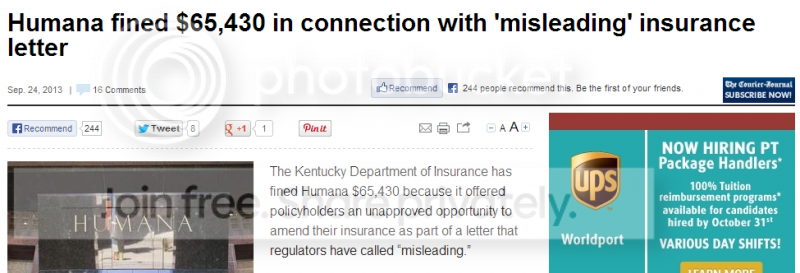
(Louisville) courierjournal.com
And some of the policies that Humana quoted were actually more expensive than the subsequent unsubsidized rates Humana was quoting to Obamacare customers, and much more expensive than some subsidized rates. So the next time you read about rate shock based on a letter from an insurance company, just remember DonDiego. Passed out on the fainting couch. You don't want that to be you.
That's dated spet 24 ,before the law even went into effect. How in the world were they able to be finmed BEFORE it was even law?
Because Kentucky law says that it's illegal for insurance companies to defraud customers with misleading advertising. I'm sure that law has been on the books for many years.
You REALLY don't want this story to be true, do you?
DonDiego remains seated upright at his keyboard. Technically he hasn't fainted since he got his first polio shot in first grade at the Wolf Elementary School. He was participating in a spelling bee when the whole world just turned yellow and disappeared; next thing he knew Doctor Filipek was holding a bottle of smelling salts under his nose. This was back in the day when doctors made housecalls. But DonDiego digresses . . .
But to answer jatki 99's question, one need only consult the original Louisville Courier-Journal article which forkush cited:
" 'The Department of Insurance [of the State of Kentucky] fined Humana for providing members with a policy amendment form that was not approved. This was a clear-cut violation of Kentucky’s insurance code,' said Sharon Clark, Insurance Department commissioner."
That's it.
But there is more.
"The department investigated letters sent in August to 6,543 individual plan policyholders in Kentucky. The letters said they needed to renew their plans for 2014 within 30 days or choose a more expensive option that complies with the Affordable Care Act."
Just so, . . . much as Anthem Blue Cross and Blue Shield had done:
"Kentucky regulators also reviewed a letter by Anthem Blue Cross Blue Shield asking people to 'call now' to lock in 'today's affordable rates,' targeting people who buy insurance on their own and who will soon be able to compare plans on the state insurance exchange.
However, a spokeswoman said the insurance department determined that the letter was marketing that appeared to go to potential customers and thus did not violate the insurance code. Humana’s letter, by contrast, went to current policyholders."
So, Humana and Anthem Blue Cross and Blue Shield sent out letters suggesting one might want to renew or initiate an insurance policy before 1 October, . . . to get the rates prevailing before the ACA rules went into effect.
__"Intentionally Misleading" or not?
Maybe, DonDiego doesn't know the details.
He does know that although "[Sharon] Clark has previously said she considered the letter 'misleading intentionally'", . . . the fine was applied solely for an unapproved policy amendment form, because that's what the newspaper article states:
"While the investigation continues into whether the letter was intentionally misleading, state officials said, the department fined Humana on Sept 10 for the unapproved amendment that 'caused confusion' among policyholders. An estimated 2,200 returned signed amendments, it said."
Why was Humana fined and Anthem not?
__Anthem's correspondence was deemed a marketing letter and sent to potential customers, not policyholders.
__Humana's letter was sent to present policy holders and included an unapproved policy amendment form.
Re: "Because Kentucky law says that it's illegal for insurance companies to defraud customers with misleading advertising. I'm sure that law has been on the books for many years."
DonDiego, as forkushV, hopes that such a law is, indeed, on the books. But as indicated in the newspaper article Humana has not been charged with any such fraud.
Will Humana be so charged. DonDiego concludes from the article that Sharon Clark hopes so. But the investigation is not yet concluded.
For the record, DonDiego counsels the readers (if any) to be conscious of the possibility of fraud when dealing with insurance companies, lawyers, real estate agents, candy store clerks, and shapely nubile young bar wenches who may be more interested in tips than falling in love with the reader.
Oh, and the good news is that in spite of fainting after the polio shot, DonDiego has not contracted polio, . . . yet.




